
How to Build a Gym Habit That Actually Survives March
by Renata Vasquez, CSCS · ~1,763 words
You have done this before. You signed up in January, you went hard for two weeks, you were sore in places you did not know existed, and then one Tuesday you were tired and you skipped. Then Thursday. Then the whole thing quietly ended and the membership just sat there, charging you every month like a bad souvenir.
I want to say something clearly, because most people carry this around as evidence about their character: that is not a discipline problem. That is a design problem. The plan you were following was built to be impressive, not to be repeated. It worked exactly as long as motivation lasted, and motivation is a mood, not a system.
At Cedar Line Strength in Boise, we see the January wave every year, and we see who is still around in October. The people still training are almost never the people who came in the hottest. They are the ones who found something small enough to keep doing on the days they did not feel like it.
So let's talk about what actually builds the habit, and why the version you tried before fell apart on schedule.
Consistency beats intensity, and it is not close
Here is the trade that nobody makes on purpose, but almost everyone makes by accident: six days a week for three weeks, or two days a week forever.
The first one feels like progress. It looks like the montage. It also has an expiration date built into it, because six days a week requires your life to cooperate perfectly, and your life will not. A kid gets sick, work goes sideways, you sleep badly for a week, and the whole structure comes down at once, because there was no version of it that survived a bad week.
Two days a week feels like nothing. Two days a week is also, if you keep it, over a hundred training sessions a year, every year, for as long as you want. Your body does not know it is supposed to be impressed. It only responds to what you actually do, repeatedly, over a long time.
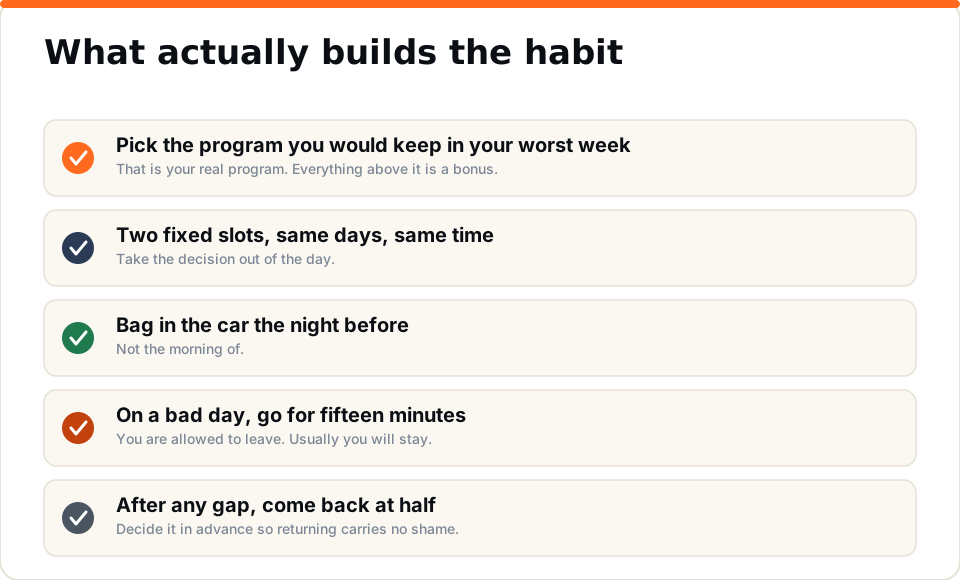
So when you plan your return, do not ask what the best program is. Ask what the smallest program is that you would still do during your worst week of the year. That is your real program. Everything above it is a bonus you can add later when the floor is solid.
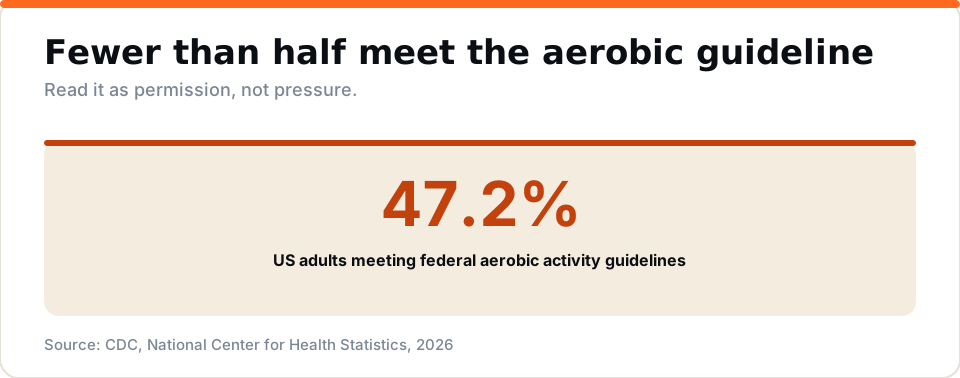
The CDC's National Center for Health Statistics tracks how many adults actually hit the federal activity guidelines, and the number is humbling in a useful way. In 2024, 47.2% of adults age 18 and older met the federal guidelines for aerobic physical activity. Read that as permission, not pressure. Most people are somewhere in the middle of figuring this out, and steady beats heroic.
Soreness is not the scoreboard
The first time you train after a long break, you will get sore. That is normal. What is not helpful is treating that soreness as the measurement of whether the workout counted.
Soreness mostly tells you that you did something unfamiliar. It does not tell you that you got stronger, and the absence of it does not mean you wasted your time. If you chase soreness, you will keep making every session novel and punishing, because familiar work stops producing it. That is the exact opposite of what builds a habit, since habits are made out of repetition, and repetition is by definition familiar.
Better scoreboards, all of them boring:
Did you show up on the days you said you would? Can you do the same weight for one more rep than last month? Are the stairs at work quieter than they used to be? Do you finish a session feeling like you could have done a little more?
That last one matters most in your first two months. Leaving a little in the tank is not laziness. It is what makes Thursday possible after Tuesday. The workout that wrecks you is a workout that also cancels the next one, and the next one was the point.

Make the decision once, not every day
Willpower is a terrible scheduling system, because it asks you to renegotiate the whole thing every single day, usually at the worst possible moment, when you are tired and the couch is right there.
So take the decision out of the day. Pick two fixed slots on your calendar, the same two slots each week, and treat them the way you treat a dentist appointment: not thrilling, not optional, just a thing on the calendar that you go to. Same days, same time, same place. The more identical each week looks, the less thinking it costs you, and the less thinking it costs you, the more likely it survives a rough patch.
The practical version:
Put your gym bag in the car the night before, not the morning of. Choose the time slot that has the fewest moving parts in your life, which for a lot of people is early morning, not because mornings are magic but because nothing else has had a chance to go wrong yet. Pick the gym that is on a route you already drive. A convenient gym you use beats a perfect gym you skip.
And give yourself a rule for the bad days, decided in advance: on a day you do not want to go, you go and do fifteen minutes, and you are allowed to leave. Most of the time you will stay. On the days you leave after fifteen, you still kept the streak, which is the part that was actually load-bearing.
Walk in with a plan, even a bad one
A lot of people quit not because training is hard but because standing in the middle of a gym with no idea what to do is uncomfortable. That feeling is real and it compounds. Nobody wants to keep going somewhere that makes them feel lost.
The fix is having a plan written down before you get there. It does not need to be sophisticated. Something like: a few minutes of easy walking or cycling to warm up, one thing that pushes, one thing that pulls, one thing for your legs, one thing for your midsection, then leave. Same movements every week for at least a month, adding a little when they start feeling manageable.
Repeating the same handful of movements is not a beginner's compromise. It is how you learn them well enough to stop thinking about them, and it is how you can tell whether anything is improving, because you have something to compare against. Constantly changing your program hides your progress from you.
If you do not know where to start, ask. Any decent coach would rather spend twenty minutes showing you five movements than watch you drift for two months and disappear. That is not an imposition. That is literally the job.
Get cleared first if something is going on
One practical note, said once and then I will leave it alone.
If you have a heart or lung condition, if you are pregnant or recently postpartum, if you are managing blood pressure or blood sugar, if you are on medication that affects your heart rate, or if you have an injury or a joint that has been talking to you, talk to your doctor before you start. Ask what is fine, what to modify, and what to watch for. It is one conversation and it usually ends with a green light and a couple of adjustments.
Do this because it makes the plan better, not because exercise is dangerous. Knowing your actual constraints means you can train around them confidently instead of guessing, backing off out of vague worry, or pushing into something that flares up and knocks you out for a month. Good information makes you bolder, not more cautious. The CDC publishes public health guidance worth a look before that appointment, if only so you know what to ask.
Expect the wobble, and plan for it
You will miss a week. Not might. Will. Somewhere around week six or week nine, something will happen, and you will look up and realize you have not been in a while.
This is the moment the habit either survives or does not, and it has almost nothing to do with the missed week itself. It has to do with the story you tell about it. The story that kills it is: I blew it again, I am someone who does not stick with things, and now I have to start over from the beginning and earn my way back in.
There is no starting over. There is only the next session. A missed week is a missed week, not a verdict. Come back on your next scheduled slot, do less than you think you should, and let the week after be normal. The people who train for years are not the people who never miss. They are the people whose gaps are short because they never made returning into a big emotional event.
Write down, right now, what your comeback looks like. Something like: after any gap, my first session back is half of what I would normally do, no matter how good I feel. Deciding that in advance removes the shame from it, and shame is what turns a missed week into a missed year.

What a year of this actually looks like
Nothing dramatic, which is the point.
Month one, you feel awkward and you go anyway. Month two, you stop needing the written plan because you know it. Month three, which is where the old version of you quit, is just another month, because you never went hard enough to burn out. Month six, you notice that the weight that used to be your top set is now your warmup and you cannot say exactly when that happened. Month twelve, going to the gym is simply a thing you do, like getting groceries, and the question of motivation has quietly stopped coming up.
That is the whole arc. It is not exciting. It works.
If you are thinking about coming back and you want a hand building the smallest version that fits your actual week, come by Cedar Line and ask for a coach. We will walk the floor with you, write down five movements, pick your two days, and send you home. No pressure to buy anything, and no speech. Whenever you are ready, we are here.