
How to Read a Repair Estimate and Spot a Real Recommendation
by Marcus Delgado, ASE Master Technician · ~1,555 words
You came in for a noise. Now you are standing at the counter holding a printout with eleven lines on it, a total at the bottom that is four times what you expected, and a service advisor waiting for an answer. Somewhere in that list is the thing you actually drove in for. The rest of it you have never heard of.
That feeling is normal, and it is not proof that anyone is cheating you. A real inspection turns up things you had no way of knowing about. Your car will tell you about a dead battery. It will not tell you about a leaking strut or a ball joint with play in it until something louder goes wrong. But a long estimate and an honest estimate are two different documents, and you have every right to know which one is in your hand.
I have been under cars for nineteen years, and I have written plenty of these estimates myself. Here is how to read one.
Read the lines before you read the total
The total is the last thing you should look at. Start at the top and read each line on its own.
A line worth trusting names three things: what is wrong, how somebody knows, and what it costs to fix. "Front brake pads at 2mm, rotors below minimum thickness, replace pads and rotors" is a line. "Brake service" is not a line. It is a category. If your estimate is a stack of categories, ask for the measurements behind them before you ask about the price.
Look for parts and labor broken out separately on each item. A shop that lumps everything into one number is not necessarily hiding anything, but you lose the ability to compare. Labor time in this trade comes out of a published guide, so the hours on a water pump are not a mystery. Parts come in grades: economy, mid grade, and dealer. You are allowed to ask which grade is quoted and what the other two would cost.
Expect a diagnostic fee, usually somewhere between one and two hours of labor. That fee pays for someone's time and equipment to find the actual fault instead of guessing with your money. Many shops apply it toward the repair if you do the work there. Ask. You will also see a shop supplies line and a disposal fee. Both are normal in small amounts. A shop supplies charge that scales into real money on a big job is worth a question.
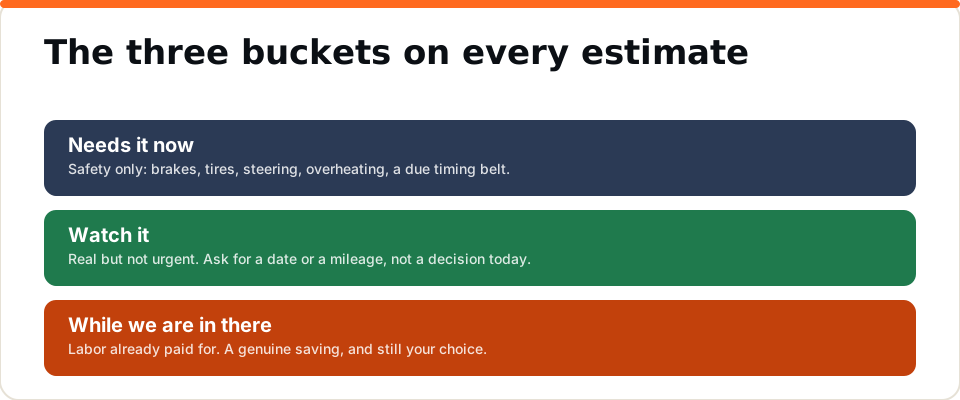
The three buckets
Every honest estimate sorts into three piles, even if the printout does not label them that way. Ask your advisor to sort it out loud.
Needs it now. This is safety, and the list is short. Brake pads down to the backing plate, or a brake line weeping fluid. A tire with cords showing or a bubble in the sidewall. Steering or suspension with real play in it. An engine that is overheating. A timing belt past its interval on an engine where a failure bends valves. These are not opinions. Pads at 2mm are pads at 2mm, and the technician can hand you the gauge.
Watch it. This is the honest middle, and it is where most of the argument lives. A valve cover gasket seeping just enough to darken the metal. Pads at 4mm going into winter. A battery that still cranks fine but tested weak. None of it will strand you this month. All of it costs more if you ignore it for two years. The right answer here is a date or a mileage, not a decision today. "Recheck it at your next oil change" is a complete recommendation.
While we are in there. This one is real, and it has a bad reputation it only half deserves. If the timing belt is already off, the labor to replace the water pump behind it is nearly free, and the pump itself might run seventy to a hundred and fifty dollars. Saying no means paying that same block of labor again in two years. The same logic covers a serpentine belt on a job that already removes it, or a rear main seal while the transmission is out. That is a genuine saving, and it should still be your choice. The tell is how it gets framed. "This saves you six hours of labor later, and it is optional" is a technician talking. "You have to do it now" is not.
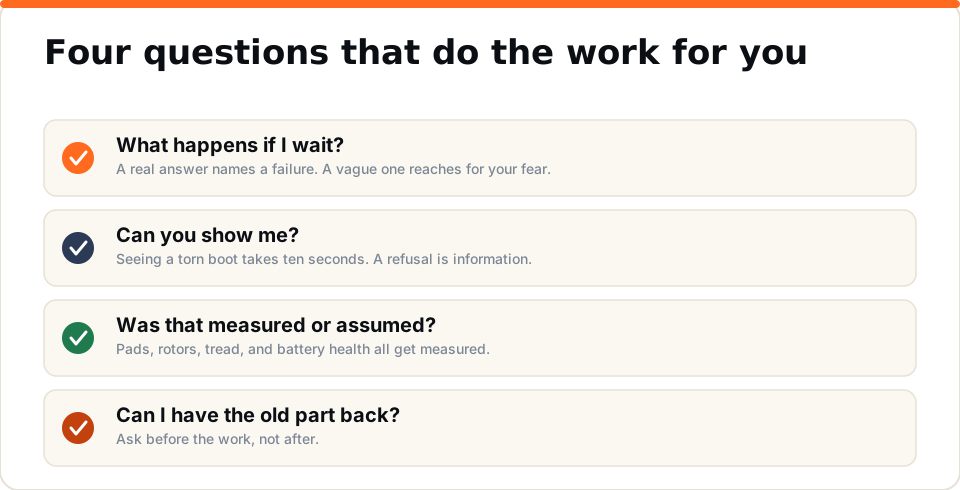
Four questions that do the work for you
You do not need to know anything about cars to ask them.
"What happens if I wait?" The answer separates shops faster than anything else. A real answer is specific, and it is comfortable being small: "the seep gets worse over a year and you top off a quart between oil changes." A vague answer that reaches for your fear without naming a failure is a sales line wearing a uniform.
"Can you show me?" Most shops will walk you into the bay or send you a photo. Seeing a torn boot or a wet strut takes ten seconds and settles the whole conversation. A refusal is information.
"Was that measured or assumed?" Pad thickness, rotor thickness, tire tread depth, battery health, and coolant condition all get measured with a tool. If a line item rests on mileage alone, that can be perfectly reasonable, but the shop should say so.
"Can I have the old part back?" Ask before the work, not after. Some parts go back to the supplier for a core credit and cannot be returned to you, and that is a legitimate answer, as long as you hear it up front. The request itself is not an insult. I hand parts to customers every week. A cracked control arm bushing sells the repair better than I ever could.
Where estimates go sideways
Almost never with a lie. Usually with a menu.
A service menu that recommends by mileage alone will sell you fluid you do not need and skip fluid you do. Some flushes are real maintenance on the right vehicle at the right interval. Others are a product line. Ask what your manufacturer's schedule actually calls for, and remember that the book in your glovebox outranks the poster on the wall.
Watch for bundling. Four items priced only as a package, with no line pricing, is a decision made for you. Ask to see it itemized, then pick.
Watch for urgency that shows up after the estimate is written. If nothing new was found, nothing new became urgent.
And watch the parts grade quietly. A cheap rotor on a heavy SUV warps, and you are back in eight months paying the labor twice. Sometimes the more expensive line is the honest one, and a shop that can explain why is doing its job.
Sometimes the right answer is no
The best advice I give is often "do not spend that."
If the repair costs more than the car is worth and the rest of the car is tired, the math is not close. If you are selling in six months, the safety items get fixed and the cosmetics do not. If the estimate says 2,400 dollars and you have 900 dollars, say so out loud. Any shop worth using will sequence it for you: brakes this month, the strut in the spring, the seep never if it never gets worse. Being honest about your budget is not embarrassing. It is most of the point of having a shop instead of a vendor.
I have talked customers out of more work than I have talked them into, and those are the ones whose kids bring me their first cars.
Get it in writing, then go home and think
Nothing on an estimate is binding until you approve it, and approval should be a signature or a text message you can find later, not a nod across a loud lobby.
Ask for a written estimate before any work starts. Ask the shop to call for authorization before the price exceeds it, and put a number on that ceiling. Many states require exactly this, and it is good practice everywhere else. Get the warranty in writing too, parts and labor both, with the term spelled out. A shop that stands behind a two year, twenty four thousand mile warranty will put it on paper without flinching.
Estimates and advertising are not a lawless corner of this business, either. The FTC publishes business guidance for companies on advertising and sales practices, and a shop is expected to know what is in it. If you want to check how a shop is licensed and permitted where you live, USAGov collects the official small-business resources on licensing and permits.
Then take the paper home. A real recommendation survives a night on your kitchen table. A pitch usually does not.
At Halstead Automotive here in Dayton, we hand you the estimate, sort it into the three buckets out loud, and tell you which lines you can skip this year. If you are holding an estimate from anywhere and want a second set of eyes on it, bring it by or give us a call. Reading it with you costs nothing.