
Should You Repair or Replace Your AC? An Honest Answer
by Curtis Hanley, Lead HVAC Technician · ~1,891 words
It is ninety six degrees outside, the air coming out of your vents is barely cooler than the air already in the room, and you are standing in the hallway doing math in your head. The unit outside is fifteen years old. It is making a noise it did not use to make. And somewhere in the back of your mind, a question is already forming: is this thing worth fixing, or am I about to spend four hundred dollars on a machine that is going to quit on me anyway?
That is one of the most common calls we take at Fairview Heating and Air, and it is a completely fair question to be asking. Nobody wants to pour money into a system with one summer left in it. Nobody wants to drop seven or eight thousand dollars on a new one either, especially if the old one still had five good years in it.
There is no single rule that answers this for every house. But there is a way of thinking about it that gets most people to the right answer, and it does not require you to know anything about refrigerant charge or static pressure. It requires three facts: what broke, how old the system is, and what the repair costs compared to a replacement.
Here is how I walk homeowners through it standing in their own driveway.
Start with what actually broke
Not all air conditioner failures are the same, and treating them as one category is where people get talked into decisions they regret later.
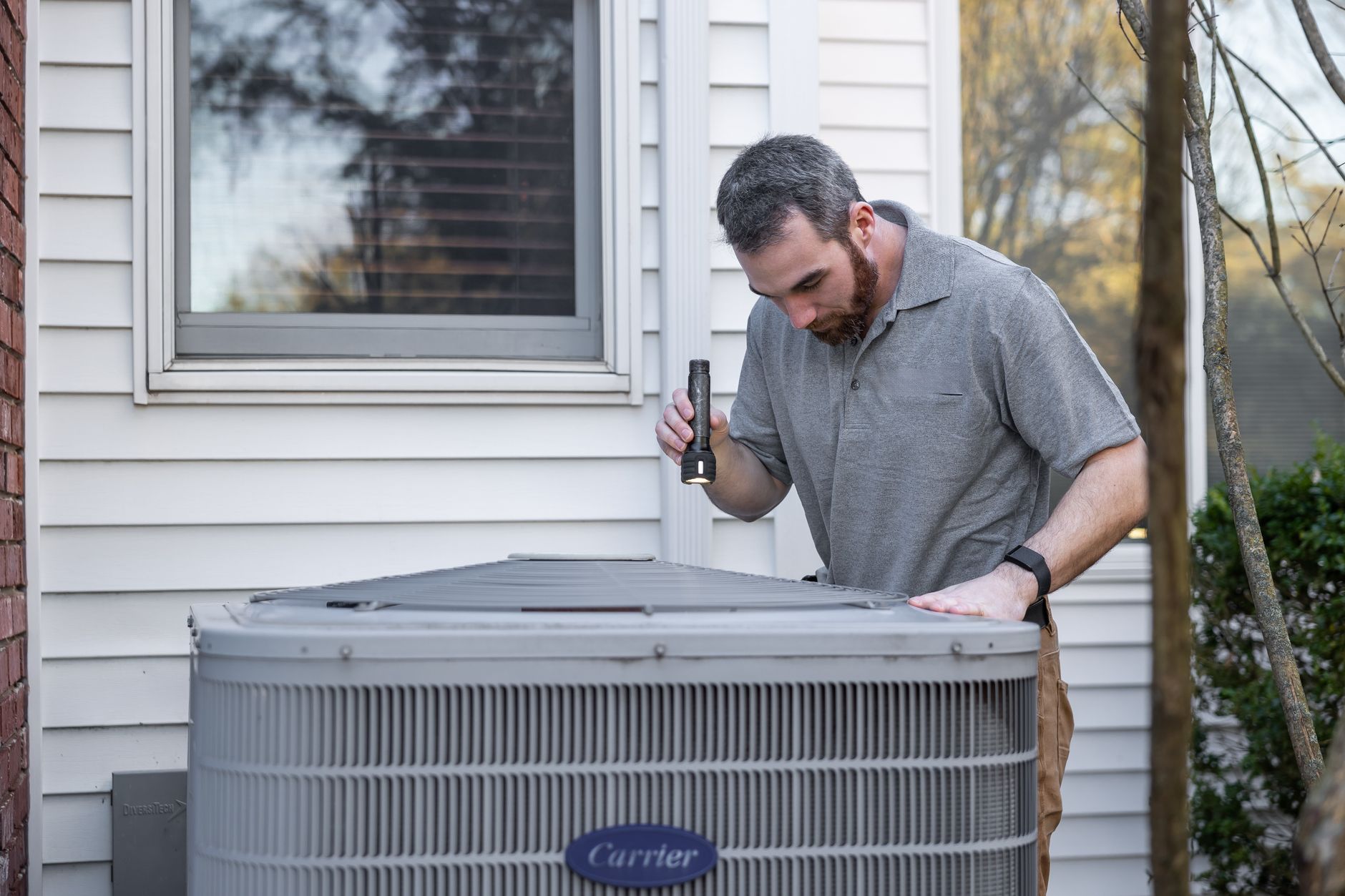
Some parts are basically consumables. A run capacitor is a small cylinder that helps the motors start and keep spinning. They fail constantly, especially after a long stretch of hundred degree afternoons, and they are cheap. A contactor is a relay that gets pitted and burned over thousands of cycles. Also cheap. Both of these fail on brand new systems and on twenty year old ones alike. Replacing one on an aging unit is not throwing good money after bad. It is upkeep, the same as putting a battery in a car that otherwise runs fine.
The middle tier costs real money but stays bounded: a condenser fan motor, a blower motor, a control board, an expansion valve. These usually land in the several hundred dollar range installed, sometimes a little more. On a system under ten years old, you fix these and move on with your life. On a system pushing eighteen, the conversation gets more interesting.
Then there is the top tier, and it has only two real entries: the compressor, and a coil that has developed leaks. The compressor is the heart of the machine and by far the most expensive part in it. A leaking evaporator or condenser coil is close behind, because the labor is brutal and the refrigerant is not free. If a technician tells you one of these has failed on an older system, that is the moment to slow down and think, because you are now looking at a repair bill that is a serious fraction of a whole new system.
So before anything else, find out which tier you are in. A homeowner who knows the difference between a capacitor and a compressor is much harder to steer.
The rule of thumb that actually holds up
You will see a formula floating around online that says to multiply the age of the unit by the repair cost, and if the answer clears five thousand, replace it. I have never cared for that one. It is arbitrary, and it punishes small repairs on old equipment for no good reason. By that math you would scrap a nineteen year old unit over a two hundred and seventy dollar capacitor, which is nonsense. That unit might run another four summers.
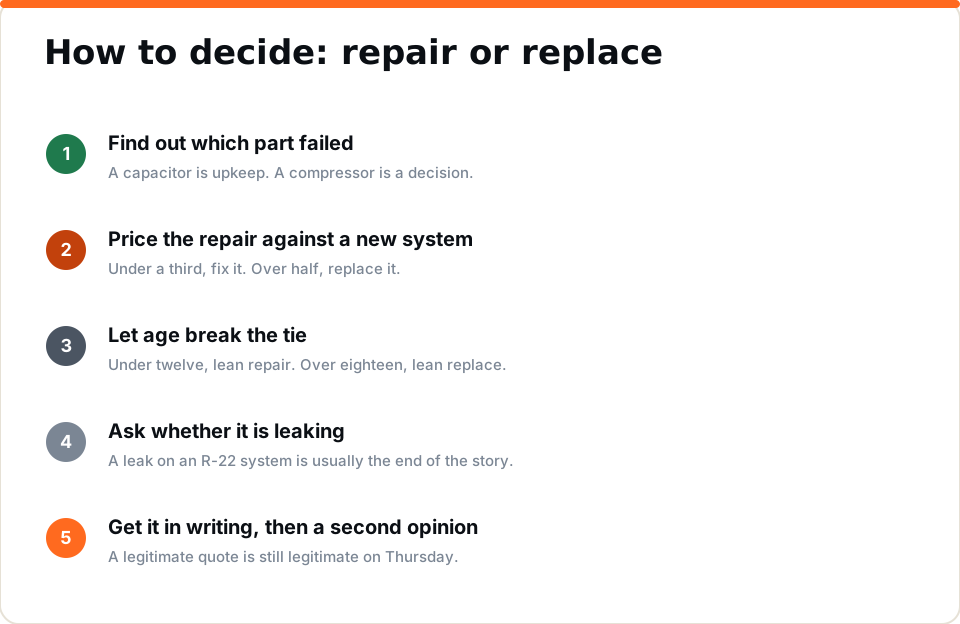
The version I use is simpler. If the repair costs less than a third of a comparable new system, fix it. If it costs more than half, replace it. If it lands in between, the age of the equipment breaks the tie.
Say a straight replacement in our market runs somewhere around seven thousand dollars for a standard system, give or take, depending on size and what the ductwork needs. A six hundred dollar motor is under a third. Fix it, even at sixteen years old. A four thousand dollar compressor job is well over half. Replace it, even at eleven years old, because you are buying one part with a warranty measured in months while the rest of the machine keeps aging around it.
The in between cases are where judgment matters, and that is what the next two sections are for.
Age matters, but not the way you think
Most residential systems in our part of Missouri last twelve to eighteen years. Some make it past twenty. A few die at nine. The spread is wide, and the number on the data plate tells you less than people assume.
What actually drives that spread is run time and care. A unit that was oversized for the house short cycles for its whole life, slamming the compressor on and off thousands of extra times a year, and it wears out early. A unit whose coils have never been rinsed runs hot every single day, and heat is what kills compressors. A unit whose filter has been changed twice in a decade has been starving the blower and icing the coil for years.
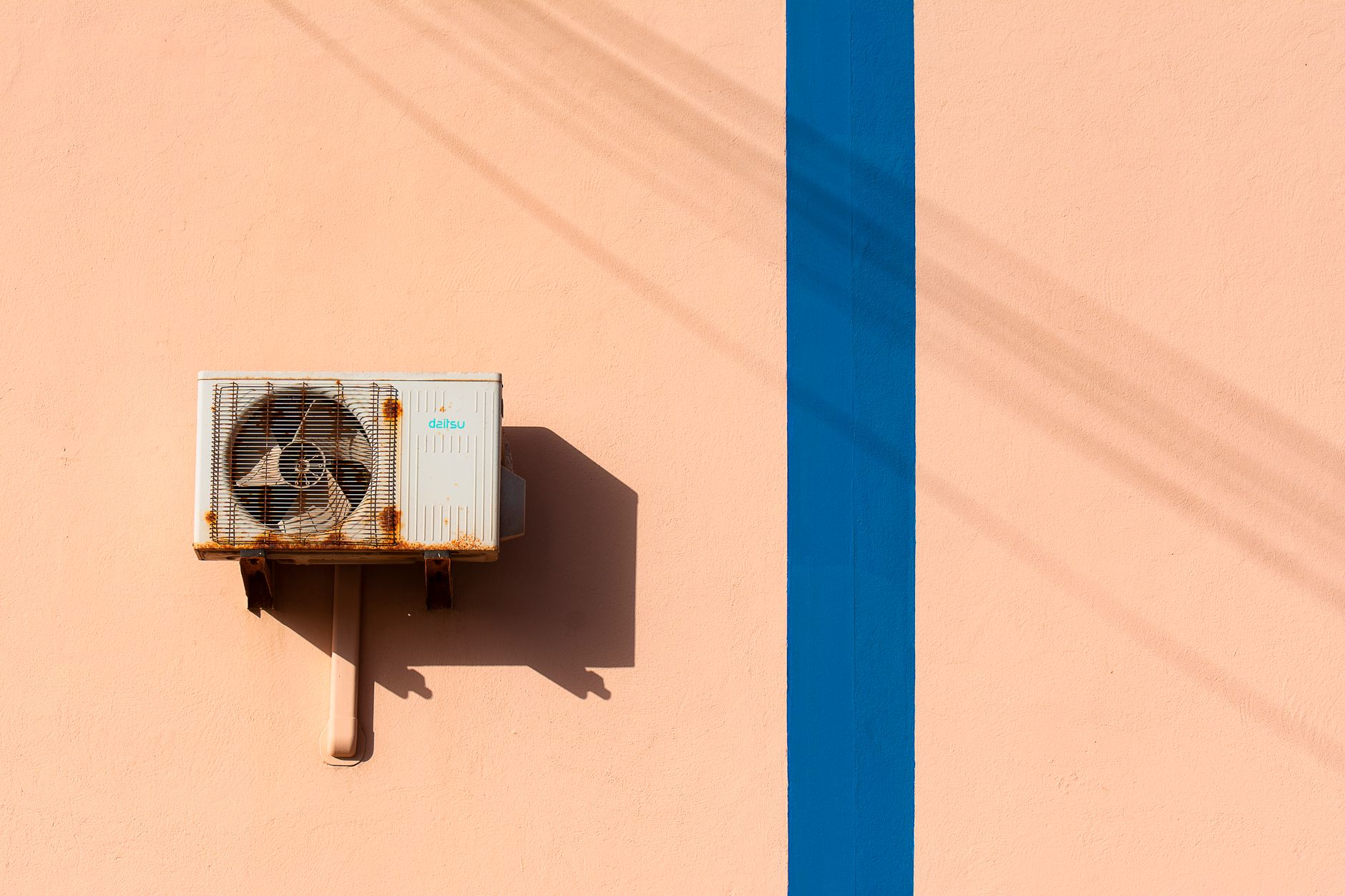
So when I say a fifteen year old system, I mean something specific. Fifteen is the age where I stop assuming the machine owes you anything. Below twelve, I lean toward repair almost automatically unless the compressor is gone. Above eighteen, I lean toward replacement on anything past the cheap tier, because the next failure is coming and it will not be the last one. Between twelve and eighteen, I look at the machine itself. Is the cabinet rusted through at the base? Are the coil fins crumbling in your fingers? Has this system needed a refrigerant top off two summers running? Those tell me more than the year stamped on the label.
That last one deserves its own section.
A leak is not a repair
Air conditioners do not consume refrigerant. It is a closed loop. If a system is low, it is low because it is leaking, full stop. Anyone who adds refrigerant without mentioning the leak has sold you a temporary fix and reset the clock on the exact same problem.
Sometimes the leak is findable and reachable, and repairing it is reasonable. Often it is inside the coil itself, somewhere in hundreds of feet of tubing, and the honest answer is that you replace the coil or you replace the system.
This is also where older equipment runs into a wall. If your system is old enough to run R-22, the refrigerant it needs has been phased out of production in the United States under federal rules. What is left is reclaimed stock, and it is priced accordingly. A leak on an R-22 system is frequently the end of the story, not because the machine cannot be fixed, but because charging it back up costs more than the machine is worth. If you own an R-22 unit and it starts losing charge, put your money toward a replacement instead. I tell people that even when it costs me a repair ticket, because the alternative is watching them pay twice.
What replacing it actually buys you
Here is where I want to be careful, because this is the part of the conversation my industry oversells.
A new system will use less electricity than a fifteen year old one. That part is real. Efficiency standards have climbed steadily, and the federal efficiency rating on a new unit is a real number you can compare against what you own now. If your old unit is genuinely inefficient and your summers are long, the savings do show up.
But savings alone rarely justify replacing a system that still works. If someone tells you a new AC will pay for itself in three years on the power bill, be skeptical and ask them to show you that arithmetic against your actual usage. On most homes the payback stretches out much further. Replacement pays off when the old system is failing anyway, when repairs are stacking up, or when the house has never been comfortable and a correctly sized system finally fixes the rooms that were always too hot.
The other honest argument for replacing is the one nobody prints in a brochure: certainty. A new system comes with a warranty and roughly a decade of not thinking about any of this. If you are on your third repair in two summers, a real part of what you are buying is the end of that cycle. That has value, and it is fine to say so plainly.
How to get a straight answer from whoever you call
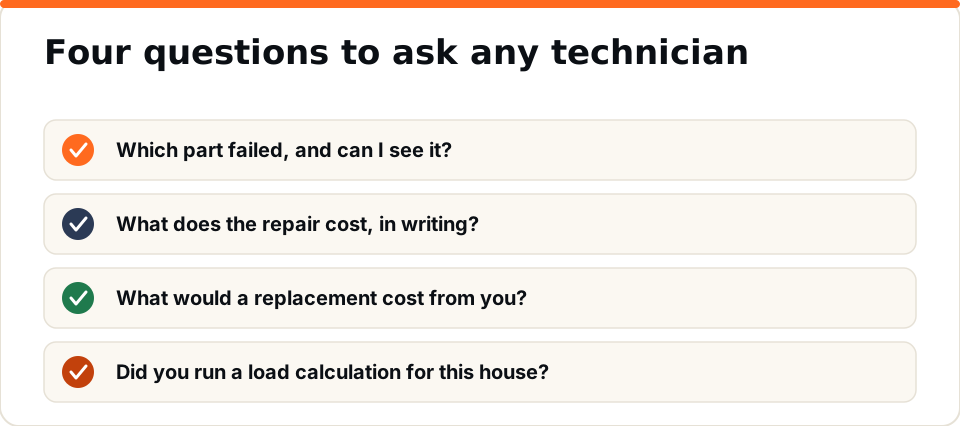
You do not have to become an HVAC expert to protect yourself. Four questions do most of the work.
Ask which part failed, and ask to see it. Any honest technician will hand you the burned contactor or the swollen capacitor and explain how they tested it. Ask what the repair costs, in writing, before anybody starts turning wrenches. Ask what a replacement costs from the same company, so you can do the one third and one half math yourself. And if the number is large, get a second opinion. A company that gets annoyed at a homeowner asking for a second quote on a seven thousand dollar decision has told you something useful about itself.
Be careful about pressure, too. Emergencies are how bad decisions get made, and a hot house in July is an emergency. If the recommendation is replacement and the price expires today, that deadline is not there for your benefit. The FTC publishes business guidance on advertising and sales practices, and a contractor is expected to know what is in it. A legitimate quote is still legitimate on Thursday.
One more question for any replacement quote: ask about the load calculation. If a contractor gives you a tonnage without measuring anything, they are copying whatever is sitting out there now, which may have been the wrong size since the house was built. Getting the sizing right is the single biggest factor in how the new system feels and how long it lasts.
There is one last thing worth saying, and it is the advice almost nobody takes. The cheapest year to make this decision is the year before your system dies. If your unit is fourteen or fifteen and still running, that is the moment to get a real assessment, price a replacement calmly, and put a plan on paper while you are not sweating. Everyone who does this is glad they did.
If you are standing next to your outdoor unit right now trying to decide, we are glad to come take a look and tell you what we would do if it were our house. Sometimes that answer is a two hundred dollar part and see you in a few years. Give Fairview Heating and Air a call, and you will get the real number either way.