
What Happens After a Car Accident Claim, Stage by Stage
by Rowan Whitfield, JD, Licensed in Ohio · ~1,761 words
Reviewed by Rowan Whitfield, JD, Licensed in Ohio. Last reviewed July 17, 2026.
The tow truck has gone. Your car is in a lot somewhere across town, your neck is stiffer today than it was last night, and there is a business card on your kitchen counter from an adjuster who would like a recorded statement. Underneath all of it, a quieter question is already forming: what happens now, and how long is this going to take?
That question is completely normal. Almost nobody knows the answer in advance, because an injury claim looks simple from the outside and turns out to have a shape of its own. It is not a single event. It is a sequence of stages, and the pace is set mostly by your medical treatment, not by anyone's paperwork.
What follows is the shape of a typical car accident claim in plain words, from the first days after a crash to the day the file finally closes. At Whitfield and Cray Injury Law in Columbus, we walk through this on the first call, because knowing the stages ahead of time takes some of the fear out of the waiting. Your claim may skip a stage, or sit in one far longer than you expect. Read this as a map of the territory rather than a schedule.
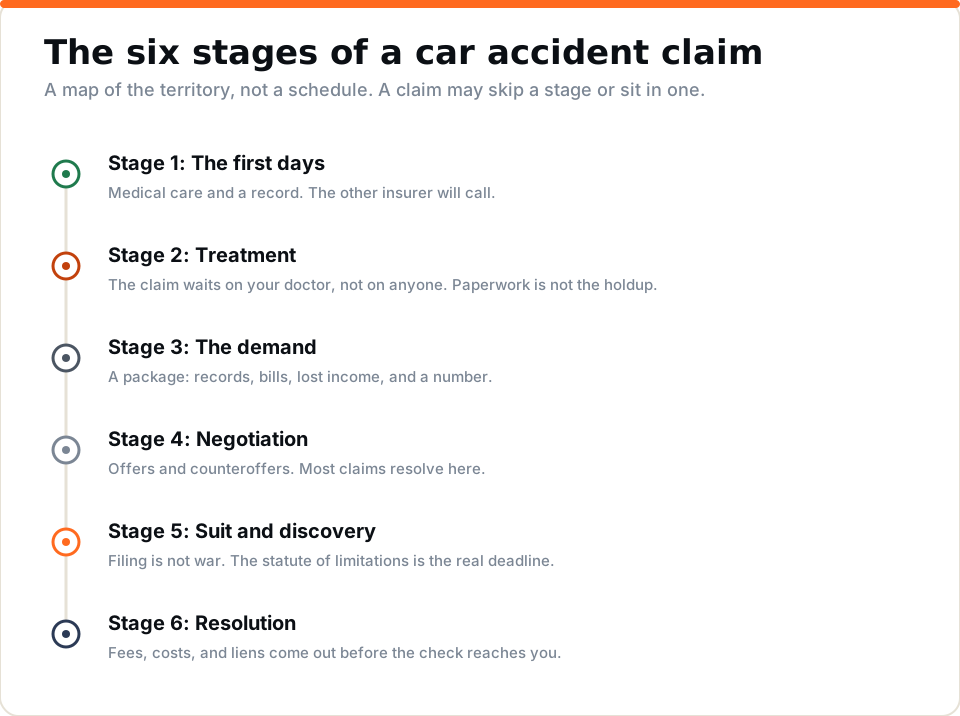
Stage one: the first days after the crash
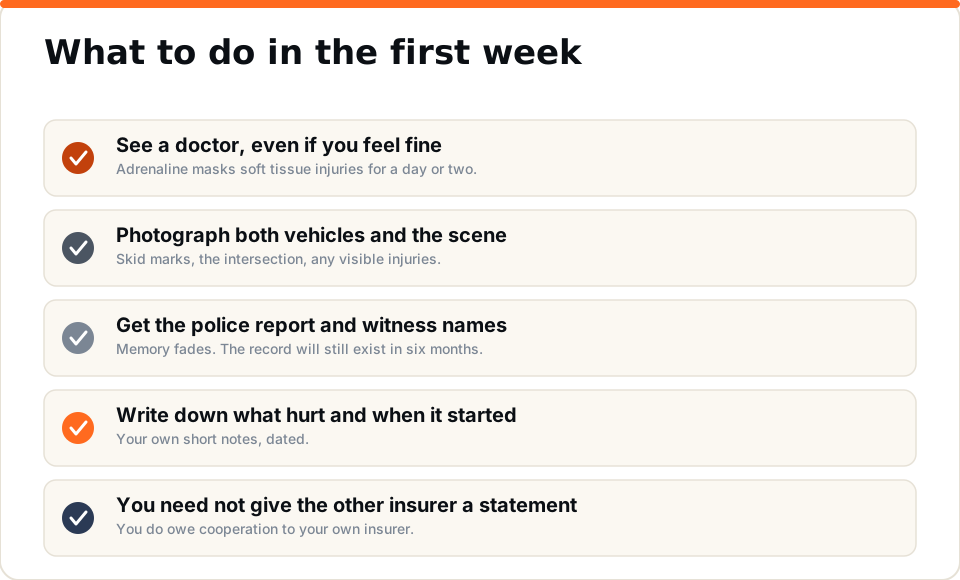
Two things matter in the first week, and they are both simpler than people assume. Get medical care, and create a record.
Medical care comes first for the obvious reason, and for a second reason worth saying out loud: a gap between the crash and your first visit to a doctor is the most common thing an insurer points to later. Not because the gap proves anything. Because it gives them a story to tell. Adrenaline masks soft tissue injuries for a day or two, so plenty of people feel fine on Tuesday and cannot turn their head on Thursday. If that is you, go anyway, and tell the provider a crash happened.
The record is everything that will still exist in six months, when memory has faded and everyone remembers the light being a slightly different color. The police report. Photos of both vehicles, the intersection, the skid marks, your visible injuries. The names of anyone who stopped. Your own short notes about what hurt and when it started.
Somewhere in this first week, an adjuster from the other driver's insurance company will call. They will be pleasant, and they will ask for a recorded statement. You are not required to give one to the other side's insurer, and there is rarely an advantage in giving one early, before anyone knows how badly you are hurt. You do owe cooperation to your own insurance company under your own policy, which is a different obligation entirely.
This is also the week the word liability starts appearing. It only means legal responsibility for causing the crash and the harm that came out of it. Fault is not always parked on one driver, either. Many states reduce what an injured person recovers in proportion to their own share of the blame, so the question is often how much rather than who.
Stage two: treatment, and why the claim waits on your doctor
This is the stage that surprises people most, because from the outside it looks like nothing is happening at all.
A claim cannot be valued honestly until your doctors know roughly where you are going to end up. Lawyers call that point maximum medical improvement, which is a formal way of saying your condition has either resolved or settled into something predictable. A sprain that clears in six weeks and a disc injury that turns into a surgical consult are the same claim on day three. They are very different claims on day ninety.
Settling before that point is close to irreversible. A settlement closes the claim permanently, including for treatment you have not had yet. If a shoulder needs surgery in March and you signed the release in January, the January number is the number, and there is no reopening it.
So the middle of a claim is mostly you going to appointments while your attorney collects: records, itemized bills, wage information from your employer, and anything that documents what you can no longer do without help. It is quiet work, and it is the work that decides the outcome. Long claims are usually long because injuries take time, not because someone is stalling.
Stage three: the demand
At some point your treatment stabilizes, and the claim moves into daylight.
A demand letter is really a package. Despite the name, it is less a letter than an organized argument: here is what happened, here is why your insured is responsible, here are the medical records and the bills, here is the lost income, here is what this cost my client in the parts of life that never show up on an invoice, and here is the number.
That number covers two kinds of loss. Economic losses are the ones with receipts: medical bills, missed paychecks, the car itself. Non-economic losses are pain, limitation, and the months of your life that did not go the way they were supposed to. Reasonable people disagree about the second category, which is exactly why the next stage exists.
Insurers usually take a few weeks to respond, sometimes longer if the file is thick. The first response tends to be low. That is not an insult and it is not a verdict on your case. It is an opening position.

Stage four: negotiation, and the truth that most claims settle
Most injury claims settle. Not all of them, and nobody can tell you in advance which kind yours will be, but the large majority resolve by agreement rather than by a jury. Television has given people the opposite impression.
Negotiation is a series of offers and counteroffers, usually by phone, usually stretched over weeks. What moves a number is not volume or outrage. It is the strength of the file: clear liability, consistent treatment, credible records, and an honest presentation of the injury. Exaggeration is the fastest way to lose an adjuster's belief in the parts that are completely true.
You are the one who decides. Your attorney's job is to tell you plainly what the case looks like it is worth, what the risk is on each road, and what happens next if you say no. It is not your attorney's decision to make. An ethical firm will also never promise you a particular result, because nobody controls what an adjuster, a judge, or a jury ultimately does.
If the numbers converge, you sign a release, and the claim is finished. If they do not, the next stage opens.
Stage five: filing suit, discovery, and the deadline behind all of it
Filing a lawsuit is not a declaration of war. It is often just what happens when two reasonable parties value the same case very differently, and a great many filed lawsuits still resolve before a trial ever starts.
One hard deadline hangs over the whole process: the statute of limitations, the law that sets how long you have to file. It varies by state and by the type of claim, and missing it usually ends a claim no matter how strong it was. That single fact is the best reason to talk to someone early rather than late. If you want to read the underlying statutes and case law yourself, the Legal Information Institute at Cornell Law School offers free public access to statutes, regulations, and court decisions.
Most car accident cases proceed in state court rather than federal court. If you are curious how the federal system is put together, United States Courts is the authoritative source of information on the federal court system. For tracking down official state agencies, like the office that holds crash reports or your state insurance department, USA.gov is the official guide to government information and services.
Once suit is filed, the case enters discovery. Discovery is simply the formal exchange of information between the two sides, and it has three familiar pieces: written questions each side answers under oath (interrogatories), requests for documents (records, photos, employment files), and depositions, which are recorded question and answer sessions with a court reporter present.
Being deposed is the part clients dread and almost always survive. You are not performing, and you are not expected to know law. You are answering questions truthfully about your own life, after preparation, with your attorney sitting beside you. Many cases then go to mediation, where a neutral third person spends a day moving between two rooms trying to close the gap. Mediation resolves a great many cases that had felt permanently stuck.

Stage six: resolution, liens, and the money that actually reaches you
When a case resolves, one more stage runs quietly in the background, and clients deserve to hear about it before it arrives rather than after.
A settlement check does not land in your account at full size. The gross amount is reduced by the fee set in your agreement, by case costs (filing fees, record retrieval, expert opinions), and often by liens. A lien is a right to be repaid out of your recovery, and the usual holders are health insurers, Medicare or Medicaid, or medical providers who treated you on the understanding that they would be paid at the end. Those amounts can frequently be negotiated down, which is real work that puts real money back in your pocket.
Ask for the breakdown in writing before you sign anything. A good firm hands it to you without being asked, then walks the sheet with you, line by line, until the arithmetic makes sense.
Then it ends. Some paperwork, a release, a check, and a stretch of your life that took months to resolve closes on an ordinary afternoon.
Timelines vary, injuries vary, and general information can only carry you so far. If you are somewhere in this sequence and unsure what the next step should be, that uncertainty is worth one phone call. The team at Whitfield and Cray Injury Law in Columbus is glad to talk through where your claim sits and what usually comes next, with no obligation on your part.
This article is general legal information and is not legal advice. For advice about your specific situation, consult a licensed attorney in your jurisdiction.