
What Actually Happens During a Chiropractic Adjustment
by Marcus Delaney, DC, CCSP · ~1,548 words
Reviewed by Marcus Delaney, DC, CCSP. Last reviewed July 17, 2026.
You have had a stiff neck for two weeks. A friend keeps telling you to see a chiropractor, and you keep putting it off, mostly because you have no idea what you are agreeing to. The internet has not helped. You have seen videos of dramatic twists and loud cracks, and something in you says no thank you.
That hesitation makes sense. Most people have never had anyone explain what an adjustment actually is, what it feels like, or why anyone would want one. It is hard to say yes to something you cannot picture.
So here is the picture. At Riverbend Chiropractic in Boise, this is roughly what a first visit looks like, what happens when a joint is adjusted, who tends to benefit, and, just as honestly, who does not.
Your first visit is mostly talking and testing
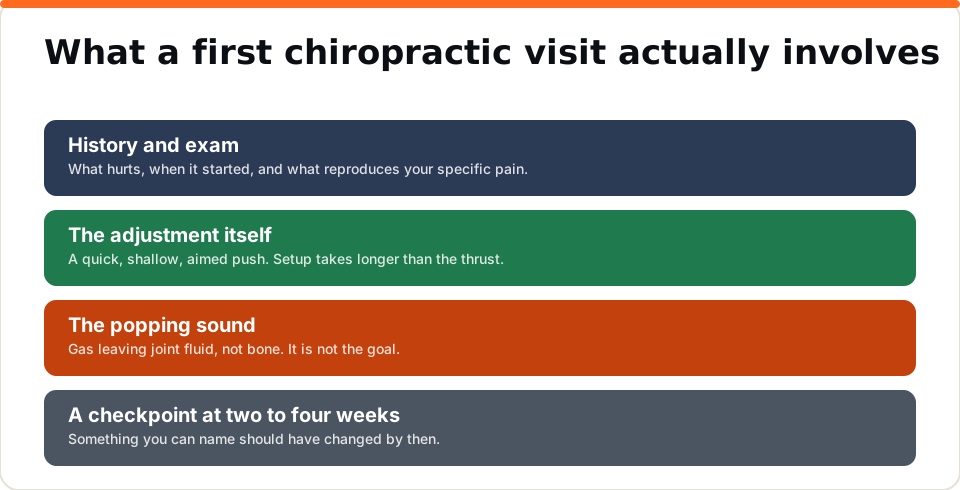
Nobody is going to adjust you in the first five minutes. A good first visit is heavy on questions and light on hands.
We want to know when the pain started, what you were doing, what makes it better or worse, whether it travels down an arm or a leg, how you sleep, and what your day physically demands of you. A warehouse picker with low back pain and an accountant with the same complaint often have very different problems underneath the same words.
Then comes the exam. We watch you move: bend forward, lean back, turn your head, walk across the room. We check reflexes, strength, and sensation if there is any sign the nerve is involved. We feel along the spine and the surrounding muscles, looking for segments that do not move the way their neighbors do, and for spots that reproduce your specific pain rather than just generic tenderness.
That last distinction matters more than people realize. Plenty of things on your back will hurt if pressed hard enough. The useful finding is the one that makes you say "that is it, that is the pain I came in for."
X-rays are not routine. They are useful when there is a reason to suspect a fracture, when the history includes real trauma, or when certain red flags show up in your story. For ordinary mechanical back or neck pain, imaging usually adds cost and radiation without changing what we would do. If someone wants to X-ray your whole spine before they have even asked you a question, that is worth questioning.

What an adjustment actually is
A spinal adjustment, also called a manipulation, is a quick, shallow, controlled push applied to a specific joint.
That is the whole thing. It is fast, it is small, and it is aimed. The speed is the point: a joint moves more easily when the force arrives faster than the surrounding muscles can react to guard against it. That is why a good adjustment takes less force than people expect, not more. Force is what you need when your aim is off.
The setup usually takes longer than the adjustment. We position you so the target joint sits near the end of its available motion, take up the slack in the tissue around it, and then apply a small thrust. You will feel pressure building, then a brief push, then it is over. The push itself lasts a fraction of a second.
Most people describe it as a quick pressure and release. It should not feel violent. If a technique makes you tense and brace, that is worth saying out loud, because bracing works against the whole idea.
And there are always other ways in. Some patients get a low-force instrument-assisted technique, some get slow mobilization instead of a thrust, and some, especially patients with osteoporosis or a history of certain surgeries, should not get a traditional thrust at all. The technique is supposed to fit the patient.
The popping sound, explained
This is the part everyone asks about, usually with a slightly worried face.
The sound is not bone. Nothing is being cracked, snapped, or put back in place. The joints of your spine are enclosed in small capsules that contain fluid, and that fluid holds dissolved gas. When the joint surfaces separate quickly, the pressure inside the capsule drops, and gas comes rapidly out of solution. The sound is that sudden gas change: closer to opening a soda than to breaking anything.
A couple of things follow from that. First, the sound is not the goal. A joint can move better after an adjustment that made no noise at all, and it can pop loudly without anything useful happening. Chasing the sound is chasing the wrong thing.
Second, nothing is going out of place and getting shoved back. Your vertebrae are held together by thick ligaments and layers of muscle. They are not sliding around waiting to be reseated. What we are changing is how a joint moves and how the nervous system around it responds, not its address.
That difference matters, because it changes what you should expect. An adjustment is a nudge to a system, not a repair to a part.

Who tends to benefit
The honest answer is that the evidence is strongest for a fairly specific list.
Acute and chronic low back pain without nerve involvement is the best-supported use. Neck pain, particularly the mechanical kind that comes with stiffness and limited turning, is next. Certain tension headaches and cervicogenic headaches (headaches that start from the neck) respond as well. Some patients with mid-back pain and rib joint irritation do well.
The realistic result is a moderate reduction in pain and a moderate improvement in movement, often noticeable within a few visits. That is a genuine benefit for something that is limiting your life, and it is also not a miracle. Anyone promising to cure your asthma, your allergies, or your blood pressure through spinal adjustment has left the evidence behind entirely. MedlinePlus is a reasonable starting point if you want to read about back pain from a source with no adjustment to sell you.
Also worth knowing: adjustment rarely works best alone. The joint work opens a window, and what you do in that window decides how long the change lasts. Most of our Boise patients get specific exercise homework, and the ones who do it tend to need us less. That is the outcome we are aiming at.
When to see someone else, and when to go now
A chiropractor who never refers out is not a chiropractor you want.
Some things need a different provider. Progressive weakness in an arm or a leg, numbness in the saddle area, loss of bladder or bowel control, unexplained weight loss with back pain, pain that wakes you every night regardless of position, fever with spinal pain, or back pain following significant trauma: these belong to a physician, and in some cases to an emergency department right away. If you tell us any of that, our job is to help you get seen, not to adjust you.
There are also conditions where a forceful thrust is a poor idea: significant osteoporosis, inflammatory arthritis affecting the upper neck, certain bone or vascular conditions, recent spinal surgery, or being on blood thinners. Often we can still help with gentler methods. Sometimes the right answer is that you need someone else.
Side effects from adjustment are usually mild and short-lived: soreness like you worked out, occasional stiffness or fatigue for a day. Serious complications are rare. The one people ask about, involving the arteries in the neck, is genuinely uncommon, and it is one reason we screen your history before touching your neck. If you have questions about the safety research, the National Institutes of Health publishes accessible summaries of what is known.
How to know it is working
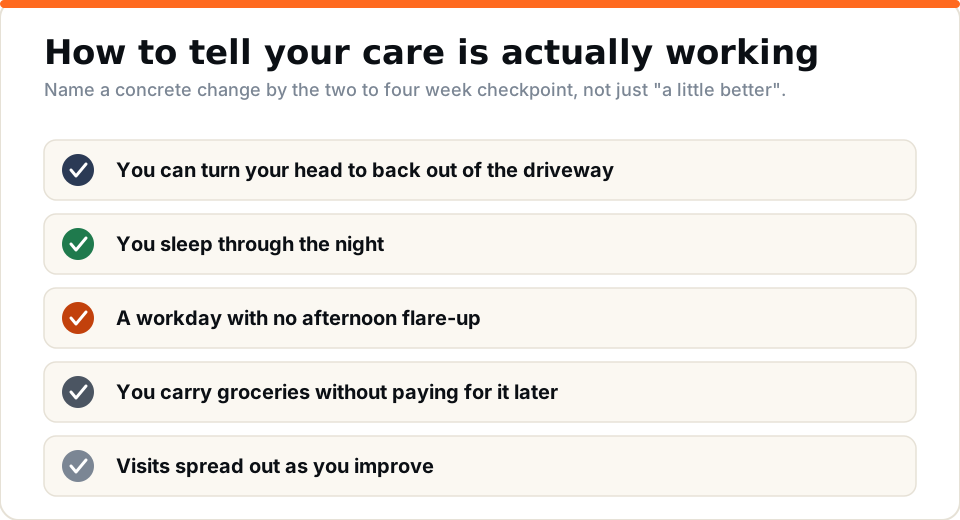
Set a checkpoint. This is the practical advice we give every new patient in Boise, and it protects you from open-ended care plans everywhere.
After about two to four weeks of care, you and your chiropractor should be able to point at something concrete that changed. Not "it feels a little better," but something you can name: you can turn your head to back out of the driveway, you sleep through the night, you got through a workday without the afternoon flare-up, you carried groceries without paying for it later.
If nothing measurable has moved by that checkpoint, the plan needs to change. Maybe a different technique, maybe imaging, maybe a referral. What it should not mean is twelve more of the same visits and a payment plan.
Care should also taper. As you improve, visits should spread out and your own exercise should take over the work. A schedule that never thins out is a business model, not a treatment plan.
If your neck or back has been limiting you and you want a straight answer about whether adjustment is a reasonable fit, call Riverbend Chiropractic and ask for an evaluation. We will tell you what we find, including when the honest answer is that you need someone other than us.
This article is general health information and is not a substitute for individualized medical advice. Talk with your healthcare provider about your specific situation.