
Notes
Apple Business Connect Gives You One Storefront and Google Gives You Another: What Owners Actually Need to Manage Both
Open the Maps app on any iPhone and search for a dentist, a chiropractor, or a plumber. The results you see are not a neutral list.
Reviewed by Melike Erguven, Co-founder of LocalLeadSignal · October 7, 2026 · 11 min read

Open the Maps app on any iPhone and search for a dentist, a chiropractor, or a plumber. The results you see are not a neutral list. Apple Business Connect is the tool that decides how much control a business owner has over that result, and for a large share of service businesses, the listing is either unclaimed, inaccurate, or both. This article covers what the platform actually does, how it fits into a broader local visibility strategy, and where it earns its place without overstating what it can do on its own.
What Apple Business Connect actually controls and where its data shows up
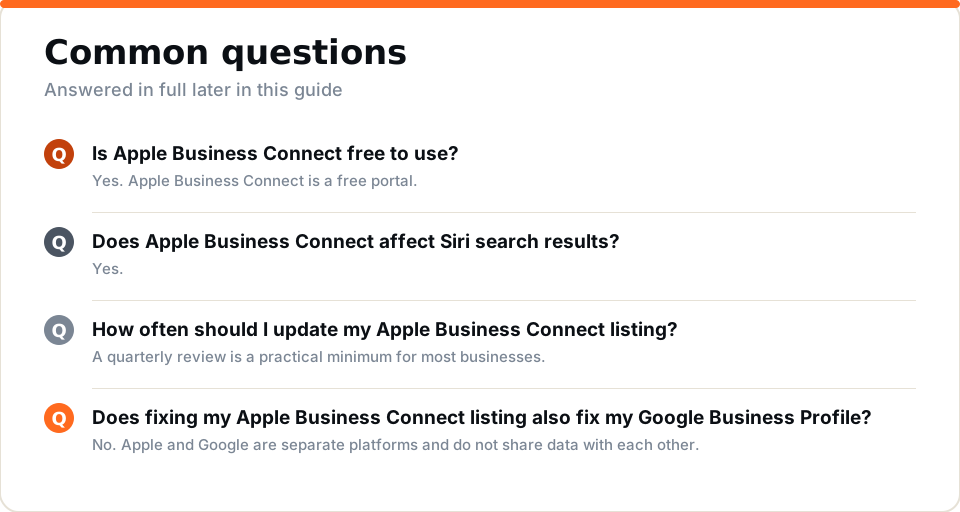
Apple Business Connect is a free portal. That is worth saying plainly, because some owners assume there must be a paid tier behind anything this useful. There is not. Any business owner can claim, verify, and manage how their business appears across Apple's platforms: Maps, Siri, Spotlight Search, Safari, and Messages.
Once a listing is claimed and verified, the owner controls the business name, address, phone number, hours, photos, logo, and a short description. Apple calls this a Showcased listing. The information entered here flows across every device in the Apple ecosystem, including iPhones, iPads, Macs, and Apple Watch, so every Apple device reads from the same verified source rather than from whatever a data aggregator happened to have on file.
Category selection is an early decision that deserves real attention. Apple uses the category to decide which search queries a listing is eligible to appear for. Choosing a broad category when a more specific one exists means the listing may not surface for the searches that matter most.
Beyond the static card, business owners can add action links. These are functional URLs that point to a booking page, an ordering system, or a contact form, and they turn the listing from a reference into an actual conversion path. For a dental practice or a physical therapy clinic, a direct booking link inside the Maps result reduces the number of steps between a search and a scheduled appointment.
Siri is the other piece worth understanding here. Voice search local queries increasingly run through Siri on iPhone, and Siri routes those queries through Apple Maps data. A claimed, accurate listing has a direct path to Siri's spoken and displayed answers in a way that an unclaimed one simply does not.

How Apple Business Connect fits into the wider local listing landscape
Apple Maps is not the most-used map product in the US by overall usage share. But iPhone penetration among US consumers is high enough that ignoring Apple Maps means leaving a real slice of mobile local search unaddressed. For service businesses whose clients skew toward iPhone users, that slice is not trivial.
NAP consistency matters here the same way it matters everywhere else. If the name, address, and phone number inside an Apple listing do not match what is on the business website and Google Business Profile, Apple's confidence in the listing drops. That inconsistency is a signal problem, not just a cosmetic one.
One thing Apple Business Connect does not do is syndicate corrections automatically. A fix made inside the portal does not cascade to data aggregators, and a correction made at an aggregator does not automatically update the Apple listing. Each platform requires its own update. This is why a thorough audit of your local presence before doing manual citation work saves time. It lets you see which platforms have wrong information before you start fixing things in the wrong order.
Bing Places and Apple Business Connect serve overlapping but distinct audiences. Maintaining both is the right approach for most service businesses. Treating one as redundant with the other means leaving real searches unanswered.
The broader citation ecosystem, including Yelp, Foursquare, and the major data aggregators, still feeds Apple Maps in cases where an owner has not claimed their listing. That is one reason citation cleanup matters even when a business thinks it has already handled Apple. Unclaimed listings are populated by whatever sources Apple can find, and those sources are not always current or accurate.
For businesses with multiple locations, Apple Business Connect has a bulk management option and an API access path, which makes large-scale updates manageable. Manual entry at scale is not realistic, and knowing this option exists changes how multi-location businesses should plan their listing strategy.
Who benefits most from Apple Business Connect and who it does not help much
Brick-and-mortar and service-area businesses with a defined local geography get the clearest benefit. Here are the practice types where this matters most:
- Dental practices whose patients search on iPhone before calling to schedule an appointment
- Chiropractors and physical therapists who need accurate location data and hours to appear in "near me" voice queries
- Personal injury lawyers and family law firms where a wrong phone number or outdated address is a client experience problem, not just a visibility problem
- Healthcare practices generally, where HIPAA compliant marketing standards shape how reviews are displayed and responded to
For healthcare practices and law firms, listing accuracy carries weight beyond visibility. A patient who dials a disconnected number or arrives at the wrong address does not come back. The reputational cost of inaccurate listing data in those contexts is higher than in most other verticals.
Businesses in competitive local categories, like dental SEO or chiropractor SEO contexts, should understand that Apple listing quality is one of many signals. It is not a single lever that moves rankings on its own. Treating it as a piece of a larger system is more accurate than treating it as a shortcut.
Online-only businesses are a different story. We learned this firsthand. When we pointed our own LocalLeadSignal dashboard at our own business, map rankings and local listings simply did not fit, because we are an online software company without a storefront. Apple Business Connect's map-centric design is built around physical places, and trying to force a software company into that framework produces results that do not reflect how the business actually operates.

Service businesses whose clients are concentrated in geographies where iPhone market share is lower may see a smaller return on the effort. That said, the baseline effort to claim and verify an Apple listing is low enough that skipping it entirely is rarely the right call. An hour of setup is a reasonable investment even when the expected return is modest.
Using Apple Business Connect alongside AI assistants and the visibility gap most owners miss
Siri routes local queries through Apple Maps data. That connection is direct: what a business owner puts into Apple Business Connect has a clear path to what Siri says when someone asks for a recommendation nearby. That is not a hypothetical relationship. It is how the system is built.
AI assistants more broadly pull from multiple sources. ChatGPT, Perplexity, and Gemini each have their own data pipelines, and none of them reads exclusively from Apple Maps. But an accurate, verified Apple listing is one input that increases the chances a business's information is correct when it does surface, rather than carrying forward an old address or a disconnected phone number from a stale aggregator record.
Generative engine optimization, the practice of making a business more citable by AI answer engines, depends significantly on data consistency across platforms. Apple Business Connect is one node in that consistency network. It does not drive AI citations on its own, but an inconsistent or missing Apple listing creates a data conflict that AI systems have to resolve, and they may resolve it in ways that do not favor the business.
We have watched this pattern directly. Over the summer of 2026, more AI assistants named LocalLeadSignal when asked about us directly, but for buyer-intent questions, those same assistants still recommended older, more established brands. The lesson we took from that is that listing accuracy is a necessary condition for AI visibility, not a sufficient one. A complete, verified listing gets you into the conversation. It does not automatically put you at the top of it.
AI search trends in Q3 2026 continued to favor businesses with strong review signals, consistent NAP across platforms, and structured data on their own website. Apple Business Connect contributes to the first two of those. Local business schema markup on the website, specifically LocalBusiness schema, reinforces what the Apple listing says. When an AI assistant reads both sources and they agree, the business's information is more likely to be treated as reliable.
Tracking AI visibility separately from Google map pack ranking is worth building into any reporting workflow. The signals that move one do not always move the other, and conflating the two leads to misreading which actions are actually working.
What a well-maintained Apple Business Connect listing actually looks like in practice
A complete listing is not complicated. It starts with a few things done correctly:
- Verified business name: exactly as the business operates, with no added keywords or promotional language in the name field
- Consistent address or service area: matching the website, the Google Business Profile, and every major citation source
- Primary phone number: the one a potential client would expect to reach a human at
- Current hours: updated for holidays, seasonal closures, and any schedule changes
Photos should be recent and specific. Exterior shots help people confirm they are at the right place. Interior shots help practices communicate their environment before a first visit. A clear logo reinforces brand recognition when the card appears in search results. Apple gives visual content meaningful weight in how a Showcase card renders, so placeholder images or photos from years ago are worth replacing.
The business description is a plain language field. It should describe what the business does and who it serves. Apple's guidelines prohibit promotional language and slogans in the name field, and that spirit carries over to the description: keyword stuffing reads as low-quality to both Apple's systems and to actual people reading the card.
The Place Action Link is one of the most underused features in the whole platform. A booking link, an order link, or a contact form URL embedded directly in the Maps result means a person who finds the listing can take the next step without leaving Maps. For any service business where scheduling is the conversion event, that friction reduction matters.
Review signals appear in Apple Maps results. A pattern of unanswered negative reviews is visible to anyone who looks at the listing. For practices already running an online reputation management workflow, Apple Maps reviews should be part of that process. Google's guidance on managing customer reviews applies the same logic: a response policy that covers one platform but ignores another leaves gaps that potential clients can see.
A listing that was accurate when it was first claimed and then left alone will drift. Hours change, phone numbers change, and photos age. A quarterly review is a realistic minimum maintenance standard for most businesses.
Where Apple Business Connect sits in a realistic monthly local SEO workflow
The right cadence for Apple Business Connect is not weekly. For most service businesses, it looks like this: a claim-and-verify sprint at the start, then a quarterly check timed to business changes like new hours, new staff, or seasonal shifts.
The heavier ongoing work in local SEO belongs elsewhere. Google Business Profile optimization, on-site content, review generation, and citation cleanup all move more traffic for more US local businesses than Apple listing maintenance does. Apple Business Connect supports that work. It is not a substitute for it.
For owners without a marketing team, sequencing matters. Google Business Profile and on-site fundamentals come first. Apple Business Connect is a same-week task if the listing is unclaimed, because the baseline effort is low and the listing will otherwise continue to be populated by whatever sources Apple found on its own. After that initial setup, it becomes a quarterly item.
Citation cleanup will surface Apple Maps discrepancies alongside Google and Bing ones when it is done properly. Running a local SEO audit before starting manual citation work is the right order of operations. Fixing the wrong platform first, or fixing an address that was already correct, wastes the time that should have gone to the actual problems.

Some listing management tools cover Google Business Profile and Bing Places but leave Apple Business Connect as a manual step. That is worth confirming before assuming a platform has the whole picture. At LocalLeadSignal, listings management is part of higher-tier plans, and the audit that runs at setup checks Apple alongside the other platforms so discrepancies surface in one report rather than requiring a separate review process.
Long-tail local keywords and local keyword research also apply inside Apple Business Connect. The vocabulary a potential patient or client uses in a search should match the vocabulary in the listing description and category selection. That alignment is not about stuffing the description with search phrases. It is about using the language of the people the business actually serves, which is good writing and good SEO at the same time.
The U.S. Small Business Administration offers guidance on building a sustainable small business presence, and consistent, accurate local listings are a fundamental part of that foundation for any service business that depends on local clients finding them first.
Apple Business Connect is a genuine, free tool that gives local service businesses direct control over how they appear to every iPhone user who searches on Apple Maps, asks Siri, or uses Spotlight. It does not replace the work that happens on Google, on the website, or across the citation network. But an unclaimed or stale listing leaves real searches unanswered.
Claiming and verifying the listing takes roughly an hour. The quarterly maintenance takes less than that. The harder question is whether the rest of the local SEO foundation, the Google signals, the site structure, the NAP consistency, and the review profile, is strong enough that the Apple listing has something solid to work alongside.
Run a free local SEO audit on your business to see exactly which platforms have your information right and which ones are sending potential clients somewhere else.
Frequently asked questions
- What is Apple Business Connect and do I need it if I already have a Google Business Profile?
- Apple Business Connect is Apple's free tool for claiming and managing how your business appears on Apple Maps, in Siri results, and in CarPlay. Google Business Profile covers Google's ecosystem only. If you want accurate information on Apple devices, which run the default Maps app for a large share of smartphone users, you need to claim and verify your listing separately through Apple Business Connect.
- Does fixing my Google Business Profile automatically update my Apple Maps listing?
- No. Google and Apple operate separate platforms with separate data pipelines. Changes you make in Google Business Profile stay within Google's ecosystem. Apple Maps draws from its own sources, including third-party data aggregators. The only way to directly control what Apple Maps shows is to claim your listing through Apple Business Connect and update it there.
- Does Apple Business Connect affect how Siri answers local business questions?
- Yes. Siri uses Apple Maps data for local queries like 'find a dentist near me' or 'what are the hours for this business?' A claimed and accurate Apple Business Connect listing gives Siri verified information to read. An unclaimed or outdated listing means Siri may surface wrong hours, an old phone number, or skip your business entirely.
- How often should I update my Apple Business Connect listing?
- At minimum, review it whenever your hours, phone number, address, or website changes. Beyond that, Apple Business Connect supports Showcases, which are time-limited cards for promotions or seasonal messages, so businesses with recurring offers benefit from checking in monthly. An unclaimed listing should be claimed and verified before any other update work begins.
- What is the difference between Apple Business Connect and Bing Places for Business?
- Both are free, platform-specific tools for claiming your business listing outside of Google. Apple Business Connect controls your presence on Apple Maps, Siri, and CarPlay. Bing Places for Business controls your presence in Bing Maps and Bing local search results. They draw from different data sources and have different feature sets, but both require a separate claim and verification from your Google Business Profile.
See where your own business stands.
We measure your local rankings, your listings, your website, and how AI assistants answer for your business. No signup required.
Or jump straight to pricing →