
Local SEO
Local SEO in 2026: The Complete Guide for Single-Location Service Businesses
If you run a single-location service business, local SEO is the difference between a phone that rings and a phone that does not. A prospect three miles away types a few words into Google, sees three businesses on a map, and picks one.
Reviewed by Melike Erguven · June 8, 2026 · 15 min read
If you run a single-location service business, local SEO is the difference between a phone that rings and a phone that does not. A prospect three miles away types a few words into Google, sees three businesses on a map, and picks one. Most of the time they pick from those three. Everyone else competes for scraps below the fold.
This guide is the complete, practical version of local SEO in 2026. It is written for owners and operators of single-location businesses across every vertical: a physical therapy clinic, a dental office, a law firm, an HVAC company, a med spa, a plumber, an accountant. The mechanics are the same whether you fix knees or fix furnaces. What changes is emphasis, and we will cover that too.
No jargon for its own sake. No 40 step checklists you will never finish. Just how local search actually works now, what to fix in what order, and how to know whether any of it is working. When you are ready to see where you stand today, you can run a free audit and get a snapshot of your local presence.
What local SEO actually means in 2026
Local SEO is the practice of making your business the obvious answer when someone nearby searches for what you do. That is the whole definition. Everything else is detail.
The detail matters because the search experience has changed. Ten years ago, local SEO meant ranking in the blue links. Today a local query returns a stack of surfaces, and the blue links are near the bottom. A single search for a service plus a location now shows a map with three highlighted businesses, a panel of reviews and hours, sometimes an AI generated summary at the very top, and only then the traditional organic results.
So local SEO in 2026 is really about winning placement across several surfaces at once:
- The local pack, which is the map plus three businesses that sits above the organic results
- Your Google Business Profile panel, which appears when someone searches your name directly
- The organic results, where your website pages still earn clicks for research style queries
- AI answers, where assistants like ChatGPT, Gemini, and Perplexity recommend local businesses by name
The good news for a single-location business is that the same foundation feeds all four. You do not run four campaigns. You build one strong local presence, and it shows up everywhere a prospect looks.
Why local SEO is the highest leverage channel for a single-location business
Paid ads can work, but they stop the moment you stop paying, and costs climb every year. Social media builds awareness but rarely captures someone at the moment of need. Local SEO is different because it meets people exactly when they have decided to act and are choosing who to call.
Consider what a local search represents. Someone searching for an emergency plumber at 9pm is not browsing. Someone searching for a pediatric dentist near them is ready to book. These are the highest intent moments in all of marketing, and local SEO is how you show up in them without paying for every click.
There is also a structural advantage for the small operator. A single-location business can rank in its own neighborhood far more easily than a national brand can rank everywhere. Proximity is a real ranking factor, and you are close to the people who matter most: the ones near your front door. A focused local SEO effort can let a one location clinic outrank a regional chain inside its own service area. That is leverage you will not find in most channels.
How Google decides who ranks: relevance, distance, and prominence
Google has been consistent about the three things that drive local rankings: relevance, distance, and prominence. Understanding them turns local SEO from guesswork into a plan.
- Relevance is how well your business matches the search. If someone searches for a sports physiotherapist and your profile only says clinic, you are less relevant than the competitor whose profile, categories, and content speak directly to sports injuries.
- Distance is how close you are to the searcher or to the location in their query. You cannot move your building, but distance interacts with the other two factors, which is why a slightly farther business with a stronger profile and more reviews can still win.
- Prominence is how well known and trusted your business is. This is where reviews, links, citations, and your overall web presence come in. Prominence is the factor you have the most room to improve, and it is where most of your local SEO effort should go.
These three combine differently for every query and every searcher, but they map cleanly onto the signals you can actually control. Google does not publish weights. This is our rough reading of how those signals tend to weigh for a single-location business.
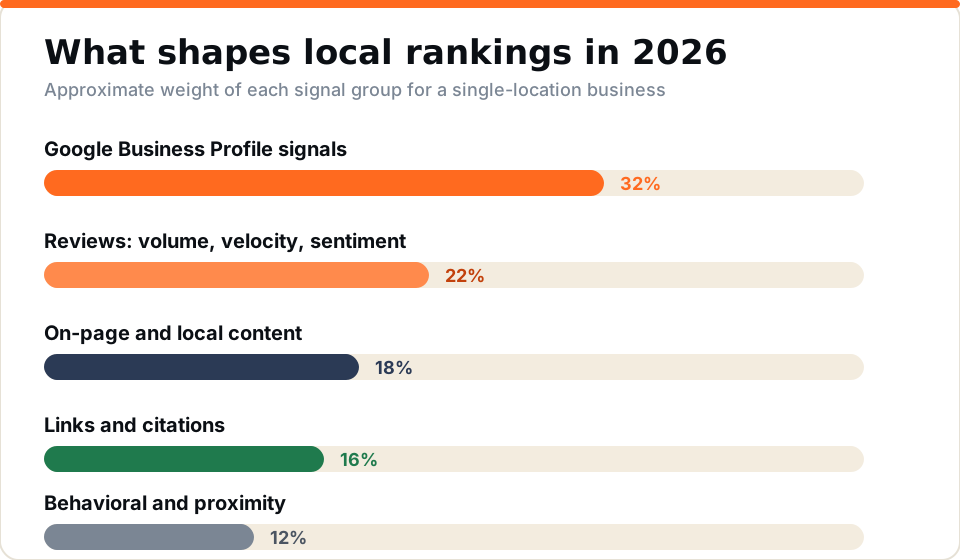
Notice that the two largest groups, your Google Business Profile and your reviews, are also the two you can influence the fastest. That is not a coincidence. It is the reason local SEO rewards consistent operators over clever ones.
Reading the local pack: what every result is really telling you
Before you optimize anything, learn to read the local pack the way Google does. Every element on the screen is a signal you can work on.
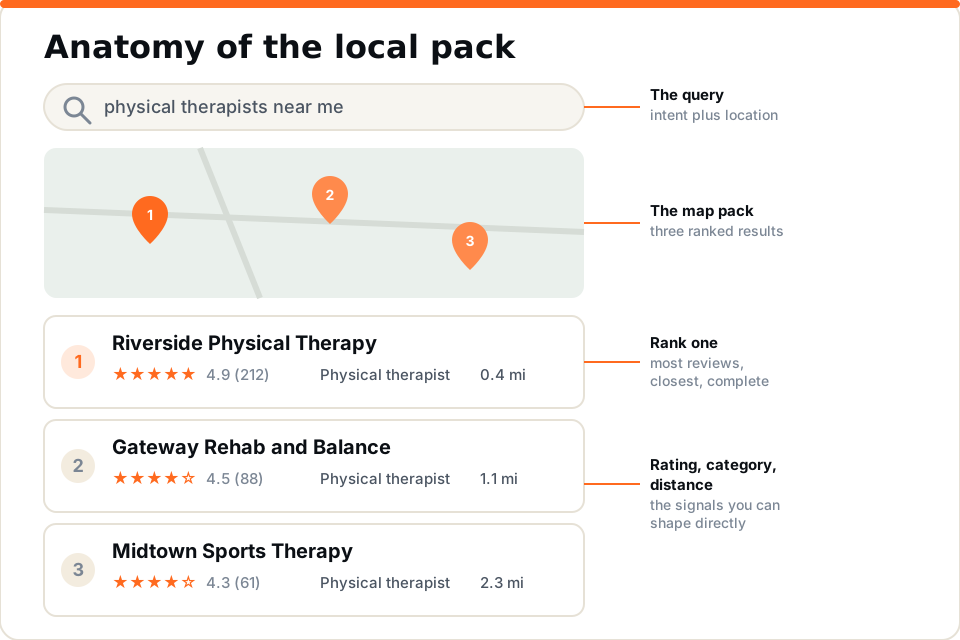
When you look at the business sitting in position one, you are almost always looking at some combination of the same traits: a complete and verified profile, the right primary category, a healthy and recent stream of reviews, and proximity to the searcher. The business in position three usually has a gap in one of those. Your job in local SEO is to close your own gaps before your competitors close theirs.
This is also why staring at your ranking on your own phone is misleading. You see results biased by your own location and history. The honest way to know where you stand is to measure from the searcher point of view across your service area, which is exactly what a proper audit does.
The local SEO foundations stack
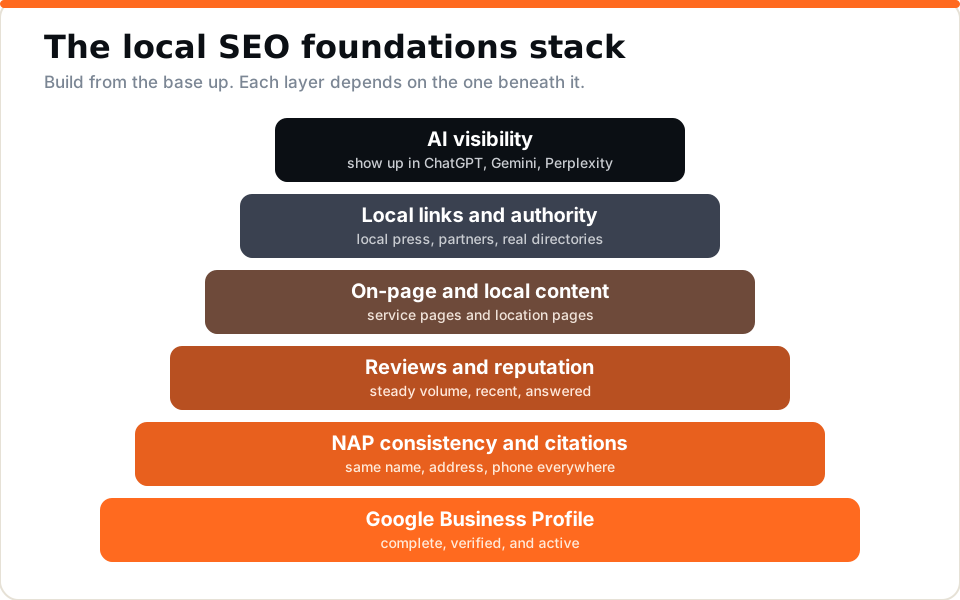
Local SEO works best when you build it in order. Skip the base and the upper layers wobble. Here is the stack, from the foundation everything rests on up to the newest surface.
Layer 1: your Google Business Profile
Your Google Business Profile is the single most important asset in local SEO, full stop. It is the thing that places you in the map pack, and it is free. If you do nothing else this month, make this profile complete and verified.
Google's guidelines are written for businesses that meet customers in person. We learned what that means firsthand: we are an online software company without a storefront, and map rankings and local listings simply did not fit when we pointed our own dashboard at ourselves.
Complete means every field is filled: the correct primary category, relevant secondary categories, accurate hours including holiday hours, your service area, a real description, your services listed individually, and recent photos. Google's tips for local ranking start with entering complete business information. Keep it active too. A profile that posts updates, answers questions, and adds photos signals to Google that the business is alive and engaged. For the field-by-field version of this layer, our Google Business Profile optimization checklist walks through all 27 settings in working order.
Layer 2: NAP consistency and citations
NAP stands for name, address, and phone number. Citations are the places across the web where that information appears: directories, your website, social profiles, industry listings. Consistency means the exact same details everywhere.
This sounds trivial and it is not. A business that moved, rebranded, or changed phone numbers often leaves a trail of outdated listings, and those inconsistencies confuse the systems that decide whether your business is legitimate. Pick one canonical version of your name, address, and phone number, and make every listing match it character for character. This is unglamorous local SEO that quietly lifts everything above it.
Layer 3: reviews and reputation
Reviews are the closest thing to a ranking cheat code that is also completely legitimate. They influence the local pack directly, and they influence the human reading it even more. Three things matter here, and all three are within your control:
- Volume. More reviews generally beat fewer, but you do not need to win the absolute count. You need enough to look established and trusted.
- Velocity. A steady trickle of recent reviews beats a pile from two years ago. A handful of fresh reviews this quarter tells a reader more than a large pile that stopped years ago.
- Sentiment and responses. Reply to reviews, the good and the bad. A thoughtful response to a complaint reassures the next reader more than a perfect average ever could.
The simplest review engine for a single-location business is a habit: ask every satisfied customer, at the moment they are happiest, with a link that takes two taps. Build that habit and your local SEO compounds on its own.
Layer 4: on-page and local content
This is where your website earns its keep. For a single-location business, you do not need hundreds of pages. You need the right handful, each one clearly about a service you offer and the place you offer it.
- A strong home page that states who you are, what you do, and where, with your NAP visible
- A dedicated page for each core service, written for the person searching for that exact service
- A location or service area page that names the neighborhoods and towns you serve
- Helpful content that answers the questions your customers actually ask, like this guide does
The goal is relevance. When your pages use the same language your prospects search with, you become the obvious match. This is also the layer that feeds AI answers, because assistants read your pages to decide what you do and who to recommend.
Layer 5: local links and authority
Links from other reputable sites tell Google your business is known and trusted. For local SEO, local links carry special weight: the chamber of commerce, a local news mention, a partner business, a sponsorship, a supplier directory. You do not need thousands of links. You need a steady handful of genuinely local, genuinely relevant ones.
Authority builds slowly, so start early and treat it as a background activity. Sponsor the youth team. Get quoted in the regional paper. Partner with a complementary business and link to each other where it makes sense. Each real connection is a small, durable vote for your prominence.
Layer 6: AI visibility
The newest layer, and the one most businesses have not noticed yet. More people now use AI assistants: in a Pew Research Center survey, 34% of US adults said they had used ChatGPT, about double the share in 2023. Some of them ask an assistant for a local recommendation instead of opening a search engine. When someone asks ChatGPT or Gemini for the best clinic in your town, your business either comes up or it does not.
The encouraging part is that AI visibility rests on the same foundation as the rest of the stack. Assistants lean on your profile, your reviews, your content, and your mentions across the web to decide who to name. Build the lower layers well and you tend to earn AI visibility as a byproduct. We go deeper on this in our guide to AI visibility for local business.
Your first 90 days: a local SEO plan you can actually run
A pillar guide is useless without a sequence. Here is a 90 day plan scoped for a busy single-location operator who does not have a marketing team. Do these in order.
Days 1 to 30: fix the foundation
- Claim and verify your Google Business Profile if you have not already
- Set the correct primary category and add accurate secondary categories
- Fill every field: hours, services, description, service area, and at least 10 recent photos
- Audit your NAP across your website and your top directory listings, and fix every inconsistency
- Set up a simple way to ask for reviews and start asking every happy customer this week
Days 31 to 60: build content and reviews
- Write or rewrite a dedicated page for each of your core services
- Add a location or service area page that names the places you serve
- Publish one helpful article that answers a real customer question
- Keep the review habit going and respond to every review within a few days
- Post to your Google Business Profile a few times to keep it active
Days 61 to 90: earn authority and measure
- Pursue three to five genuinely local links: chamber, partners, a sponsorship, a local mention
- Check your AI visibility by asking a few assistants for recommendations in your category and town
- Measure where you rank in the local pack from across your service area, not just your own phone
- Review what moved, double down on what worked, and set the next quarter from real numbers
If that looks like a lot, it is the honest amount of work local SEO takes. The alternative is to compress it: a free audit shows you which of these steps will move your rankings most, so you start with the highest leverage fix instead of guessing.
Local SEO across verticals: same playbook, different emphasis
The stack does not change between industries. The emphasis does. A few examples for single-location operators:
- Healthcare and clinics lean hardest on reviews and trust signals, because patients are choosing who to trust with their body. Accurate categories and insurance details matter, and review responses must be careful and compliant.
- Home services like plumbing, HVAC, and electrical lean on response speed, service area pages, and emergency intent. Showing up for near me searches at odd hours is the whole game.
- Professional services like law and accounting lean on content and authority, because the buyer researches before they call. Strong service pages and local links do heavy lifting.
- Personal care like salons, med spas, and dentistry lean on photos, reviews, and a polished profile, because the decision is visual and reputational.
Whatever your vertical, the order of operations holds: profile first, then consistency, then reviews, then content, then links, then AI visibility. Start at the base.
The mistakes that quietly cost single-location businesses customers
Most local SEO problems are not exotic. They are small, common, and fixable. Watch for these.
- An incomplete or unverified profile. The most common and most expensive mistake. A half filled profile cannot win the pack.
- The wrong primary category. Picking a broad category when a specific one fits makes you less relevant for the searches that matter.
- Inconsistent NAP. An old address or a tracking phone number scattered across directories erodes trust signals.
- Letting reviews go stale. A great average from two years ago looks abandoned next to a competitor with fresh reviews this month.
- Ignoring reviews you do not like. A silent owner reads worse than a flawed one. Respond.
- One thin website page for everything. A single page that tries to cover every service ranks for none of them well.
- Buying links or fake reviews. Short term tricks that invite penalties and erase trust. Local SEO rewards the real thing.
- Measuring from your own phone. Your personalized results lie to you. Measure across your service area.
None of these require an agency to fix. They require attention and a sequence, which is exactly what this guide is for.
How to measure local SEO: the metrics that matter
You cannot improve what you do not measure, and most owners measure the wrong thing. Vanity rankings on your own device feel good and mean little. Track these instead.
- Local pack position for your core terms, measured from several points across your service area
- Profile actions: calls, direction requests, website clicks, and messages from your Google Business Profile
- Review volume and velocity: how many new reviews per month and how recent the latest ones are
- Organic visibility for your service and location pages
- AI mentions: whether assistants name your business for category plus location prompts
- The bottom line: calls, bookings, and new customers that trace back to search
The thread connecting all of these is that they reflect what a real prospect experiences, not what you see on your own screen. A monthly check on these numbers tells you whether your local SEO is compounding or coasting. If you want that snapshot without building the tracking yourself, our free audit measures your local presence from the searcher point of view and shows you what to fix first.
Common questions about local SEO in 2026
How long does local SEO take to work?
No one can promise a timeline, and Google does not publish one. Some fixes, like completing and verifying your Google Business Profile, give Google better information right away. The compounding parts, reviews, content, and authority, take longer to build and keep paying off after that.
Do I need a website if I have a Google Business Profile?
Yes. A profile places you in the map pack, but your website is what proves relevance, captures research style searches, and feeds AI answers. The two work together. A strong profile without a site leaves prominence and AI visibility on the table.
How many reviews do I need?
Enough to look established and trusted in your market, which depends on your competitors more than any absolute number. Focus less on a magic count and more on velocity and responses. A steady stream of recent reviews that you reply to beats a large but stale pile.
Can I do local SEO myself?
For a single-location business, yes, much of it. The foundation layers are about attention and consistency, not technical wizardry. The hard parts are knowing what to fix first and measuring honestly, which is where a tool or an audit saves you months of guessing.
Where to start
Local SEO in 2026 is not complicated, but it is sequential. Build your Google Business Profile, make your information consistent everywhere, earn a steady flow of reviews, write the handful of pages that prove what you do, gather a few genuine local links, and let AI visibility follow. Do it in that order and a single-location business can own its neighborhood.
The fastest way to start is to find out where you stand. Run a free audit to see your map rankings, on-page basics, Google listing, reviews and whether ChatGPT names you, without creating an account. From there, the 90 day plan above gives you the sequence. The phone does the rest.
If you want to go deeper on the layers, read our local SEO audit checklist for a hands on walkthrough, and our guide to Google Business Profile content strategy for the profile layer in detail.
See where your own business stands.
We measure your local rankings, your listings, your website, and how AI assistants answer for your business. No signup required.
Or jump straight to pricing →