
Notes
Dental SEO in 2026: How to Get Your Practice Found Online Without a Big Agency Budget
Imagine it's a Tuesday morning. A dentist pulls up their Google Business Profile between patients, types in the search they've done a dozen times, and there it is: the practice two blocks away is sitting in spot one of the map pack. Again.
Reviewed by Melike Erguven, Co-founder of LocalLeadSignal · June 29, 2026 · 13 min read
Imagine it's a Tuesday morning. A dentist pulls up their Google Business Profile between patients, types in the search they've done a dozen times, and there it is: the practice two blocks away is sitting in spot one of the map pack. Again. For "dentist near me," for "teeth whitening," for "emergency dentist." That competitor's schedule is probably full. Yours has gaps.
The frustrating part is the care you provide is just as good, maybe better. The problem isn't quality. It's visibility. And that gap, between how good a practice is and how easy it is to find online, is exactly what dental SEO is designed to close.
This article walks through what actually moves the needle for dental practices in 2026. We'll cover the fundamentals of local search, the specifics of your Google Business Profile, citations, reviews, content strategy, and where AI-powered search fits into all of it. No marketing team required. No enormous budget either.
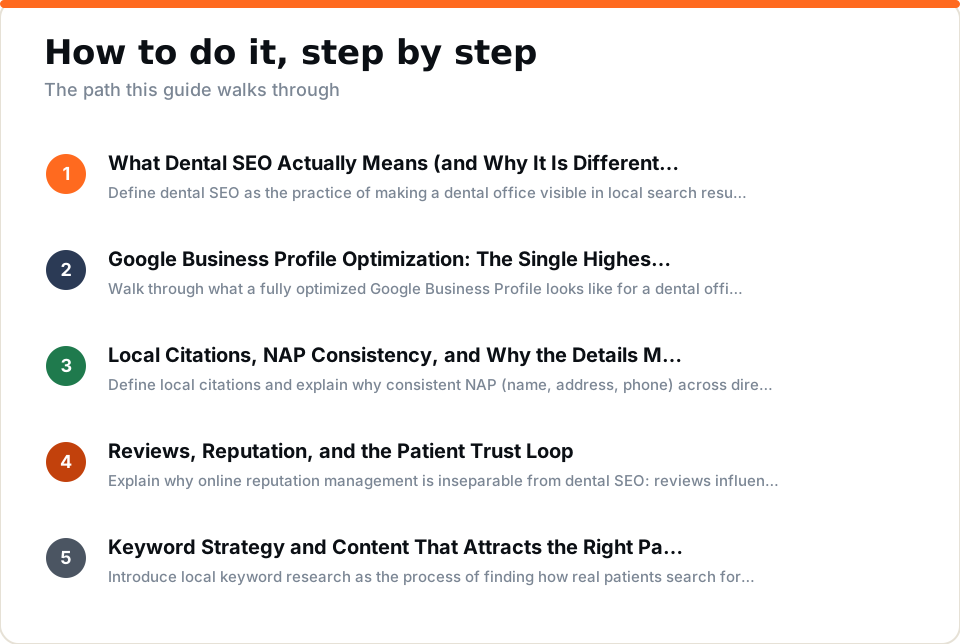
What Dental SEO Actually Means (and Why It Is Different from General SEO)
Dental SEO is the practice of making a dental office visible in local search results, map packs, and increasingly, in AI-generated answers. It's not about ranking for "what is a root canal" on a national scale. It's about showing up when someone three miles away searches for a dentist who takes their insurance, offers same-day appointments, or does Invisalign.
That distinction matters a lot. When people talk about local SEO vs traditional SEO, the core difference is intent. Traditional SEO chases broad informational queries. Local SEO targets proximity-based intent, searches where the person wants a business they can actually walk into or call. Dental searches are almost always that second type. Someone searching "dental implants" might be doing research. Someone searching "dental implants in my area" or "dentist open Sunday" is ready to book.
That shift in intent changes the entire strategy. You're not competing with informational content mills or national health websites on most of your important keywords. You're competing with the eight other dental practices in your zip code. The signals that determine who wins those searches are different from what makes a national site rank.
The three pillars that matter most for dental practices are Google Business Profile, local citations, and on-site local signals. Think of them as a three-legged stool. Weaken any one leg and the whole thing wobbles. Most practices that struggle with visibility have at least one of these legs either missing or shaky.
It's also worth noting that dental practice vs DSO SEO strategies are genuinely different. A single-location independent practice needs to dominate its neighborhood. A dental service organization running fifteen locations has to think about how those locations compete against each other in search, how reviews and branding scale, and how to avoid cannibalizing their own rankings. If you're a solo practice or a small group, the good news is your strategy is more focused. You don't need enterprise tools or an agency charging per seat. You need to execute the fundamentals really well.
Google Business Profile Optimization: The Single Highest-Leverage Thing a Dental Practice Can Do
If you had to pick one thing to fix first, it would be your Google Business Profile. Nothing else has as direct and immediate an impact on whether your practice shows up in the map pack. A fully optimized profile for a dental office looks very different from a bare-bones listing, and the gap between the two is often the difference between being found and being invisible.
A complete profile includes the right primary and secondary categories (start with "Dentist" as the primary, then add more specific ones like "Cosmetic Dentist" or "Orthodontist" if applicable), a detailed services section with actual service names and descriptions, accurate hours including holiday hours, a strong business description written for humans not just algorithms, and a steady stream of recent photos. The Q&A section is chronically ignored by dental practices, but it's a real opportunity. Pre-populate it with questions your patients actually ask.

Google map pack ranking is driven by three broad signals: relevance (does your profile match what someone searched for), distance (how close your practice is to the searcher), and prominence (how well-known and trusted your practice appears online). You can't move your office, but you can absolutely move the needle on relevance and prominence. Filling out every field, using specific service language, and earning consistent reviews all push toward both.
The most common GBP mistakes dental practices make are surprisingly basic. Mismatched NAP, meaning your name, address, or phone number on the profile doesn't exactly match what's on your website or other directories, is one of the biggest. Using a generic primary category instead of "Dentist" is another. Leaving the services section blank is practically handing map pack spots to competitors. And ignoring Google Posts means you're missing a free channel to show active, up-to-date information.
Google maps marketing shouldn't be treated as a one-time setup task. It's an active channel. That means posting updates, responding to reviews publicly, adding new photos regularly, and checking for suggested edits from users that might be wrong. If you want a full breakdown of every setting worth touching, checking off the 27-point setup is a good place to start.
The right mindset is to treat your profile as a living asset, something you update monthly. Not a form you fill out once and forget. Practices that treat it that way consistently outperform those that don't.
Local Citations, NAP Consistency, and Why the Details Matter More Than You Think
A local citation is any mention of your practice's name, address, and phone number on the web. It could be on Healthgrades, Yelp, WebMD, a local chamber of commerce directory, or a dental association listing. Citations are one of the foundational trust signals in local SEO. They tell search engines: this business is real, it's located where it says it is, and multiple independent sources agree.
NAP consistency is the concept of making sure those three data points match exactly everywhere they appear. Not approximately. Exactly. "Suite 200" versus "#200" can create a discrepancy. A phone number with an area code formatted differently across directories creates confusion. Search engines cross-reference these listings, and when the details don't line up, it introduces doubt. That doubt translates to lower confidence in your listing, which can suppress your rankings.
The difference between citations vs backlinks is worth understanding clearly. Citations confirm that your business exists and is legitimate. Backlinks pass authority from one website to another. Both matter, but they serve different roles. You can think of citations as your business's proof of identity and backlinks as votes of credibility. Dental practices often neglect citations because they're less glamorous than link building, but they're harder to rank without.

For dental practices specifically, the citation sources that carry the most weight include Healthgrades, Zocdoc, WebMD, Yelp, and Bing Places. General directories like Apple Maps, Foursquare, and data aggregators that feed dozens of other sites also matter. Getting listed on these isn't enough if the data is wrong or inconsistent, so auditing your existing listings is step one.
There's also a technical layer that reinforces all of this: local business schema markup. Schema is structured data you add to your website that tells search engines exactly what your business is, where it's located, what services you offer, and how to contact you. For healthcare businesses, schema markup in the healthcare category gives search engines additional context they can rely on. It's not a magic ranking button, but it strengthens the signals your citations are already sending.
Managing citations manually is genuinely tedious. You're looking at dozens of directories, each with its own submission process, each needing to be monitored for user-suggested changes or duplicate listings. Most dental practices fall behind on this not because they don't care, but because there aren't enough hours in the day.
Reviews, Reputation, and the Patient Trust Loop
Online reputation management isn't a soft marketing nice-to-have. It's a hard SEO signal. The quantity, quality, recency, and velocity of your Google reviews directly influence where your practice shows up in the map pack. Reviews also affect click-through rates, meaning even if you rank, a profile with a low star average or no recent reviews loses clicks to a competitor with a better reputation.
Getting a steady flow of reviews without crossing HIPAA compliant marketing lines is one of the most common questions dental practices have. The answer is simpler than many people expect. You can absolutely ask patients to leave a review. You just can't reference anything about their care, appointment, or health status in the ask. A text or email that says "We'd love to hear about your experience, here's a link to leave us a Google review" is compliant. Mentioning their procedure, diagnosis, or anything clinical in that message is not.

The best systems for getting more Google reviews are consistent and low-friction. Ask at checkout, send a follow-up message the same day, and make the link to leave a review as easy to tap as possible. Practices that build this into their workflow outpace those that rely on patients doing it unprompted.
Responding to negative reviews in a healthcare context requires a specific approach. Acknowledge the reviewer's experience without confirming or denying that they were a patient. Do not disclose any clinical information. Offer to continue the conversation offline with a direct phone number or email. That response template does three things: it shows potential patients that the practice takes concerns seriously, it avoids any HIPAA exposure, and it removes the conflict from the public thread.
Reputation recovery after a string of negative reviews is possible, but it takes time. There's no shortcut. The path is to address whatever operational issue caused the reviews if there was one, then build a consistent pipeline of new positive reviews so recent results reflect current reality. A realistic timeline is several months. Review velocity, meaning how many new reviews you're earning per week, matters more than the total count when it comes to recency signals in the map pack algorithm.
All of this is SEO work. Reviews aren't just a reputation play. They're a ranking strategy.
Keyword Strategy and Content That Attracts the Right Patients
Local keyword research for a dental practice is the process of figuring out how real people in your area actually search for dental care. That sounds basic, but most dental websites are optimized for the terms the dentist would use, not the words a nervous patient at midnight types into Google. Those are often very different things.
Long-tail local keywords are where the real opportunity is. Phrases like "affordable dental implants," "emergency dentist open Saturday," "Invisalign for adults," or "dentist that takes Medicaid" have lower search volume than "dentist" but convert at a dramatically higher rate. Someone who searches that specifically already knows what they need. Your job is to be the answer they find.
The way to build around these keywords is through dedicated service pages and supporting blog content. A single page trying to rank for everything usually ranks for nothing. A service page specifically about dental implants, written for patients in your town (without over-optimizing for location to the point of awkwardness), signals clearly to both search engines and patients what you offer and who it's for. Blog content handles the question-based searches that lead people to your services.
One often-overlooked tactic is to refresh underperforming blog posts rather than constantly creating new ones. If a post about "signs you need a root canal" was written two years ago and ranks on page three, updating it with current information, better structure, and more thorough answers can move it to page one faster than a brand new post would. It's one of the more efficient uses of content time a practice has.
Local link building for dental practices doesn't require anything aggressive. Local directories, community sponsorships, dental association listings, and partnerships with other local healthcare providers are all natural sources of links. The American Dental Association membership directory is one example of an authoritative citation that doubles as a link signal. Local relevance matters more than domain authority for these.
A dental SEO audit is the right starting point for all of this. Before you create content or build links, you need to know what you already rank for, what your competitors are ranking for that you're not, and where the biggest gaps in your current setup are. It turns guesswork into a prioritized list.
AI Search, Voice Search, and What Dental SEO Looks Like in 2026
Something has shifted in how people find local businesses, including dental practices, and it's moving faster than most practices realize. AI-powered search tools like ChatGPT, Perplexity, and Gemini are now returning local business recommendations in response to conversational queries. Someone asking "what's a good dentist near me who does same-day crowns" might be getting an answer directly from an AI model, not from a list of ten blue links.
Generative engine optimization, or GEO, is the practice of structuring your online presence so that AI models can find, understand, and accurately cite your business. In plain language: the same signals that make you rank in Google's map pack, clean citations, authoritative content, consistent structured data, are largely the same signals AI models rely on when generating local recommendations. This isn't a separate strategy. It's an extension of doing local SEO well.
AI visibility for local business comes down to a few things: being consistently cited across authoritative directories so AI models have reliable data to pull from, having clear on-site content that answers the questions patients actually ask, and having schema markup that makes it unambiguous what your business is and where it's located. If you want to understand what that looks like in more depth, this breakdown of showing up in ChatGPT and Perplexity covers the mechanics.
Voice search local SEO adds another dimension. Patients asking a voice assistant for a dentist typically use conversational, question-based language: "Is there a dentist near me open on weekends?" or "Who does emergency dental work around here?" Content that directly answers these questions in natural language, in headings, short paragraphs, and FAQ sections, is more likely to be pulled as a voice answer. The optimization isn't different in kind from traditional local SEO, but it rewards clarity and directness.
AI search trends heading into late 2026 point toward AI-generated answers taking an increasing share of search clicks, particularly for local and transactional queries. Practices that have already built strong citation profiles, consistent NAP data, authoritative content, and solid GBP optimization are structurally better positioned as that shift accelerates. The groundwork you lay today compounds.
This is also why a single managed service that handles GBP, citations, reviews, and AI visibility together makes more sense than trying to manage each piece independently. These signals reinforce each other. A citation that's inconsistent hurts your GBP trust score, which hurts your map pack ranking, which makes you less likely to appear in AI recommendations. Managing it as one connected system is just more effective.
Getting Found Doesn't Require a Big Agency or a Big Budget
Dental SEO is not a mystery, and it's not something only large DSOs with full marketing departments can afford to do well. It's a set of consistent, repeatable actions: a polished Google Business Profile, clean and consistent citations across the directories that matter, a steady flow of recent reviews, keyword-focused content that speaks to what patients actually search for, and an eye on how AI search is reshaping discovery.
The problem is that most agencies charge $500 or more per location and hand you a dashboard to figure out yourself. That's a lot of money for a lot of homework.
LocalLeadSignal starts at $249 a month, no contract, and does the work for you from day one. That means tracking your visibility, managing your GBP, building and cleaning up citations, helping with reviews, and keeping your presence sharp as AI search keeps evolving. You don't need to hire a marketing team or become an SEO expert. You just need someone handling this consistently while you focus on patients.
Frequently asked questions
- What is dental SEO and how is it different from regular SEO?
- Dental SEO is the process of optimizing a dental practice's online presence so that patients can find it in local search results, the Google map pack, and increasingly in AI-powered search tools. It differs from general SEO because the goal is hyper-local visibility within a small geographic radius rather than national rankings. The tactics focus on Google Business Profile, local citations, reviews, and locally relevant content rather than broad domain authority.
- How long does dental SEO take to show results?
- Most dental practices start seeing measurable improvements in map pack visibility and organic rankings within three to six months of consistent SEO work. Quick wins like fixing NAP inconsistencies and completing a Google Business Profile can show movement faster, sometimes within a few weeks. Long-term gains from content and review building compound over time, which is why ongoing SEO produces better results than one-time fixes.
- Does a dental practice need a different SEO strategy than a dental service organization (DSO)?
- Yes, the strategies differ in meaningful ways. A single-location dental practice benefits most from concentrated local signals: one well-optimized GBP, a strong review profile, and locally targeted service pages. A DSO managing multiple locations needs a scalable system that keeps NAP data consistent across locations, avoids cannibalizing the rankings of nearby sister locations, and manages reviews at scale. The core SEO principles are the same, but the execution and tooling are more complex for multi-location groups.
- How do reviews affect dental SEO rankings?
- Google uses review signals, including the number of reviews, average rating, and how recently reviews were posted, as part of its local ranking algorithm. A steady flow of new, positive reviews signals to Google that a practice is active and trusted, which supports map pack visibility. Reviews also directly influence whether a potential patient chooses your practice after finding you, making reputation management both an SEO and a conversion factor.
- Can dental practices show up in AI search results like ChatGPT or Perplexity?
- Yes, and it is becoming increasingly important. AI tools like ChatGPT, Perplexity, and Gemini pull information from structured, authoritative online sources when answering questions about local services. Dental practices that have consistent citations, well-structured schema markup, a complete Google Business Profile, and educational on-site content are better positioned to be cited or recommended in AI-generated responses. This area of optimization is newer but growing quickly.
- What should a dental practice look for in an SEO provider?
- Look for a provider that handles the core pillars together: GBP management, citation building and cleanup, review monitoring, on-site content, and reporting you can actually understand. Be cautious of providers that require long contracts, charge separately for each service, or deliver reports without taking action. A good dental SEO partner does the work for you and shows clear visibility tracking so you know what is improving and why.
See where your own business stands.
We measure your local rankings, your listings, your website, and how AI assistants answer for your business. No signup required.
Or jump straight to pricing →