
AI visibility
AI Visibility for Local Business: How to Show Up in ChatGPT, Perplexity, Gemini, and Claude
A prospect used to open Google, type a service plus a town, and pick from the three businesses on the map.
Reviewed by Melike Erguven · June 10, 2026 · 13 min read
A prospect used to open Google, type a service plus a town, and pick from the three businesses on the map. What is new is the question they ask before they ever reach Google: they open ChatGPT, Perplexity, Gemini, or Claude and say, "Who is the best physical therapist near me?" The assistant answers with a short list of names. If your business is not on that list, you were never in the running, and you will never see the lead you lost.
This is what AI visibility for local business means. It is whether the AI assistants people now treat as their first stop name your business when someone in your service area asks for what you do. It is a new channel, and few businesses measure it yet. That is the opportunity: the businesses that start measuring now will know where they stand before their competitors do.
This guide is the practical, complete version. We will cover what AI visibility actually is, why it matters right now, how the four major engines decide who to recommend, the signals that move the needle, how to run a measurement probe yourself, and a plan you can act on this month. When you want a fast read on where you stand, you can run a free audit and see whether ChatGPT names your business, alongside the rest of your local presence.
What AI visibility for local business actually means
AI visibility is the practice of becoming the business an AI assistant names when a nearby prospect asks it for a recommendation. That is the whole definition. Everything else is detail about how the assistants decide.
For two decades, local marketing meant one scoreboard: your position in Google's map pack and organic results. AI visibility adds a second scoreboard that runs in parallel. When someone asks Gemini for the best clinic in their town, or asks Perplexity to compare two law firms nearby, the assistant produces a named answer. Your business is either in that answer or it is not. There is no map, no scrolling, no page two to crawl back from. The answer is short, and short answers are unforgiving.
People sometimes call this work generative engine optimization, or GEO, because the goal is to show up inside the output of a generative engine rather than a ranked list of links. The label matters less than the shift it describes. Search used to hand the visitor ten blue links and let them choose. The assistant chooses for them and hands back two or three names. AI visibility for local business is about being one of those names.
The reassuring part, which we will return to throughout this guide, is that the assistants are not pulling those names from nowhere. They lean on the same foundation that already drives local search: your profile, your reviews, your content, and your mentions across the web. Build that foundation well and you tend to earn AI visibility as a byproduct. Neglect it and the engines quietly recommend someone else.
Why AI visibility matters now for local businesses
A few things have converged that make this the year to pay attention.
- Adoption crossed a line. In a Pew Research Center survey, 34% of US adults said they had used ChatGPT, about double the share in 2023. These are not just engineers and students. They are homeowners looking for a plumber and parents looking for a pediatric dentist.
- People ask for local recommendations. Some of those people ask an assistant for a local recommendation: a doctor, a contractor, a clinic, a restaurant. That is a buying-intent moment happening entirely outside the search box you have spent years optimizing.
- The answer is a shortlist, not a page. When the assistant names two or three businesses, the long tail of competitors below the fold simply does not exist for that prospect. Winning a spot in the answer is closer to winning the single top result than to ranking on page one.
- Few businesses are measuring it. Google Search Console has begun to report some AI feature data, but no standard dashboard shows what ChatGPT, Perplexity or Claude say about you. If you do not run probes, you have no data.
Put those together and the conclusion is simple. AI visibility for local business is a high-intent channel, and it is growing. The cost of starting is a few minutes of measurement. The cost of waiting is every lead that asks an assistant first.
How AI engines choose which local business to recommend
To improve AI visibility, it helps to understand the machine you are trying to influence. The four major assistants differ in the details, but they share a basic shape: they combine what they learned during training with fresh information retrieved at the moment of the question, then they generate a named answer.
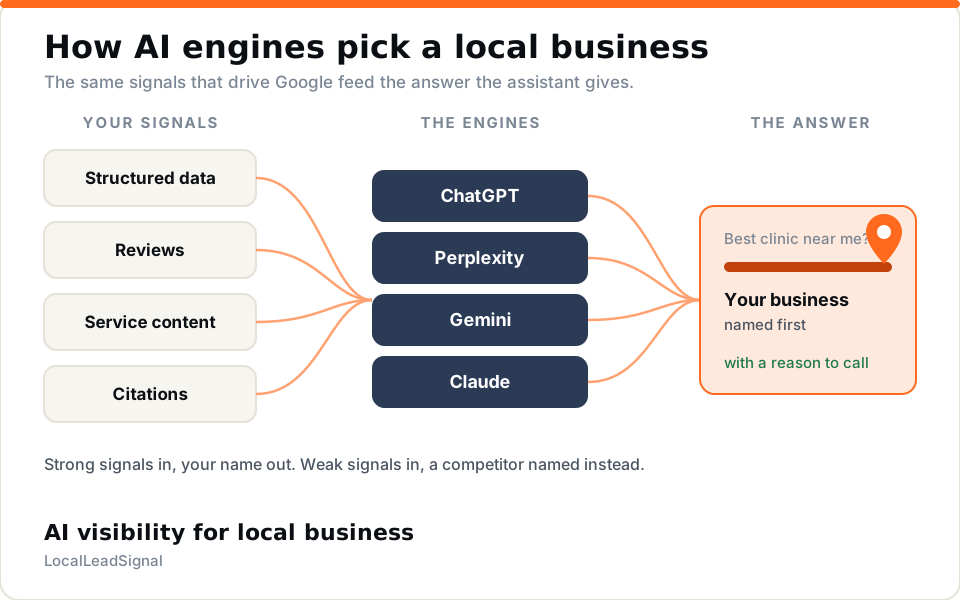
Here is how the four engines tend to behave when someone asks for a local recommendation.
ChatGPT
ChatGPT answers from a blend of its training knowledge and live web retrieval through its browsing and search features. For a well-known local business, it may recall you directly. For most local queries it retrieves in real time, which means your fresh, structured, on-page information is what it reads. Clear service pages and a consistent business name across the web make you easy to retrieve and easy to name.
Perplexity
Perplexity is built around retrieval and citation. It runs a live search, reads the top sources, and answers with links back to them. That makes it the most transparent engine to optimize for, because you can see exactly which pages it pulled. If your site and your directory listings are the sources it reads, you get named and cited. AI visibility here rewards businesses with crawlable, authoritative pages.
Gemini
Gemini is tied closely to Google's index and to the same local signals that drive the map pack. If you already rank well locally, you have a head start in Gemini. A complete and verified Google Business Profile, strong reviews, and accurate categories carry weight here in a way that overlaps heavily with classic local SEO.
Claude
Claude answers from training knowledge and, when connected to tools, from retrieved web content. It tends to reward clear, well-structured, trustworthy sources and is careful about claims. Plain, accurate descriptions of who you serve and what you do, backed by consistent information across the web, help Claude name you with confidence.
The throughline across all four is that none of them invent a winner. They surface the business whose signals most clearly match the intent. That is good news, because those signals are exactly the things you can control.
The signals that drive AI visibility
If the engines all read the same kinds of inputs, the practical question becomes: which inputs matter most? No engine publishes a formula. Based on how the assistants retrieve and what they cite, this is our rough reading of the weights for a single-location business.
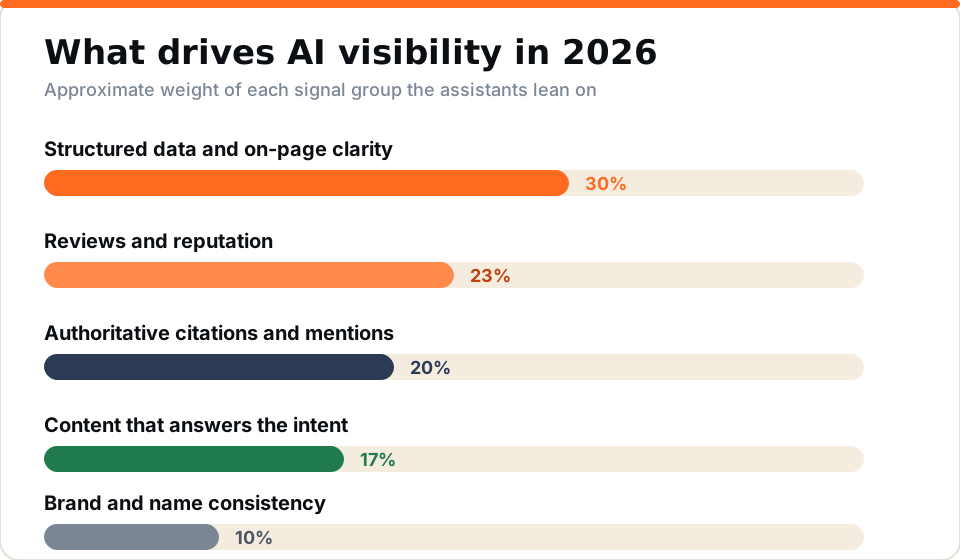
- Structured data and on-page clarity. Schema.org markup is how machines read your site without guessing. LocalBusiness, Service, and Review schema tell an engine what you do, where, and how well-regarded you are, in a format built for retrieval. Google's own structured data documentation explains the formats, and the assistants benefit from the same clarity.
- Reviews and reputation. Volume, recency, and sentiment all feed the engines' sense of who is trustworthy. A steady stream of recent, answered reviews reads as an established, active business, and the assistants pick up on that.
- Authoritative citations and mentions. A mention in a respected directory or a vertical platform, Yelp, Healthgrades for medical, Justia for legal, is high signal. When several trusted sources name you in the same context, the engines connect your brand to the intent.
- Content that answers the intent. If a prospect asks for back pain physical therapy in your town and you have a page titled exactly that, you are the source the engine wants to retrieve and quote.
- Brand and name consistency. The same name, address, and phone number everywhere removes ambiguity. Inconsistent details make it harder for an engine to be sure you are one business rather than three.
Notice that the two heaviest groups, structured data and reviews, are also the two you can improve fastest. AI visibility rewards the same disciplined operators that local search has always rewarded.
How to measure your AI visibility: run the probe
You cannot improve what you do not measure, and there is no built-in dashboard for this. So you build the measurement yourself. The probe is mechanical and you can run a first pass in fifteen minutes.
Pick the handful of queries a real prospect would type. Use plain language, mix in your geography, and cover your core service lines. Then ask each one, in a fresh chat with no prior context, to ChatGPT, Perplexity, Gemini, and Claude. For each engine, record whether your business name appears in the answer.
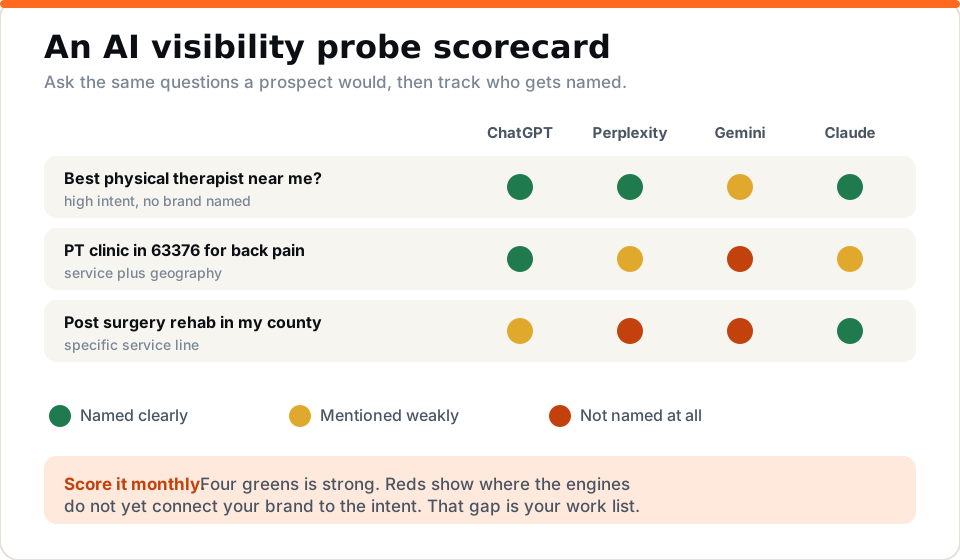
Sample probes for a physical therapy clinic:
- "Who is the best physical therapist in [your town]?"
- "Recommend a physical therapy clinic near [your ZIP] for back pain."
- "I need post surgery rehabilitation in [your county]. Who should I see?"
Score each cell green, yellow, or red. Green means the engine names you clearly. Yellow means a weak or buried mention. Red means you are absent and a competitor took the spot. Four greens across a query is strong. Anything mostly red means the engines do not yet associate your brand with that intent, and that is precisely the gap to close.
Run the probe once a month and keep the history. The movement over time tells you whether your AI visibility work is compounding. If running this by hand every month sounds tedious, our free audit checks whether ChatGPT names your business for your category and ZIP code. We run the full four-assistant probe every week on our own business.
A practical plan to improve AI visibility for local business
Measurement tells you where you stand. Here is what to do about it, ordered by how fast each lever tends to move the needle.
Put structured data on every important page
Add LocalBusiness schema to your site, Service schema to each service page, and Review or AggregateRating schema where you display ratings. This is the single clearest way to tell an engine what you do and where, in a format it reads without guessing. If you only do one thing this month, make it this. The schema.org LocalBusiness vocabulary is the reference for the fields to include.
Keep reviews fresh and answered
Build the habit of asking every satisfied customer for a review at the moment they are happiest, with a link that takes two taps. Reply to every review, the good and the difficult. Volume, recency, and your responses all feed the reputation signal the engines weigh heavily. A clinic with thirty recent answered reviews can read as more trustworthy than one with two hundred that stopped two years ago.
Write content that answers the intent literally
Look at your probe queries and write the page that answers each one by name. If prospects ask for "back pain physical therapy in [your town]," publish a page with that exact focus. The assistants retrieve and quote pages that match the question word for word. This is also the layer that feeds your classic local rankings, so the work pays off twice.
Earn and clean up citations
Claim your listings in the directories that matter for your vertical and make the name, address, and phone number identical everywhere. Pursue a few genuine local mentions: the chamber, a partner business, a local news quote. Each trusted source that names you in the right context strengthens the link between your brand and the intent.
Do these in order, profile and structured data first, then reviews, then content, then citations, and your AI visibility tends to climb the same way your map pack position does. They are not separate projects. They are the same foundation seen from a new angle.
AI visibility and local SEO are the same foundation
Reading all of this, you might think AI visibility adds a second job to your list. It does not. This is the central idea of this guide: AI visibility for local business is built on the same foundation that local SEO has always rewarded. When an assistant decides which business to name, it looks at your Google Business Profile, your reviews, your service pages, and your citations, which are the same things that decide where you land in the map pack.
That is why the right move is not to chase the assistants directly with tricks. It is to build the local foundation well and let AI visibility follow. We walk through that foundation layer by layer in our complete local SEO guide for 2026, and our companion piece on why AI visibility is the next channel small businesses cannot ignore goes deeper on the strategic case. If you want a hands on starting point, the local SEO audit checklist gives you the foundation work in a form you can run today.
The businesses that win the answer box are not doing something exotic. They are doing the basics consistently, and the assistants reward them for it.
Common questions about AI visibility for local business
Is AI visibility different from SEO?
It is a new surface that runs on familiar fuel. The engine is different, an assistant generating a named answer rather than a ranked list of links, but the inputs are the same profile, reviews, content, and citations that drive local SEO. Think of AI visibility as a second scoreboard fed by the same foundation, not a separate game.
Which AI engine should I focus on first?
Do not pick one. The four behave differently, so a business strong in Gemini can be invisible in Perplexity. Run your probe across all four, find your reds, and fix the underlying signals. Because they share a foundation, the work that lifts you in one engine usually lifts you in the others too.
How long does it take to improve AI visibility?
There is no reliable timeline, and no engine publishes one. Structured data and consistent listings change what the engines can retrieve, while reputation and content build over time, the same way they do in local SEO. In our own weekly checks, more assistants began naming us over the summer when asked about LocalLeadSignal directly, while buyer questions still named older brands. Recognition tends to come before recommendation.
Can I do this myself?
Much of it, yes. Running the probe is free and takes minutes. Adding schema, keeping reviews fresh, and writing intent-focused pages are all within reach of an owner who is willing to be consistent. The hard parts are measuring honestly every month and knowing which gap to close first, which is exactly where a tool or an audit saves you the guesswork.
Where to start
AI visibility for local business is not complicated, but it is a real channel with a real scoreboard, and right now most of your competitors are not watching it. The prospects who ask ChatGPT, Perplexity, Gemini, or Claude before they ask Google are making buying decisions inside an answer box you can influence. The way to influence it is the same disciplined local foundation that has always worked: clear structured data, fresh and answered reviews, content that answers the question by name, and consistent citations across the web.
The fastest way to begin is to find out where you stand. Run a free audit to see your map rankings, on-page basics, Google listing, reviews and whether ChatGPT names you, without creating an account. From there, run your monthly probe, fix the reds in order, and let the answer box start naming you.
See where your own business stands.
We measure your local rankings, your listings, your website, and how AI assistants answer for your business. No signup required.
Or jump straight to pricing →