
Notes
Med Spa Marketing Beliefs That Sound Right but Keep Your Books From Filling Up
Med spa owners are rarely short on marketing advice, and med spa marketing guidance in particular tends to sound plausible enough to act on even when it is wrong in ways that are hard to notice until a slow month reveals the gap.
Reviewed by Melike Erguven, Co-founder of LocalLeadSignal · October 30, 2026 · 15 min read

Med spa owners are rarely short on marketing advice, and med spa marketing guidance in particular tends to sound plausible enough to act on even when it is wrong in ways that are hard to notice until a slow month reveals the gap. Someone who follows this advice is not being careless. They are following logic that is half-right, which is exactly what makes it expensive.
This piece works through six beliefs that show up consistently among med spa owners who are doing the work but not seeing the bookings. Each one contains real truth. None of them are complete strategies. Understanding where each one breaks down is more useful than replacing one tactic with another, because the same half-right thinking will repeat itself unless the underlying picture is clearer.
No dramatic reversals here. Just a sharper look at how med spa marketing actually functions in 2026.
The Belief That a Polished Instagram Presence Is Enough to Bring In New Patients
Social proof is real. Before-and-after photography builds genuine trust for high-consideration services like injectables and laser treatments, and a well-maintained Instagram feed tells a prospective patient something meaningful about the quality of the work and the feel of the practice. That matters. For med spa marketing especially, where the patient is making a decision about their face or body, visual credibility carries weight.
Where the logic breaks down is in what happens next.
Most people do not book a $400 Botox appointment because an Instagram reel moved them. They get curious, they leave the app, and they start researching. They type a query into Google. They might ask an AI assistant which med spa in their area comes recommended for lip filler. They check reviews, look at the website, scan the Google Business Profile. By the time they are ready to book, they have moved entirely outside the platform where the practice first reached them.
If the practice is not visible at that decision moment, the social content did something generous: it warmed up a patient for a competitor who shows up in search.
The missing piece is search intent. The difference between someone scrolling Instagram and someone typing "med spa near me" into Google is the difference between awareness and purchase intent. Both matter. But they are not interchangeable, and they require different assets to capture. A profile that shows up when someone searches for a local med spa needs to be accurate, photo-rich, regularly updated, and strong across the signals Google weighs. A thorough audit of your profile settings is often where practices discover that the basics, categories, service listings, recent photos, are quietly incomplete.
AI visibility is also a growing part of this picture. Since mid-2026, AI assistants have been more likely to name a specific practice when someone asks about that business directly than when someone asks a general buyer question. For a med spa trying to capture new patients, this means two things: the practice needs to be named in enough credible online sources to appear in AI answers at all, and the signals that feed those answers overlap heavily with the signals that feed Google's local results. Social content alone does not build those signals.
Social and search are not rivals for your budget. Social builds awareness; search captures the moment when awareness becomes a booking decision. Neglecting social can slow the top of the funnel. Neglecting search bleeds the bottom of it.

Why Online Reviews Do Not Manage Themselves, Even When the Service Is Excellent
Good service is the foundation of a strong review profile. No review strategy fixes a practice that consistently disappoints patients, and no star rating survives a pattern of genuine problems. That part of the conventional wisdom is correct.
The mistake is assuming that good service produces good reviews without any prompting.
It does not. Satisfied patients have full lives, and leaving a review requires them to do something they did not come to the appointment planning to do. Dissatisfied patients, by contrast, are motivated. The result is a passive review profile that skews more negative than the practice's actual patient experience. The practice is not failing; it just is not asking.
There is also a recency problem that most owners do not realize until they look closely at how local search rankings work. Google's local ranking algorithm weights recent reviews. A practice with a solid bank of reviews accumulated over two or three years is routinely outranked by a newer competitor whose reviews are from the last 90 days. The older reviews are not worthless, but they do not carry the same signal weight as recent ones.
The most effective review request is direct and timely. A personal message sent within 24 hours of a positive appointment converts far better than a quarterly email blast to the full patient list. That is not a claim about a specific conversion rate; it is just how motivation works. The experience is fresh, the patient feels good about it, and the ask is personal rather than automated.
Responding to negative reviews in a healthcare setting adds a layer of complexity that generic marketing advice glosses over. A calm, measured response to a one-star review often matters more to prospective patients reading it than the review itself, because it shows the practice is accountable. But the response has to stay HIPAA-compliant. That means the response never confirms the reviewer was a patient, never references any detail about their visit or treatment, and is addressed to anyone reading it, not to the reviewer specifically. The response is public communication, not a private clarification.
Here is what a structured approach to reputation management actually covers:
- Review request timing: Send the ask within 24 hours of a positive appointment, not as part of a mass campaign.
- Response to negative reviews: Reply calmly, acknowledge the concern without confirming patient status, and invite the person to contact the practice directly.
- Recency cadence: Consistent requests over time beat a burst of asks followed by months of silence.
- Reputation recovery: A dip in star rating recovers through new volume from recent patients, not through disputing reviews that meet Google's content policies or ignoring them entirely.
A practice owner who builds a light but consistent ask cadence into their post-appointment workflow will outpace competitors who trust good service to do the work on its own.
The Belief That Running Paid Ads Is the Fastest Path to a Full Schedule
Paid advertising can absolutely produce bookings quickly. If the offer is clear, the landing page is strong, the targeting is right, and the practice's underlying credibility is already established, ads work. That is not in dispute.
The problem is that most med spas running ads are sending warm traffic to a profile that does not close.
A patient who clicks an ad for a $600 laser treatment is not ready to book from the ad alone. They are ready to research. They will check the Google Business Profile, read the reviews, visit the website, and depending on the service, they may ask an AI assistant whether the practice comes recommended. If the review count is low, the star rating is shaky, the profile is incomplete, or the website looks thin, the ad budget paid to introduce a stranger to a practice that could not finish the conversation.
NAP consistency is part of this, and it is easy to underestimate. Name, address, and phone number across directories, listings, and the website need to match exactly. Not approximately. Inconsistencies across local citations create small but real friction in how Google and AI systems understand the practice, and they can create confusion for patients trying to call or navigate. That quiet inconsistency undermines the credibility the ad spend is trying to build.

Citation cleanup is not glamorous, but it belongs before scaling ad spend. Getting the listings accurate across major directories means ad traffic lands on a coherent, trustworthy presence rather than a fragmented one.
We came across an online ad promising guaranteed top placement on Google, Google Maps, and AI search within 90 days. When we pulled up the terms of service for that same offer, the document stated plainly that the company makes no guarantees about the performance of its services. The headline and the fine print directly contradicted each other. That contradiction deserves a careful read before signing anything, because FTC business guidance on advertising is clear that marketing claims need to reflect what a service actually delivers.
Ads accelerate a foundation. They do not create one. A med spa with a well-maintained Google Business Profile, strong recent reviews, consistent listings, and solid organic visibility will convert paid traffic more efficiently than a practice without those signals, often dramatically so.
Med Spa Marketing Content That Publishes Regularly but Ranks for Nothing
Publishing consistently does signal that a site is active. Content remains the primary way a local practice can rank for informational queries that precede a booking decision, and a practice that never publishes is leaving real opportunity on the table. So far, so true.
The part that breaks down is the assumption that any content helps. It does not.
A med spa blog post about "what is Botox" or "the benefits of laser hair removal" is competing against national publishers, major health information sites, and aesthetic industry platforms with vastly more domain authority. A local practice cannot win that ranking fight by publishing the same general content. The post might get indexed. It will not bring in a patient who is ready to book.
Long-tail, location-modified queries are where local practices can actually rank. Not "Botox benefits" but "how long does Botox last for forehead lines." Not "laser hair removal explained" but "laser hair removal for darker skin tones near me." These are queries tied to a specific service decision, often with a local intent, and they face much less competition from national publishers. A practice that builds content around the specific questions its actual patients ask, in language that reflects a specific service area, is far more likely to rank for searches that convert.
There is also a quality problem specific to AI-assisted content that every practice owner using these tools should understand. Our own content engine's first draft of an internal post described results that had never happened. We rejected that draft and rewrote the post entirely from documented facts. Content that sounds authoritative but invents outcomes erodes exactly the trust a med spa is working to build, and in a trust-sensitive category like aesthetics, that cost is real.
Four content principles that actually move rankings for a local med spa:
- Location-specific service pages: A page for each core service, written for the area the practice serves, ranks for queries that a generic service page cannot.
- FAQ content grounded in real patient questions: Questions patients actually ask convert better than questions chosen because they seem SEO-friendly.
- Refresh before you publish new: A post that ranked for a while and then slipped often has more ranking potential than a new post does. Updating it with current information and stronger local signals frequently outperforms writing from scratch.
- Schema markup on service and FAQ pages: Adding structured data to these pages makes them easier for both Google and AI assistants to parse and cite. As AI overview results capture more of the search page, this matters more, not less.
Volume without specificity is a liability in a category where patients are making decisions about their bodies and their health. A smaller number of accurate, locally-relevant pieces beats a large archive of generic posts every time.
The Belief That Med Spa Marketing Is Something to Hand Off and Forget Once the Agency Is Hired
Delegating execution makes sense. A med spa owner should not be writing their own blog posts, manually managing listings, or building their own citation profiles. That is a real and legitimate reason to work with a marketing service.
The mistake is confusing delegation with absence.
When an owner steps entirely out of visibility into their own marketing results, they lose the ability to tell whether the work is producing anything. A monthly PDF report can be made to look like progress. Rankings can be reported for keywords that no patient actually searches. Review counts can be highlighted in a chart without noting that most of the reviews are two years old. None of this requires bad faith on the agency's part; some of it is just the way reporting gets packaged to look reassuring.
There is also a structural reality about how some SEO services are delivered that is worth understanding calmly. Some agencies resell work done by a third-party team operating under a different name. The reports come back unbranded, the agency puts its logo on them, and the client never knows who is actually doing the work or what standards they apply. This is not inherently wrong as a business model. But it matters to know, because the quality and accountability of that third-party team directly affects the practice's visibility, and the agency the owner is paying may have limited visibility into it themselves.

What a med spa owner actually needs to see to stay informed:
- Map pack position for two or three core service keywords, checked at intervals, not just at the start of the engagement.
- Review velocity: how many new reviews the practice is receiving each month and whether that rate is holding steady.
- AI assistant mentions: whether the practice appears when someone asks an AI for a recommendation in its category, and whether that answer is accurate.
- Listing consistency: whether the practice's name, address, and phone number match across the directories that matter most.
These are not advanced marketing metrics. They are basic visibility signals, and an informed owner can read them in a few minutes once they know where to look.
As of mid-2026, AI assistants are considerably more likely to name a practice when someone asks about that specific business than when someone asks a general buyer question. A patient asking "is [practice name] good for lip filler?" gets a more specific answer than one asking "what is the best med spa for lip filler near me?" That distinction matters for setting realistic expectations about AI visibility. It also means the work of building AI citations is a longer project than some services suggest.
LocalLeadSignal is built specifically for owners who do not have a marketing team. Every plan surfaces visibility data in plain terms, tracks map rankings and AI assistant mentions, and drafts weekly SEO content, so an owner can stay genuinely informed without becoming a marketer. That is the kind of delegation that holds up over time.
The Belief That Showing Up on Google Maps Means Local Search Is Covered
Appearing in the map pack for a primary service term is genuinely valuable. High-intent searchers click those results. Calls come in from them. It is worth working to get there and worth maintaining once the practice does.
The coverage is more limited than most owners realize, though.
A Google search result page in 2026 is not just a map pack. It may include an AI overview at the top, local service ads, organic listings, the map pack, and in some queries, additional AI-generated answer formats. Being visible in one of those slots while missing the others means the practice is present for some searchers and invisible to others on the exact same search.
Common GBP mistakes that undercut map visibility even when the basic profile exists:
- Incomplete service menus: A profile that lists the practice category but does not enumerate specific services ranks for fewer queries than one that does.
- Mismatched or generic categories: The primary category should reflect the most specific accurate description of the practice, not a broad umbrella.
- Inconsistent hours: Hours that differ between the GBP, the website, and other listings create confusion and can suppress ranking. Google's own guidance on local ranking emphasizes accurate, complete information as a core factor.
- Unanswered questions in the Q&A section: These are indexed by Google and visible to searchers; leaving them unanswered or letting inaccurate community answers stand quietly works against the practice.
Voice search and AI assistant queries represent a genuinely adjacent channel. A patient asking their phone "what is the best med spa for lip filler near me" is not browsing a search results page. They are receiving a spoken or displayed answer generated by an AI layer. The signals that feed that answer overlap with but are not identical to map pack signals, and a practice that is strong in one does not automatically show up in the other.
Bing is easy to dismiss because it holds a smaller share of searches than Google. But Bing's AI-powered results draw directly from Bing Places data, and an unclaimed or inconsistent listing there is a small, real gap for every patient who uses that search engine or the AI products built on it.
Local business schema markup on the practice's website helps both Google and AI systems understand the practice accurately: what type of business it is, which services it offers, what its hours are, and how its reviews should be interpreted. Google's SEO Starter Guide treats structured data as a meaningful way to help search engines understand page content, and that guidance applies directly to service-based local businesses.
Google maps marketing is necessary. It is not a complete local visibility strategy. A practice that monitors its full picture, including AI assistant mentions, organic rankings, review velocity, and listings on secondary platforms, is structurally better positioned than one tracking only its map pack rank for a single keyword.
All six of these beliefs share the same structure. Each one contains enough truth to feel like a reasonable strategy. A good Instagram feed does build trust. Good service does earn reviews. Paid ads can fill a schedule. Regular publishing does help. Delegating execution is smart. Showing up on Google Maps does matter. None of those things are false.
The cost comes from treating a partial truth as the whole picture, then building a marketing strategy on that assumption and wondering why the bookings are not there.
The med spa owner who acts on a half-right belief is not careless. They are following advice that sounds credible, often from people who have a surface-level grasp of how local visibility actually works. The correction is rarely a full rebuild. It is usually a clear read of where the current signals are strong and where they are quietly leaking bookings.
Before shifting budget, making changes to an agency relationship, or publishing more content, the most useful step is to see what is actually measured. Not what a report says looks fine. What the signals actually show.
Run a free local SEO audit on your med spa. It will show you exactly which visibility signals are working, where things are slipping, and whether AI assistants are naming your practice when a prospective patient asks. That is a clearer starting point than any belief about what should be working.
Frequently asked questions
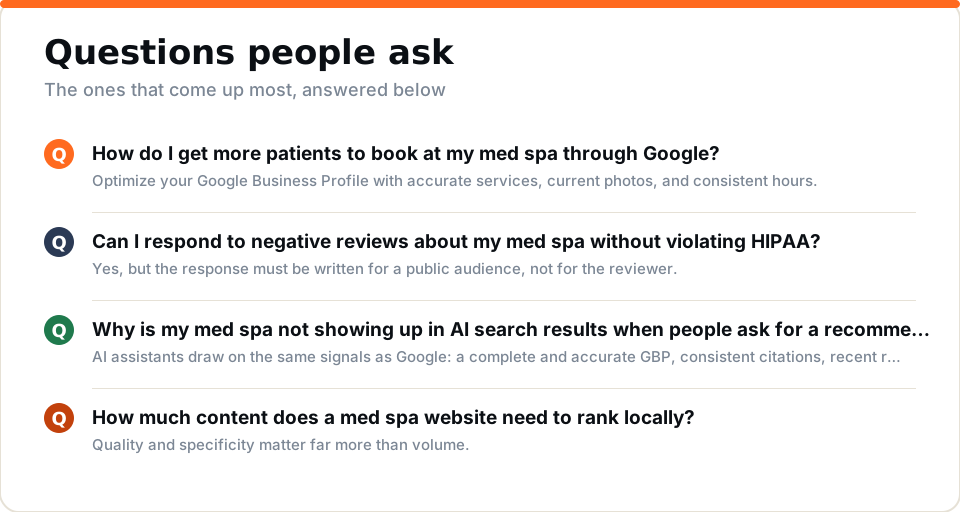
- How do I get more patients to book at my med spa through Google?
- Optimize your Google Business Profile with accurate services, current photos, and consistent hours. Build review velocity by asking satisfied patients within 24 hours of their visit. Strong organic local rankings and a trustworthy listing work together to convert the high-intent searches that happen right before someone books.
- Can I respond to negative reviews about my med spa without violating HIPAA?
- Yes, but the response must be written for a public audience, not for the reviewer. Never confirm that the person was a patient or reference any detail about their visit or treatment. A calm, professional response that expresses concern and invites the person to contact the practice directly is both compliant and reassuring to prospective patients reading it.
- Why is my med spa not showing up in AI search results when people ask for a recommendation?
- AI assistants draw on the same signals as Google: a complete and accurate GBP, consistent citations, recent reviews, and authoritative website content. Practices with thin or inconsistent local signals are less likely to be named. Improving those foundational signals over time increases the likelihood of appearing in AI-generated recommendations.
- How much content does a med spa website need to rank locally?
- Quality and specificity matter far more than volume. A handful of well-written service pages optimized for the specific treatments you offer, plus regular posts that address the actual questions prospective patients search for, will outperform a large library of generic wellness content that does not match local search intent.
- Is it enough to show up in the Google Map Pack for my main service?
- It is a strong signal but not complete coverage. Search results in 2026 include AI overviews, organic listings, local service ads, and AI assistant answers in addition to the map pack. A practice that monitors its full visibility picture across all these surfaces is in a structurally stronger position than one tracking only its map pack rank.
See where your own business stands.
We measure your local rankings, your listings, your website, and how AI assistants answer for your business. No signup required.
Or jump straight to pricing →