
Notes
AI Search Citations and GEO: How Local Businesses Get Named in AI Answers
Imagine a homeowner types "best plumber near me" into ChatGPT. Or a person dealing with back pain asks Perplexity to recommend a chiropractor in their area.
Reviewed by Melike Erguven, Co-founder of LocalLeadSignal · August 7, 2026 · 12 min read

Imagine a homeowner types "best plumber near me" into ChatGPT. Or a person dealing with back pain asks Perplexity to recommend a chiropractor in their area. The AI responds with a short, confident answer, names two or three businesses, and maybe drops a link or two. Your business is not one of them. That is not a Google ranking problem. It is a GEO problem.
Generative engine optimization is newer territory than traditional local SEO, but the core idea is not complicated. AI models cite sources they trust. The businesses most likely to show up in those answers are the ones that have given AI systems clear, consistent, and authoritative signals about who they are, what they do, and where they operate. This piece breaks down exactly what those signals are, why citations work differently in AI search than in a standard Google search, and what a small service business can do right now to improve its position without hiring an agency that starts at $1,500 a month and takes six months to return a call.
What GEO Actually Means for a Local Service Business
Generative engine optimization, or GEO, means structuring your content and your online presence so that AI models include your business in the answers they generate. It is distinct from traditional SEO in one fundamental way: there is no ranked list. A standard Google results page gives users ten blue links and a map pack. An AI search result gives users a synthesized paragraph, maybe a few cited sources, and a confident answer that feels final.
That shift changes everything about how visibility works. When someone asks ChatGPT which HVAC companies serve their area, ChatGPT does not return a list of websites and let the user decide. It makes a recommendation. If your business is not part of the information the model has access to, or if the information it has is thin and contradictory, you simply do not exist in that answer.
The three AI surfaces local customers are using most in 2026 are ChatGPT, Perplexity, and Google's AI Overviews. Each works a little differently under the hood, but all three share one behavior: they synthesize information from sources they consider reliable and authoritative, and they skip or deprioritize sources that are ambiguous, incomplete, or inconsistent.
Local service businesses are especially vulnerable here. A regional law firm, a dental practice, a physical therapy clinic, a plumbing company, these are businesses that rely on local customers, often do not have large content libraries, and may not have ever audited their online presence in a systematic way. Their Google Business Profile might be half-finished. Their address might be listed three different ways across twenty directories. Their website might have no schema markup at all. None of that blocked them from ranking in the map pack back when local SEO was the whole game, but AI search is less forgiving.
Traditional local SEO focuses on google map pack ranking, earning reviews, building backlinks, and optimizing a Google Business Profile so Google's algorithm puts you near the top of a location-based results page. GEO is one layer deeper: it is about whether the AI model processing a user's question has enough reliable, structured information to name your business with confidence. Both matter. They are not the same thing.
Why AI Models Cite Some Businesses and Skip Others
To understand why some businesses get named and others do not, it helps to know a little about how these systems work, without getting lost in jargon. Large language models like the ones powering ChatGPT and Perplexity do not have perfect, real-time knowledge of every business in the country. Many of them use a process called retrieval-augmented generation, or RAG, which means the model reaches out to indexed web content and trusted data sources to pull in current, relevant information before generating an answer.
What the model retrieves depends heavily on what is available and how trustworthy it looks. This is where NAP consistency becomes a direct GEO factor. NAP stands for name, address, and phone number, and when those three details match exactly across every listing, every directory, every citation, the AI system reading that data treats your business as a confirmed entity. When your name is spelled differently on Yelp than it is on your website, or your phone number on Bing Places is six months out of date, the model picks up on that inconsistency and loses confidence.
Entity confidence is the real currency here. AI models are not just looking for a business name. They are trying to confirm that an entity, a specific business with a specific identity and location, is real, categorized correctly, and described consistently across multiple independent sources. Local citations, meaning your listings on directories, niche data aggregators, chamber of commerce pages, and association websites, act as corroborating signals. The more places that independently confirm the same facts about your business, the more confident the AI model becomes that those facts are accurate.
Google's AI Overviews pull heavily from Google Business Profile data. That connection is not incidental. Google's own guidance on improving your local ranking confirms that completeness and accuracy in a GBP profile affect how Google surfaces a business in search. If your GBP is incomplete, missing service descriptions, lacking a business category, or using inconsistent information, that gap feeds directly into how confidently Google's AI surface can represent you.
Thin or contradictory data does not just fail to help. It actively causes AI models to skip a business in favor of one with cleaner, more consistent signals. Two businesses in the same zip code offering the same service will not be treated equally if one has 40 consistent citations and a complete GBP, and the other has 8 listings with mismatched addresses. The model cites the one it can verify.
The Role of Local Citations in AI Search Results
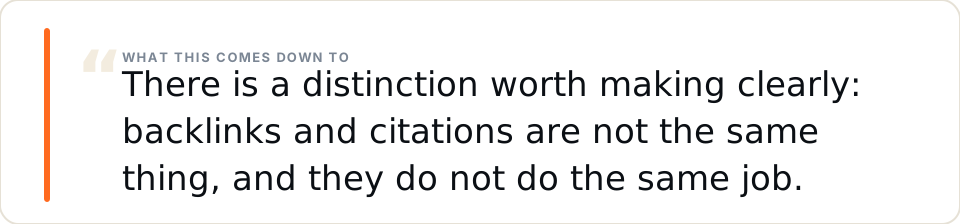
There is a distinction worth making clearly: backlinks and citations are not the same thing, and they do not do the same job. Backlinks pass authority signals that help with traditional search rankings. Citations, especially for local service businesses, pass entity verification signals that help AI models confirm your business is real, operating, and correctly categorized. Both matter for overall local SEO, but when you are optimizing for AI search citations and GEO specifically, citations deserve their own focused attention.
The citation types that carry the most weight for GEO purposes fall into two buckets. Structured citations are formal directory listings where your business information is entered into defined fields: Yelp, the Better Business Bureau, Healthgrades for healthcare practices, Avvo for attorneys, and niche directories relevant to your vertical. These carry high trust signals because they are organized, categorized, and maintained by platforms that AI models index consistently. Unstructured citations are mentions of your business in local news articles, blog posts, association pages, or community websites where your name and location appear in natural text rather than a formal listing. Both types help build the entity profile that AI models draw from.
AI models cross-reference multiple sources to confirm a business is what it claims to be. A chiropractor named in a structured Healthgrades listing, mentioned on a local chamber of commerce page, and referenced in a regional health blog is a much stronger entity signal than one that appears only on a single directory. The corroboration is the point.
A citation audit means going through every place your business is listed online, finding where information is missing or wrong, and fixing it. That includes tracking down old listings with outdated phone numbers, catching places where your business name has drifted slightly, and identifying major directories where you do not yet have a listing at all. Data aggregators like the major ones that feed information to hundreds of smaller directories at once are especially important to get right, because errors there can propagate broadly and quickly.
Citation building at scale used to require either a significant manual effort or expensive third-party tools. LocalLeadSignal handles this as part of what we do starting at $249 per month, including auditing your existing citations, correcting inconsistencies, and building out your presence in the directories that matter for your vertical. No contract, no marketing team required on your end.
Schema Markup and Structured Data: The Signals AI Can Read Directly
If citations are how AI models confirm your business from the outside, schema markup is how your own website communicates your identity directly to AI crawlers. Local business schema markup is a structured data format, a layer of code added to your website pages, that tells search engines and AI systems exactly what your business is, what it does, where it operates, and what other people say about it, in a format machines can parse without ambiguity.
Google's documentation on LocalBusiness structured data outlines the specific properties that matter most: business name, address, phone, hours, service area, business type, and more. When that information is coded into your page in a structured way, an AI model crawling your site does not have to infer anything. It reads the data directly.
For service businesses, the most useful schema types are LocalBusiness, Service, FAQPage, and Review. LocalBusiness schema establishes your entity identity. Service schema tells AI systems what specific services you offer and where. FAQPage schema marks up your questions and answers in a way that makes your content directly citable. Review schema surfaces ratings and testimonials in a structured format that reinforces credibility.
Healthcare and legal businesses have some additional considerations. A law firm benefits from using Attorney or LegalService schema to clarify its practice areas. A dental practice or physical therapy clinic gains clarity from more specific healthcare-related schema types that accurately reflect the kind of entity they are. The specificity matters because AI models categorize businesses by entity type, and a more precise classification means a more confident citation.
Schema does not replace good content. A page with accurate, helpful information and clean schema markup will outperform a thin page with perfect schema every time. But schema alongside good content makes that content dramatically more citable, because it removes the interpretive work the AI model would otherwise have to do on its own.
Content Signals That Make Your Business Citable in AI Answers
AI models are more likely to cite a page that itself references credible, verifiable sources. This is the concept of primary source authority: a service page that links to published clinical guidelines, industry association standards, or official regulatory resources signals to AI systems that it is not just an opinion, it is a reference. That does not mean stuffing footnotes into every paragraph. It means writing like someone who actually knows their field and can point to where their information comes from.
A well-structured service page with a clear, direct-answer lede is significantly more likely to be pulled into an AI Overview or Perplexity citation than a vague, meandering page that buries the key information three paragraphs down. If someone asks "what does a residential electrician do," the page that answers that question in the first two sentences, precisely and plainly, is the one the AI model is likely to quote. Write for the question, not the algorithm.
FAQ content is one of the highest-leverage moves a service business can make for both AI visibility and voice search. FAQPage schema combined with genuinely useful answers, written the way a real customer would ask the question, trains AI models to treat your site as a reference for that topic. Voice search and AI assistant queries share the same conversational phrasing patterns, so a page optimized for one tends to perform well in the other. This is also where you can connect naturally to the broader subject: understanding how AI platforms source local business information makes it easier to write content that fits how those systems work.
Publishing more pages does not help GEO if those pages are thin. A pile of 300-word city pages with no original information is not a citation signal, it is noise. One solid service page that directly answers the questions your customers are asking, links to credible external sources, carries proper schema, and matches your NAP information exactly will do more for your AI search visibility than twenty placeholder pages.
Content quality and citation signals work together. They are not separate strategies. The businesses getting named in AI answers have usually done both: built consistent citations across the web and published content that AI systems find specific and trustworthy enough to quote.
Source: Pew Research Center, 2025
How to Start Improving Your AI Visibility Without Starting from Scratch
Most small service business owners are not going to find time to rebuild their entire online presence in a weekend. The good news is that the highest-impact changes follow a clear order, and you do not have to do everything at once.
Start with NAP consistency. Before anything else, audit your name, address, and phone number across every major directory and data aggregator. Look for variations in how your business name is formatted, old addresses that never got updated, and phone numbers that point to old lines. Fixing these inconsistencies is foundational because everything else builds on it. A clean entity identity is the prerequisite for AI systems to trust you.
Fully complete your Google Business Profile. Not just the basics, the services section, the business description, the primary and secondary categories, the hours, and the photo content. GBP optimization feeds directly into AI Overviews, so an incomplete profile is a direct gap in your AI search visibility. Google's own guidance on this is worth reading closely.
Add or fix local business schema on your homepage and key service pages. If your site has no structured data, that is the next priority. At minimum, implement LocalBusiness schema with your full entity details. Add Service schema to individual service pages and FAQPage schema to any page with a question-and-answer section.
Claim and correct your top vertical-specific directory listings. Identify the five to ten directories most relevant to your industry, whether that is Healthgrades for a clinic, Avvo for a law firm, Houzz for a contractor, or the BBB for most service businesses, and make sure your listing on each one is complete, accurate, and consistent with your NAP.
Update at least one cornerstone content page. Pick your most important service page and rewrite the lede to directly answer the question a customer would ask. Add an internal FAQ section with real questions and structured answers. Link to one or two credible external sources that support your claims.
If that list sounds manageable, great, start working through it. If it sounds like one more project you do not have time for, LocalLeadSignal does all of this for service businesses starting at just $249 per month, with no contract and no marketing team required on your end. We handle the tracking, the citation management, the GBP optimization, the schema, and the ongoing AI visibility work, so you can focus on running your business.
Getting cited in AI search answers is not a separate strategy from local SEO. It is the next layer of it. Businesses that have consistent citations, clean schema, a complete Google Business Profile, and well-structured content are already building the foundation AI models need to trust them enough to name them.
The gap between businesses that appear in AI answers and those that do not comes down to one thing: how clearly and consistently they have communicated their identity and expertise across the web. Inconsistent data, missing schema, and vague content all create doubt in the AI system's confidence, and a doubtful AI model picks the competitor instead.
LocalLeadSignal handles all of this for small service businesses starting at $249 per month, no contract, no marketing team required. See how your business currently looks in AI search and get a free visibility snapshot. See what a plan covers and find out what showing up in AI answers could look like for you.
Frequently asked questions
- Why do businesses that cite primary sources show up more in AI search answers?
- AI models favor pages that demonstrate authority and accuracy. When your content links to or references credible primary sources like official associations, published guidelines, or industry data, it signals reliability. That makes your page a stronger candidate for the model to pull from and cite when answering a related question.
- What is the difference between local citations and AI search citations?
- Local citations are directory listings that confirm your business name, address, and phone number across the web. AI search citations are references to your content or profile inside a generated AI answer. Both matter for GEO because consistent directory citations help AI models verify your business as a real, trustworthy entity worth citing.
- Do I need to be on every AI platform to show up in AI search results?
- Not exactly. The signals that drive AI visibility, consistent citations, optimized profiles, schema markup, and clear content, work across platforms. Improving those fundamentals makes your business more citable on ChatGPT, Perplexity, Gemini, and AI Overviews simultaneously rather than requiring separate strategies for each.
- How does Google Business Profile affect AI search visibility?
- Google's AI Overviews pull directly from Google Business Profile data, so an incomplete or inconsistent GBP hurts your chances of being included in those answers. A fully filled-out profile with accurate categories, services, descriptions, and photos gives the AI model more to work with and strengthens your entity signal overall.
- Can a small service business with no marketing team realistically improve its GEO?
- Yes. The core GEO improvements, fixing citation consistency, completing your Google Business Profile, adding schema markup, and restructuring key content pages, are achievable and manageable. Services like LocalLeadSignal handle all of it for you starting at $249 per month with no contract, so you do not need an in-house team.
See where your own business stands.
We measure your local rankings, your listings, your website, and how AI assistants answer for your business. No signup required.
Or jump straight to pricing →