
AI visibility
ChatGPT Local Business Visibility: How to Show Up in AI Search in 2026
ChatGPT local business visibility means showing up by name when someone asks an AI assistant to recommend a business like yours.
Reviewed by Melike Erguven · June 15, 2026 · 7 min read
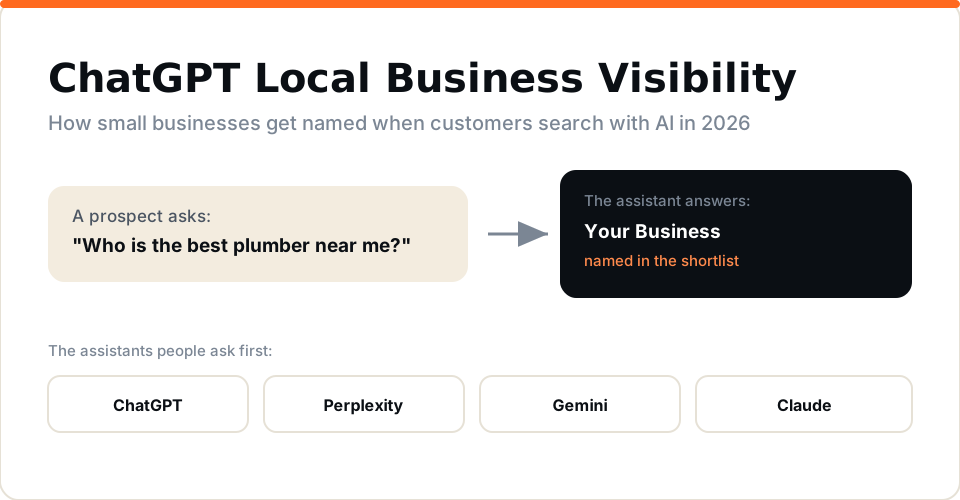
ChatGPT local business visibility means showing up by name when someone asks an AI assistant to recommend a business like yours. A growing share of customers now open ChatGPT, Gemini, or Perplexity before they ever reach Google, and a question like "who is the best plumber near me" returns a short list of names rather than a page of links. If your business is not on that list, you were never in the running.
The reassuring part is that none of this is magic, and you do not need a big marketing team or an expensive retainer to compete. This guide explains how AI assistants decide which local business to recommend, why that decision rests on the same foundation as local SEO, and the practical steps any small business can take this month to get found.
How ChatGPT actually answers a "find a local business" question
When someone opens ChatGPT and types "find me a good plumber near me," the model is not running a live Google search the way most people assume. It is doing something more layered, and understanding the difference shapes your whole strategy.
Large language models are trained on enormous amounts of web content: business websites, review platforms, directories, and local news. When a user asks a location question, the model surfaces names and recommendations that match the patterns it has learned. If your business has a strong, consistent footprint across those sources, you are far more likely to appear. If your presence is thin or inconsistent, you are effectively invisible to the model.
There is an important distinction to understand. ChatGPT has two modes that affect local results differently. In its standard, knowledge based mode, it relies on what it learned during training, which has a cutoff date. In its browsing enabled mode, it reads live web pages, so a fast, well structured site has a much better chance of being cited in real time. Both modes reward the same behavior: a clear, credible, and well organized digital presence.
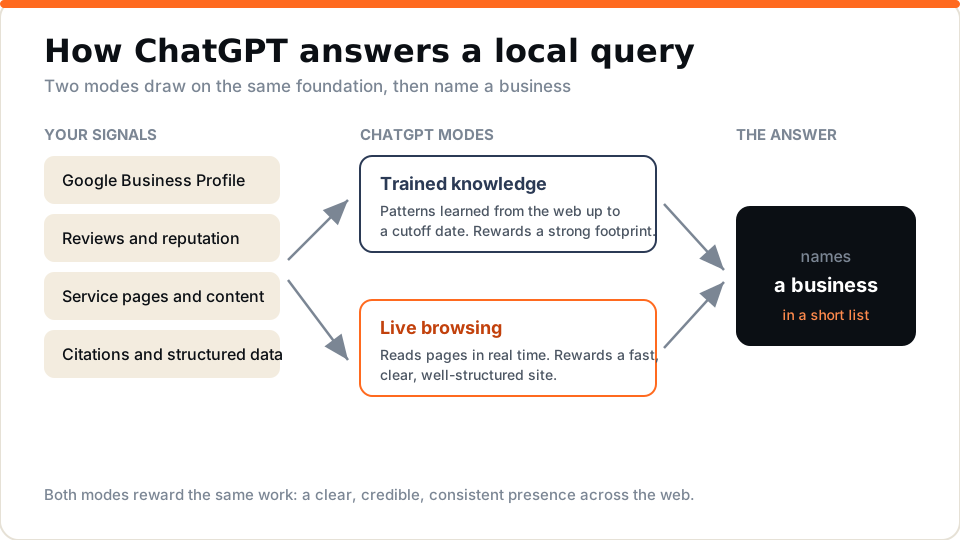
The model is not picking names at random. It is pattern matching against signals of authority and relevance, which is exactly why AI search visibility and traditional local rankings are far more connected than they first appear.
Why your Google presence still powers your AI visibility
Here is something reassuring for any owner who feels overwhelmed by the idea of optimizing for AI: almost everything you do to improve your Google presence also strengthens your AI visibility. The two systems feed each other more than they compete.
AI tools tend to validate businesses that already have credible digital footprints. A fully built out Google Business Profile, a website with clear on page content, and a steady stream of genuine reviews all function as trust signals that the models recognize. If your Google presence is strong, your AI presence is already ahead of most competitors. Our complete local SEO guide for 2026 walks through the profile and the rest of that foundation end to end.
Reviews are a direct input into how AI tools perceive your business. When an assistant encounters a business with many recent, detailed reviews, it treats that business as more credible than one with a handful of old ones. Responding to reviews matters too, because it shows engagement and adds fresh, relevant text to your profile. Site speed and technical health factor in as well: a slow or broken site creates friction that AI tools, like human visitors, quietly move past.
To be clear, strong signals improve your likelihood of appearing in AI recommendations. They do not guarantee a specific ranking, because search and AI systems are complex and results vary by market, query, and competition.

The signals AI assistants trust most
AI models are pattern recognition engines, and they are very good at spotting a business that looks inconsistent or unreliable. A few signals do most of the work.
- Name, address, and phone consistency. When your details appear identically across every directory and listing, the model can confidently confirm you are one real business. Conflicting information introduces doubt.
- Structured data on your pages. Schema markup tells machines what you do and where, in a format built for retrieval. Google's structured data documentation and the schema.org LocalBusiness vocabulary are the references for the fields to include.
- Reviews and reputation. Volume, recency, and your responses all feed the model's sense of who is trustworthy and active.
- Content that answers the question. If a prospect asks what a service costs or how to choose a provider, the businesses that already answer those exact questions on their sites are the ones most likely to be cited.
- Citations and mentions. A mention in a respected directory, your local chamber, or a community news story reads as a credibility vote the model can lean on.
Notice that the two heaviest levers, consistent listings and reviews, are also the two you can improve fastest.
What to do this month: a four stage plan
The full playbook is simpler than it looks. It breaks into four stages that build on each other.
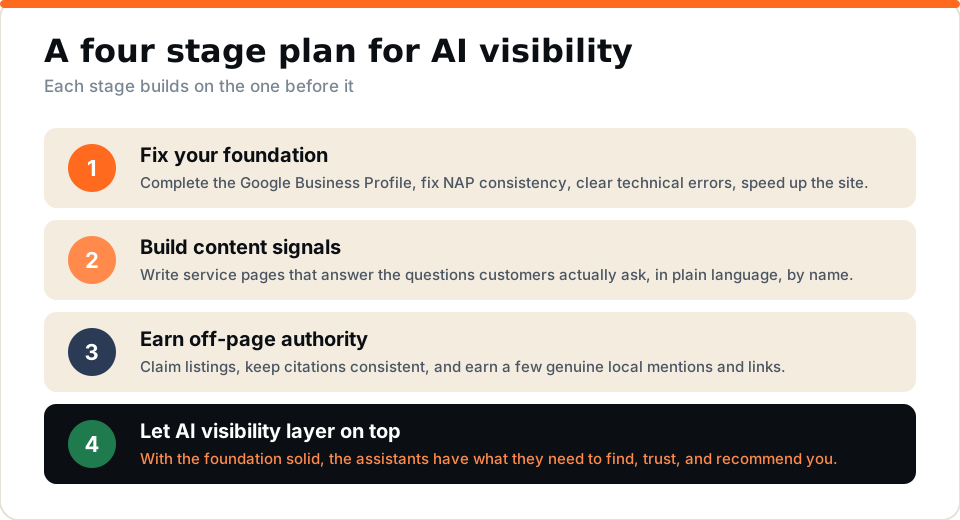
- Fix your foundation. Complete and verify your Google Business Profile, correct any name, address, or phone inconsistencies, resolve technical errors, and make sure the site loads fast. A shaky foundation limits everything built on top of it.
- Build your content signals. Write clear service pages that answer the specific questions your customers actually ask. Add a short FAQ. Describe who you help, what you do, and where you do it, in plain language.
- Earn off-page authority. Claim your listings, keep citations consistent, and pursue a few genuine local mentions and links from your community.
- Let AI visibility layer on top. Once the foundation, content, and authority are solid, the assistants have what they need to find you, trust you, and recommend you.
AI visibility and local SEO are the same foundation
It would be easy to read all this and conclude you now have two jobs. You do not. AI visibility rests on the exact foundation that local SEO already rewards. The assistants read your profile, your reviews, your service pages, and your citations to decide who to name, and those are the same assets that decide whether you sit first or fifth on the map.
That is why the right move is not to chase the assistants with tricks. It is to build the local foundation well and let AI visibility follow. We make the strategic case in why AI visibility is the next channel small businesses cannot ignore, and we go deeper on the four engines in AI visibility for local business. For a hands on starting point, the local SEO audit checklist gives you the foundation work in a form you can run today.
Common questions about ChatGPT local business visibility
Is showing up in ChatGPT different from SEO?
It is a new surface running on familiar fuel. The engine is different, an assistant that names a business rather than a list of links, but the inputs are the same profile, reviews, content, and citations that drive local SEO.
How long does it take to see movement?
Some of it moves quickly. Fixing inconsistent listings and adding structured data can change what the assistants retrieve within weeks. Reputation and content compound over a few months, the same horizon as local SEO.
Can I do this myself?
Much of it, yes. Claiming your profile, asking for reviews, and writing a clear service page are all within reach. The harder parts are staying consistent every month and knowing which gap to close first, which is exactly where a tool or a managed service saves you the guesswork.
The bottom line
ChatGPT local business visibility is not a distant mystery reserved for big brands. It is the natural extension of doing local SEO well: being findable, being trustworthy, and publishing content that clearly explains who you are and what you do. The businesses winning in AI search are not the biggest ones. They are the most consistently optimized ones.
LocalLeadSignal handles all of it, starting at $249 a month with no contract. From tracking your visibility to managing your SEO, listings, reviews, and AI presence, the work is done for you. Run a free visibility check to see where you stand across both Google and the AI assistants, or compare plans and pricing to get started.
See where your own business stands.
We measure your local rankings, your listings, your website, and how AI assistants answer for your business. No signup required.
Or jump straight to pricing →