
Notes
Chiropractor AI Search Visibility in 2026: How to Get Your Practice Found Beyond Google
Imagine a prospective patient sitting on their couch with a stiff lower back.
Reviewed by Melike Erguven, Co-founder of LocalLeadSignal · July 29, 2026 · 12 min read

Imagine a prospective patient sitting on their couch with a stiff lower back. Instead of opening a browser and typing into Google, they just ask ChatGPT: "who's a good chiropractor near me for lower back pain?" A few seconds later, they get a confident, conversational answer that names three local practices by name, summarizes what each one treats, and maybe even notes that one has great reviews. Yours isn't in the list. And the frustrating part is your Google rankings still look fine.
That's the visibility gap most chiropractic practices are running into right now. It's not showing up in their analytics because AI search doesn't always send referral traffic. It's just quietly redirecting patients before they ever reach a search results page.
This is a plain-language walkthrough of what AI search actually means for chiropractors, why many practices are invisible in it despite solid local SEO, and what a solo or small-group practice can do about it without hiring a full marketing team or paying agency-level retainers.
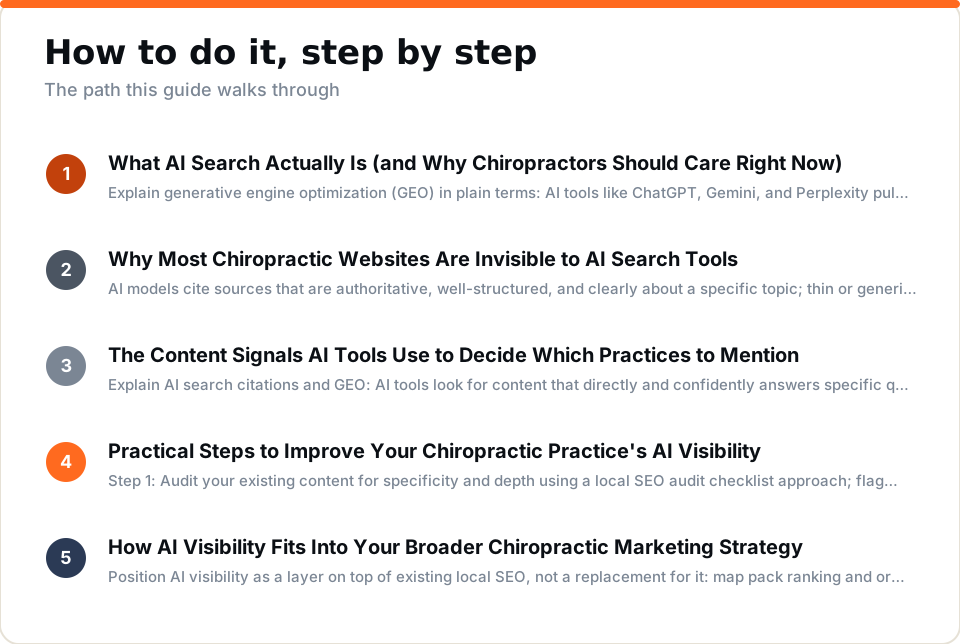
What AI Search Actually Is (and Why Chiropractors Should Care Right Now)
Traditional search gives you a list of links and lets you click around. AI search is different. Tools like ChatGPT, Gemini, and Perplexity read across dozens of sources, synthesize what they find, and hand you a direct answer in plain language. No link list to scroll. Often no reason to click at all.
That shift has a name in the SEO world: generative engine optimization, or GEO. The idea is that getting "cited" by an AI tool is becoming its own visibility channel, separate from ranking on page one or showing up in the Google map pack. These are genuinely different places a patient might encounter your practice, or not encounter it.
Patient search behavior has been moving toward conversational queries for a while. Voice search started that trend. AI tools have accelerated it significantly. Someone dealing with sciatica or a stiff neck after an accident is increasingly likely to describe their symptoms in a full sentence and ask for guidance before they ever open a browser tab. Those symptom-based, conversational questions are exactly what AI tools are built to answer.
Chiropractic is particularly exposed to this pattern. Patients rarely search for a practice by name when they don't already have one in mind. They search for help with a condition: lower back pain, headaches, numbness in the arm, disc issues. AI tools intercept those condition-based questions and give answers that either include a local practice recommendation or don't. If your practice doesn't have content that directly addresses those conditions in specific, useful language, you're not in the running to be cited.
The good news is that this is an early-mover situation, not a crisis. Most chiropractic practices haven't thought about chiropractor AI search visibility at all yet. The practices that start building the right signals now will have a real advantage over the ones that wait.
Why Most Chiropractic Websites Are Invisible to AI Search Tools
AI tools don't cite sources randomly. They favor content that is authoritative, specific, clearly structured, and demonstrably about a well-defined topic. Most small practice websites weren't built with that bar in mind, and many were never built with any particular SEO strategy behind them either.
The most common problem is thin content. A page that says "we treat back pain, neck pain, and headaches" and then lists a phone number doesn't give an AI model enough to work with. There's no depth, no specificity, no demonstration of expertise. Compare that to a page that explains what causes a herniated disc, what a chiropractic assessment for that condition looks like, and what a patient can realistically expect from treatment. The second one is citable. The first one is essentially invisible to AI.
Missing local business schema markup compounds the problem. Schema is structured data embedded in a website's code that tells search engines and AI crawlers exactly what a business is, where it's located, what it does, and who it serves. Without it, an AI tool has to guess at that context from surrounding text. Sometimes it gets close. Often it just moves on to a source that makes its identity clearer.
NAP consistency matters too, and it works indirectly. AI tools cross-reference signals from multiple sources: your website, directories, review platforms, and third-party aggregators. If your name, address, and phone number appear differently across those sources, that inconsistency signals unreliability. It's a small thing that quietly chips away at your credibility as a citation source.
Practices that put most of their effort into map pack ranking often have a well-optimized Google Business Profile but very little indexable written content for AI to actually pull from. A great GBP is genuinely valuable, but it's not a substitute for having substantive content on your own site. These two things serve different purposes now.
One more layer: healthcare content carries a higher trust bar with AI tools. Generic copy doesn't signal expertise. Content that is specific to conditions, treatment approaches, and patient experience does. The gap between "we help with back pain" and a real condition page is the gap between being invisible and being citable.
The Content Signals AI Tools Use to Decide Which Practices to Mention
For a chiropractic practice to show up in AI search answers, the content has to be what researchers in this space call "citable." That means it directly and confidently answers the kind of question a patient might actually ask. It doesn't hedge. It doesn't bury the useful information under marketing language. It gets to the point.
Condition pages are the clearest example of this done right. A page dedicated to sciatica that explains what it is, what typically causes it, how chiropractic care approaches it, and what a patient can expect from a few sessions, written in plain language, is something an AI tool can actually use. FAQ sections work similarly. Structured "how it works" explanations work well too. What they all share is that they answer a specific question directly, rather than promoting the practice in vague terms.
Local citations and NAP consistency play a role here that's easy to underestimate. AI tools don't only read your website. They absorb data from aggregators, directories, and review platforms as part of building their picture of who a business is and whether it can be trusted. Consistent, accurate citations across those sources function as a trust signal, not just for traditional local SEO but for the AI tools that cross-reference that data when forming answers.
Local business schema markup is one of the most concrete technical steps a practice can take. Properly implemented schema tells AI crawlers, in structured, unambiguous language, that this is a chiropractic practice, at this location, treating these conditions, operating these hours. Healthcare-specific schema adds another layer of specificity. This isn't magic, but it does remove ambiguity that might otherwise push an AI tool toward a source it can classify more easily.
Google reviews feed into this more than most practitioners realize. The language patients use in reviews, describing what brought them in, how they felt before and after, what the experience was like, often mirrors the conversational queries other patients are typing into AI tools. Review content is effectively patient-generated, naturally conversational content that AI tools can pick up on. That's separate from how review volume and sentiment influence trust signals more broadly.
Voice search local SEO ties into all of this neatly. The conversational phrasing that patients use in voice search ("what's a good chiropractor for neck pain near downtown") is essentially the same format as AI search queries. Optimizing content to match that natural, spoken-language style helps across both channels simultaneously. You can read more about building these AI visibility signals for local practices if you want a deeper look at how the mechanics work.
Practical Steps to Improve Your Chiropractic Practice's AI Visibility
None of this requires doing everything at once. The practices making the most progress are working through it step by step, building on each piece.
Start with a content audit. Go through your existing pages and ask honestly: does this page answer a specific question a patient would actually ask? Flag anything that is thin, purely promotional, or so generic it could describe any practice anywhere. A local SEO audit checklist approach works well here: list every page, note its topic, and note whether it has real depth or just placeholder copy.
Build or refresh condition and treatment pages. Each major condition you treat deserves its own page written in the kind of language a patient would use to describe it. Chiropractic long-tail keywords like "chiropractic care for lower back pain after sitting all day" or "can a chiropractor help with tension headaches" reflect how patients actually search. Those phrases also match conversational AI queries almost exactly. If you already have condition pages that are a few years old and ranking poorly, don't abandon them. Refreshing underperforming content by adding depth and updating the framing often works better than starting from scratch.
Add local business schema markup. This is a technical step, but it's not optional anymore. At a minimum, your site should have LocalBusiness schema that identifies your practice type, location, services, and contact information. Healthcare-specific schema adds classification detail that helps AI tools understand your specialty. If you're not sure whether your site has any schema in place, a free schema testing tool will tell you immediately.
Strengthen your local citations. Run your NAP information through the major directories and aggregators and fix anything that's inconsistent. This is foundational local SEO work, and as described above, it has a direct bearing on how confidently AI tools treat your practice as a reliable source. Local citations and traditional local SEO rankings benefit from the same cleanup.
Collect and respond to Google reviews consistently. Review volume matters. Review content matters. And responding to reviews, including critical ones, signals that a real, engaged practice is behind the listing. According to Google's own guidance on improving your local ranking, responding to reviews is one of the factors Google considers when evaluating a business's relevance and credibility. That guidance carries over into AI tools that integrate Google data.
Fully optimize your Google Business Profile. Services, Q&A, updated posts, accurate categories, and complete attributes all feed into how well your GBP performs. Gemini in particular pulls heavily from Google's own ecosystem, so a well-built GBP is part of your AI visibility strategy, not just your map pack strategy. If you want to walk through the full picture of how GBP and on-site SEO work together for chiropractic practices, there's a detailed breakdown worth reading.
How AI Visibility Fits Into Your Broader Chiropractic Marketing Strategy
AI search visibility isn't a replacement for local SEO. It's a layer on top of it. The map pack still drives meaningful patient volume. Organic rankings still matter. The practices doing well in 2026 aren't abandoning what works in traditional search; they're extending their visibility into a new channel.
The overlap is significant and worth emphasizing. Content that earns AI citations because it's specific, authoritative, and well-structured also tends to rank well in traditional search and show up in featured snippets. Voice search benefits from the same conversational content optimization. These strategies reinforce each other rather than compete.
Online reputation management sits at the center of all of it. Strong review volume and positive sentiment helps across Google search, map pack rankings, AI tool answers, and patient word of mouth simultaneously. It's one of the few investments in chiropractic practice marketing that pays dividends in every direction.
A lot of practitioners have expressed concern that AI search will cannibalize their web traffic, and Pew Research Center data does show that Google users are less likely to click on links when an AI summary appears in results. That's real. But the reframe that matters for chiropractic is this: being named in an AI answer is a trust signal in itself. A patient who hears your practice's name from ChatGPT before they've heard it anywhere else is going to search for you specifically. Being mentioned positions you as the credible local authority, whether or not the patient clicks in that moment.
The practices waiting for AI search to "stabilize" before paying attention are already ceding ground. The signals that influence AI citations, content depth, schema, citations, reviews, are being established right now, and they compound over time. Waiting six months to start means being six months behind practices that are already building that credibility.
Source: Pew Research Center, 2025
What to Look for in a Partner Who Actually Handles This Work for You
If you've read through all of this and your first thought is "I don't have time to do this myself," you're not alone. Most chiropractors running a small practice are also managing scheduling, clinical care, billing, and staff. Adding a content strategy, schema implementation, citation cleanup, review management, and AI visibility tracking on top of that is genuinely a lot.
The problem is that most SEO companies pricing their services above $500 per location assume you already have someone in-house to coordinate with, review deliverables, and keep things moving. That's a reasonable assumption for a multi-location group. It's not realistic for a solo practitioner or a small two-doctor practice.
Done-for-you local SEO should actually mean done for you. That includes tracking how your practice appears across AI tools and traditional search, managing your directory listings, building and maintaining citations, monitoring reviews and helping you respond to them, and creating the kind of citable content that helps you show up in AI answers. If a vendor pitches AI visibility but can't explain specifically which signals they're optimizing or how they measure it, that's worth pressing on before you sign anything.
LocalLeadSignal starts at $249 per month with no contract. The service covers tracking, SEO, listings, reviews, and AI visibility as a single package, not a menu of add-ons that escalates quickly. The reasoning behind that model is straightforward: small practices shouldn't have to choose between ranking in the map pack and showing up in AI search because they can't afford to do both.
If you're evaluating options and comparing tools like BrightLocal against done-for-you services, the key question is whether you want to run the tools yourself or have someone run the whole thing. BrightLocal is a solid platform if you have time and know-how to act on the data it surfaces. A done-for-you service is better suited for practices that want the outcomes without the operational lift. Both have a place; the right choice depends on your bandwidth.
Ask any prospective vendor two direct questions: how do you measure AI search visibility specifically for a chiropractic practice, and what does your process look like in the first 90 days? If the answers are vague, keep looking.
AI search visibility for chiropractors isn't a future concern you can schedule for later. It's already shaping how patients in your area find care, right now, in 2026. The bright side is that the practices building that visibility aren't doing anything exotic. They're doing the fundamentals better: deeper content, cleaner citations, more and better reviews, and proper schema that tells AI tools exactly who they are and what they treat. None of that requires a massive budget or a dedicated marketing department.
If you'd rather have someone handle this for you than figure it out piece by piece, see exactly where your practice stands in AI and local search with a free visibility check from LocalLeadSignal. No contract, no pressure. Just a clear picture of what's working and what needs fixing.

Frequently asked questions
- Why is my chiropractic website invisible in AI search results?
- AI tools like ChatGPT and Perplexity favor content that is specific, well-structured, and clearly authoritative. Most chiropractic websites use generic copy without detailed condition pages, proper schema markup, or strong citation signals, which means AI tools have little to pull from when a patient asks a relevant question.
- Does AI search visibility replace regular local SEO for chiropractors?
- No, it builds on top of it. Your Google Business Profile, map pack ranking, and organic search results still drive significant patient volume. AI visibility is an additional channel. The good news is that most of the work overlaps: better content, cleaner citations, and more reviews help across all channels at once.
- What kind of content helps a chiropractor show up in AI answers?
- Specific, conversational content that directly answers patient questions tends to get cited by AI tools. Think dedicated pages for conditions you treat, FAQ sections, and clear explanations of what to expect during a visit. The more your content reads like a confident expert answer, the more citable it becomes.
- How do Google reviews affect chiropractor AI search visibility?
- Review content is a real input for some AI tools, especially those that integrate Google data. The language patients use in reviews often mirrors the conversational queries people type into AI search. A steady volume of detailed, positive reviews strengthens your authority signal across both traditional and AI-driven search.
- How much does it cost to improve AI search visibility for a chiropractic practice?
- Most agencies charge $500 or more per location and expect you to have a marketing team in place. LocalLeadSignal starts at $249 per month with no contract and handles SEO, listings, reviews, and AI visibility for you, making it a realistic option for solo and small-group practices.
See where your own business stands.
We measure your local rankings, your listings, your website, and how AI assistants answer for your business. No signup required.
Or jump straight to pricing →