
Notes
Chiropractor SEO in 2026: How to Get Your Practice Found Online Without a Big Agency Budget
If you've been practicing for years, built real relationships in your community, and still rely heavily on word-of-mouth to keep your schedule full, you're not alone. A lot of chiropractors are in exactly that position.
Reviewed by Melike Erguven, Co-founder of LocalLeadSignal · July 1, 2026 · 13 min read
If you've been practicing for years, built real relationships in your community, and still rely heavily on word-of-mouth to keep your schedule full, you're not alone. A lot of chiropractors are in exactly that position. The frustrating part is watching a newer clinic down the street consistently show up first in Google search and the map pack, even when your care is objectively better. That disconnect happens all the time, and the reason is almost never the quality of treatment. It's visibility.
Chiropractor SEO is the collection of signals, settings, and habits that tell Google and AI search tools where you are, what you treat, who you serve, and why you're worth trusting. Get those signals right, and patients looking for help with back pain or a pinched nerve find you first. Get them wrong, or just ignore them, and someone else gets that appointment. This guide walks through the core pillars in plain language, explains what actually moves the needle for a single-location chiropractic practice, and shows how you can build real search visibility without hiring a full marketing team or signing a long-term agency contract.
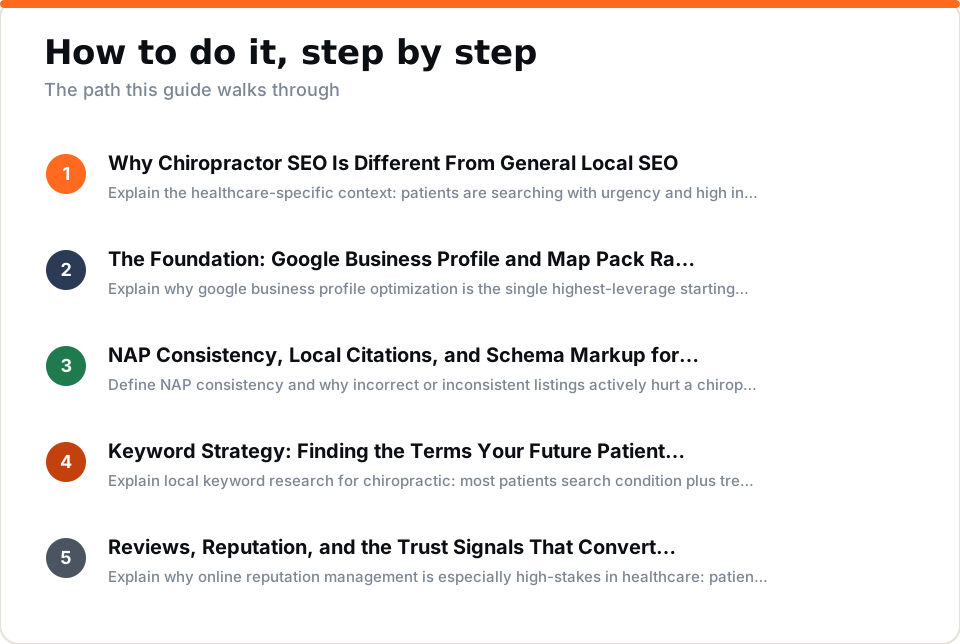
Why Chiropractor SEO Is Different From General Local SEO
When someone searches for a restaurant, they're usually in browse mode. They might tap through three or four options, check the photos, and decide based on vibe. A chiropractor search is completely different. The person typing "sciatica treatment near me" at midnight is in pain and wants help fast. That urgency changes everything about how local SEO needs to work.
Healthcare local SEO operates on a much higher trust threshold than retail or restaurant SEO. A patient isn't just choosing where to spend money. They're choosing who touches their body and manages their physical health. That means your credibility signals, your reviews, your credentials, and the consistency of your information online all carry more weight than they would for a pizza place. Patients read carefully before they book.
There's also a compliance layer that shapes what you can and can't do. HIPAA compliant marketing isn't just a legal checkbox. It's a real guardrail that affects how you ask for reviews, what you can say in testimonials, and how you reference patient outcomes in content. You can't publish a patient's story without explicit authorization that meets HIPAA standards, even if the patient is thrilled with their results. Ignoring that guardrail creates liability, so smart chiropractic marketing works within it from the start.

The other big distinction is local SEO vs traditional SEO. Traditional SEO chases organic blue-link rankings on page one. That still matters, but for most chiropractic patient journeys, the Google map pack is where the decision gets made. The three businesses that appear in that map pack get a disproportionate share of clicks, calls, and direction requests compared to everything below. Ranking in the map pack requires a different strategy than ranking in organic results, and a chiropractic practice that focuses only on blogging while neglecting its local signals will consistently lose to a competitor who got the map pack right.
Finally, chiropractor AI search visibility is becoming a real factor on top of everything else. Tools like ChatGPT and AI-powered search overviews are pulling local business information into answers. That's a newer layer, not a replacement for traditional SEO, and we'll come back to it. But it's worth knowing upfront that what you build for local search also feeds what AI tools say about your practice.
The Foundation: Google Business Profile and Map Pack Ranking
If you could only fix one thing about your chiropractic practice's online presence, your Google Business Profile would be it. Google Business Profile optimization is the single highest-leverage starting point for any local healthcare provider. It feeds the map pack, it influences AI search results, and it's free to use. Most practices set it up once, never revisit it, and leave a significant amount of visibility on the table.
The basics matter more than most people realize. Your primary category should be "Chiropractor," which seems obvious, but secondary categories like "Sports Medicine Physician" or "Massage Therapist" (if applicable) can help you appear for adjacent searches. Your services section is where a lot of practices go thin. Fill it out specifically: spinal adjustments, decompression therapy, sports injury treatment, auto accident care, pediatric chiropractic. Each service you list is a potential match for a patient search.
Attributes are easy to overlook and genuinely worth your time. Things like wheelchair accessibility, online appointment booking, and whether you accept new patients can influence both visibility and click-through rates. Google uses these signals to match profiles to specific search queries, so the more accurately your profile describes your practice, the better your google map pack ranking potential. Start with a thorough look at your profile settings to find the settings that are most commonly incomplete.
Common GBP mistakes chiropractors make include mismatched addresses (suite numbers formatted differently across platforms), phone numbers that forward to an answering service listed as the main number, zero service descriptions, and an ignored Q&A section. The Q&A section is especially valuable because you can seed it with the questions patients actually ask, like "Do you treat car accident injuries?" or "Do I need a referral?" Those questions index in Google and can show up directly in search results.
Your GBP also powers google maps marketing in a direct way. When a patient searches for a chiropractor, sees your profile, clicks for directions, and shows up at your door, that entire journey started with your GBP. Getting it right isn't a one-time task. Posting updates, adding photos, and keeping hours accurate all send freshness signals that support your map pack position over time. A good content approach for that ongoing activity is covered in detail in this guide to GBP content for medical practices.
NAP Consistency, Local Citations, and Schema Markup for Chiropractors
NAP stands for Name, Address, and Phone Number. These three pieces of information appear across dozens of directories, data aggregators, and healthcare platforms across the web. When they're consistent everywhere, Google sees a coherent, trustworthy signal. When they're inconsistent, with your suite number missing on one site, an old phone number on another, and a slight name variation on a third, Google's confidence in your listing drops, and your rankings follow.
NAP consistency matters even more for chiropractic practices because patients often cross-reference multiple platforms before booking. If they find conflicting information, some will simply move on to a competitor. Auditing and correcting your listings isn't glamorous work, but it's foundational.
Local citations for healthcare include both general directories and health-specific platforms. The ones that carry the most weight for a chiropractic practice include Healthgrades, WebMD, Zocdoc, Yelp, and the core data aggregators that feed hundreds of smaller directories downstream. Chiropractic directory citations also include condition-specific and professional association directories. Each accurate citation reinforces your legitimacy and local relevance in Google's eyes.
Citations vs backlinks is a question that comes up a lot. At the early stages of building local visibility, citations tend to have more direct impact because they establish the foundational signals Google uses for map pack ranking. Backlinks, particularly local link building from community organizations, local news, or related healthcare providers, matter more as your practice matures and you're competing in a more saturated market. Both matter. Citations come first.

Local business schema markup is a structured data layer you add to your website that helps search engines understand exactly what your practice is, where it's located, and what services you provide. For a chiropractic practice, schema should include your business name, address, phone, hours, and service types. Schema markup healthcare legal considerations are real: you want to avoid any structured data that could be read as making specific medical outcome claims, and you should not include patient-identifiable information anywhere in your schema. Done correctly, schema markup supports featured snippets, AI search citations, and rich search results.
Getting all of this right is ongoing, not a one-time task. Directories update their data, aggregators push changes, and your own practice information may change over time. A citation that's correct today can drift without active management.
Keyword Strategy: Finding the Terms Your Future Patients Actually Use
Most patients don't search for "chiropractor." They search for their problem. That's the single most important thing to understand about local keyword research for chiropractic. Someone with a herniated disc isn't typing your specialty. They're typing "lower back pain relief" or "sciatica treatment" or "car accident injury doctor." Your keyword strategy has to meet them where they are.
Long-tail local keywords are where chiropractic practices have the most opportunity. These are specific, multi-word phrases that reflect real patient intent. Back pain keywords like "chronic lower back pain treatment," sciatica SEO keywords like "sciatica leg pain relief," and care-specific terms like "sports adjustment for runners" or "pediatric chiropractic for kids" all represent searches with high intent and lower competition than broad terms. These are the phrases that bring in patients who are ready to book, not just browsing.
Mapping keywords to the right pages matters. Your homepage should target your core practice identity and location. Individual service pages should each target a specific condition or treatment type, with keyword-focused headings, descriptions, and FAQs. Blog content can target the question-based and educational searches, things like "how long does it take for a chiropractic adjustment to work" or "is chiropractic care safe during pregnancy." Each layer of content serves a different intent and a different stage of the patient's decision.
Voice search local SEO is worth taking seriously, especially for chiropractic. When someone is hunched over in back pain, they're not carefully typing a query. They're asking their phone out loud: "Who is the closest chiropractor open on Saturday?" or "What can I do for sciatica pain right now?" Those conversational queries favor content written in plain, natural language with direct answers near the top of the page. FAQ sections and clearly written service descriptions help capture these searches.
Chiropractor AI search visibility ties directly into keyword strategy. When AI tools generate answers to health-related questions, they pull from well-structured, authoritative content that directly answers what the user asked. A service page that clearly explains what spinal decompression is, who it helps, and what to expect ranks better in traditional search and surfaces more often in AI-generated answers. The work is the same; the reward now shows up in more places.
Reviews, Reputation, and the Trust Signals That Convert Searchers Into Patients
Patients in pain do not book blind. Before a new patient calls your practice, there's a very good chance they've already read your reviews, compared your rating to the clinic down the street, and formed an initial impression based entirely on what other people said about you. Online reputation management is higher stakes in healthcare than in almost any other local business category.
Getting more Google reviews in a way that's HIPAA compliant means being careful about the channel and the content. You can ask patients in person, at the front desk, at the end of a visit, in a follow-up text, or in an email. What you cannot do is reference specific treatments, diagnoses, or any detail that could identify a patient's health situation in your request. The ask should be simple: "If you had a good experience, we'd really appreciate a Google review." That's it.
Responding to negative reviews in a healthcare context requires a specific approach. You never confirm or deny that someone is a patient. You never reference any treatment or condition. And you never get defensive in a public reply. The right response is calm, empathetic, and brief: acknowledge that the experience didn't meet expectations, express that you take feedback seriously, and invite the person to reach out privately to resolve it. That response isn't for the unhappy patient. It's for every future patient reading the thread.

Reputation recovery from negative reviews isn't about burying bad reviews with fake positive ones. It's a patient, consistent strategy of generating genuine feedback from real patients over time. One bad review in a sea of positive, recent ones doesn't move the needle much. One bad review as your most recent post, sitting there for months with no response, sends a very different signal. Recency and volume both matter.
Review volume and recency also feed directly back into google map pack ranking. Google treats review activity as a local SEO signal. A practice that consistently earns new reviews signals to Google that it's active, relevant, and trusted by real patients. That's a competitive advantage that compounds over time, and it costs nothing but a consistent habit.
What Ongoing Chiropractor SEO Actually Looks Like (And What It Should Cost)
A lot of chiropractors get sold on a one-time SEO setup: someone fixes the website, claims the GBP, builds a few citations, and declares the job done. Then six months later, visibility has slipped because a competitor started being more active, a directory pushed bad data, or Google updated how it weights local signals. SEO is not a one-time project. It's an ongoing set of activities that compound when you stay consistent and decay when you don't.
A real monthly SEO workflow for a chiropractic practice includes monitoring your keyword rankings, keeping your listings accurate across directories, responding to new reviews, posting updates to your GBP, building citations, and tracking where you show up in AI search results. That's a meaningful amount of work, and it requires paying attention to changes in search behavior rather than just running the same checklist every month.
A local SEO quarterly recap is a useful habit: every three months, review which pages are gaining or losing traffic, which keywords moved, how your reviews look compared to your top competitors, and whether your citations have drifted. This cadence helps you catch problems early and spot opportunities before your competitors do. One high-return tactic that often surfaces in these reviews is the chance to refresh underperforming blog posts. Updating an older post with better keywords, more complete answers, and current information frequently recovers lost traffic without the effort of writing from scratch.
This is exactly what LocalLeadSignal handles for chiropractic practices. Starting at $249 per month with no contract, the service covers tracking your visibility, managing your SEO, keeping your listings accurate, handling reviews, and monitoring your AI search presence. That's done-for-you SEO without the assumption that you have a marketing coordinator on staff to implement recommendations.
Most agencies start at $500 or more per location and hand you a strategy document with the expectation that someone on your team will execute it. That model doesn't work for most single-location practices where the chiropractor is also the owner, the scheduler is part-time, and everyone is focused on patient care. LocalLeadSignal is built for that reality. You focus on your patients. The SEO work gets handled. See how it all works.
Putting It All Together
Chiropractor SEO in 2026 isn't one tactic. It's a set of layered, ongoing signals that work together. A well-optimized Google Business Profile anchors your map pack presence. Consistent NAP data and accurate chiropractic directory citations build Google's confidence in your practice. Condition-specific keywords and plain-language content connect you with patients at the moment they're searching for help. A steady stream of genuine reviews builds the trust that converts searchers into booked appointments. And a growing layer of AI search visibility means your practice shows up not just in traditional results but in the answers AI tools generate for health-related questions.
None of this requires a massive agency retainer or a dedicated marketing team. It requires consistent, competent execution on the fundamentals, month after month.
If you'd rather spend your energy on patient care and let someone else handle the SEO, that's exactly what LocalLeadSignal is built for. See how LocalLeadSignal handles your chiropractic SEO, from listings and reviews to AI visibility, starting at $249 per month with no contract.
Frequently asked questions
- How long does chiropractor SEO take to show results?
- Most chiropractic practices start seeing measurable movement in local rankings and map pack visibility within 60 to 90 days of consistent SEO work. Google Business Profile improvements and citation cleanup tend to move fastest, while content and link building compound over several months.
- What is the most important SEO factor for a chiropractic practice?
- Google Business Profile optimization is typically the single highest-leverage factor because most patients find and choose a chiropractor through the local map pack. After GBP, consistent NAP citations and a steady stream of recent Google reviews are the next biggest movers for local search visibility.
- Can I do chiropractor SEO myself or do I need an agency?
- You can handle basics like GBP updates and review responses yourself, but ongoing SEO including citation management, content refreshes, and AI visibility monitoring takes consistent time. Services like LocalLeadSignal are built for practices without an in-house team, starting at $249 per month with no contract.
- How do I get more Google reviews for my chiropractic practice without violating HIPAA?
- Ask patients in person after a positive visit, or send a follow-up message inviting them to share their general experience. Never reference specific conditions, treatments, or visit details in your request. Keep review response language general as well to avoid accidentally disclosing protected health information.
- Will my chiropractic practice show up in AI search tools like ChatGPT or Perplexity?
- Increasingly yes, especially for condition-specific and location-intent queries. AI tools pull from well-structured, authoritative content and strong local signals like GBP, citations, and reviews. Optimizing these same foundations for traditional local SEO also improves your chiropractor AI search visibility.
See where your own business stands.
We measure your local rankings, your listings, your website, and how AI assistants answer for your business. No signup required.
Or jump straight to pricing →