
Notes
Hair Salon Marketing Aimed at Filling Your Chair With the Right Clients
You post on Instagram three times a week. Your color work gets saved, shared, and complimented by people who already follow you. And still, the phone rings less than it should on a Tuesday afternoon when you have open slots.
Reviewed by Melike Erguven, Co-founder of LocalLeadSignal · November 2, 2026 · 13 min read

You post on Instagram three times a week. Your color work gets saved, shared, and complimented by people who already follow you. And still, the phone rings less than it should on a Tuesday afternoon when you have open slots. That gap between effort and result is the most common frustration in hair salon marketing, and it almost never comes down to talent or consistency. It comes down to a small cluster of visibility problems that stack quietly while you keep posting.
This piece works through those problems in the order most salon owners run into them. No jargon, no promises about page-one rankings in 30 days. Just an honest look at what actually moves the needle, what burns time without payoff, and where to start.
Why New Clients Cannot Find Your Salon Even When You Are Posting Every Day
Social media builds an audience that already knows you exist. That is genuinely useful for retention, referrals, and showing off new work. What it does not do is put your name in front of someone who has never heard of you and is typing "balayage near me" into Google at 9 p.m. on a Sunday.
Those are two completely different jobs, and they run on different signals.
Search discovery works through a set of channels that each reward different inputs:
- Google Search (organic results): Ranks pages on your website based on relevance, authority, and how well the content matches the specific words someone typed. A stylist who has never published a page about keratin treatments will not rank for "keratin treatment" searches, regardless of how many Instagram posts show the finished result.
- The Google Map Pack: The three business listings that appear above organic results for local searches. Ranking here depends on your Google Business Profile, your review signals, citation consistency, and your proximity to the searcher.
- Google Business Profile (GBP): The information card that shows up when someone searches your salon name or a nearby service. Incomplete profiles appear less often and convert worse.
- AI assistants: When someone asks ChatGPT, Gemini, or another AI to recommend a colorist in their area, the answer is generated from structured data, consistent citations, and review signals. Not Instagram posts.
A salon with no recent reviews, an incomplete GBP, and inconsistent name, address, and phone number across directories is nearly invisible to a first-time searcher, no matter how many followers it has.
Local keyword research specific to your services closes part of that gap. Terms like "bridal hair stylist," "extensions specialist," "Brazilian blowout," and "curtain bangs cut" are long-tail local keywords with real booking intent. Someone typing those phrases is not browsing. They are looking for an appointment. If your website does not use those terms in any meaningful way, you are not competing for those searches at all.
Voice search adds another layer. Queries phrased as full questions ("Who does the best balayage near me?") are processed differently than typed keywords, and AI assistant queries work similarly. Both pull from structured data and consistent citations, not your social media feed.

Your Google Business Profile Is Doing Less Work Than It Should Be
Most salons have a GBP. Fewer have one that is actually doing its job.
The most common problems we see described by salon owners are not technical. They are straightforward omissions:
- No services listed with descriptions: GBP lets you add individual services with names, descriptions, and prices. Most profiles leave this blank, which means the profile cannot match searches for specific treatments.
- Outdated or mismatched photos: Photos that are two or three years old, or that show work from a different stylist, do not represent the business accurately. Google's own guidelines for representing your business on Google are clear that photos should be accurate and current.
- Hours that do not match the website: A conflict between GBP hours and website hours signals unreliability to both search engines and potential clients.
- A primary category that is too broad: "Beauty salon" covers too much. Choosing a more specific primary category, and adding relevant secondary categories, helps GBP understand which searches your profile is relevant for.
The Map Pack algorithm weighs three factors: relevance (does this business match what was searched?), distance (how close is it to the searcher?), and prominence (how well-known and trusted is this business?). Distance is fixed. Relevance and prominence are where you can actually do something. Google's own guidance on improving local ranking points to complete and accurate information as a foundation for both.
A fully built-out GBP for a salon looks like this: individual service listings with real descriptions and approximate prices, a business description that includes your most-searched services, a Q&A section where you have posted and answered the questions clients most commonly ask, and a regular cadence of posts. Not once a month. Weekly.
Behind the GBP, local business schema markup does complementary work. Schema is structured code that tells search engines and AI assistants exactly what your business is, what services it offers, where it is located, and what the hours are. It is not visible to visitors, but it is read by every search engine and AI crawler that processes your site. A salon without schema is asking search engines to guess at information they could be told directly.
NAP consistency, meaning your name, address, and phone number matching exactly across every directory, aggregator, and listing, is a trust signal that GBP alone cannot supply. We will get to that in more detail later. For now, start with a thorough audit of your profile settings to find the gaps before working outward.
Reviews Are Where Hair Salon Marketing Either Builds Trust or Loses It
Reviews are not a reputation feature that you manage separately from your marketing. They are a ranking signal and a conversion signal at the same time.
A salon with a thin review count and a mediocre average rating loses bookings to a competitor with strong review volume and a high average, even when the underlying quality of the work is comparable. The searcher cannot see your work before they book. They can see your reviews. That asymmetry matters.
Getting more reviews without breaking platform rules comes down to three things:
- Timing: Ask right after a positive service experience, either at checkout or in a follow-up text sent within a day or two. That is when the client's satisfaction is freshest and the ask feels natural, not pushy.
- Friction: The fewer steps between "yes, I'll leave a review" and an actual submitted review, the more reviews you get. A direct link to your Google review form, sent via text, removes the friction of searching for your profile.
- Personalization: "Hey, it was great to see you today, I'd love if you'd share your experience on Google" lands very differently than a mass email that says "Please rate your recent visit." The first one sounds like a person. The second one gets ignored.
Negative reviews are their own subject. Ignoring them is a mistake. A response that acknowledges nothing specific and just says "We're sorry you felt that way, please call us" is almost as damaging as silence. A good response does three things: it names the specific concern without repeating inflammatory language, it stays professional even if the reviewer was not, and it shows the next reader that your business handles problems with maturity.
That next reader is who you are actually writing for.
Online reputation management for a salon is not a one-time project. A review profile that looked strong in January can look stale by summer if no new reviews have arrived. Recency matters to both search engines and clients.
It also matters to AI assistants. As we have seen in our own tracking since June 2026, AI systems that surface local business recommendations weigh review volume, recency, and response patterns as trust signals. A salon with current, answered reviews performs better in that layer than one with old reviews and no responses, even if the old rating average is technically higher.
The Content Side of Hair Salon Marketing That Most Owners Skip
A website with a services page and a contact form is invisible to anyone who does not already know your name. That is not a criticism of any particular salon owner. It is just how search indexing works: a static page with "balayage, highlights, extensions" listed in a table gives search engines almost nothing to work with for ranking purposes.
Content that ranks for service-specific searches looks different. It answers questions people actually type.

The types of content worth writing for a salon include:
- Technique explainers: A page that explains what balayage actually is, how it differs from highlights, and who it works best for will rank for informational queries that carry booking intent. The person reading it is deciding what service to get.
- Care guides: "How to maintain your keratin treatment between appointments" is specific, useful, and signals expertise. It also naturally includes the service name repeatedly in a way that reads as genuinely helpful, not forced.
- Seasonal booking content: Bridal hair searches spike before prom season and spring weddings. Content planned around those patterns can surface at exactly the right moment.
- Stylist spotlights: A profile of a stylist who specializes in a specific technique naturally includes that technique's name, the stylist's credentials, and the types of clients they work best with. All of that is useful to a searcher who is trying to find the right fit.
Older content is often a hidden opportunity. A blog post written two years ago about a trending technique may still be getting search impressions but sitting on page three because it has not been updated with current terminology, fresh photos, or a stronger direct-answer opening. Refreshing an underperforming post is almost always faster than writing a new one from scratch, and the signal to search engines is that the content is maintained and current.
AI overviews favor well-structured content with a direct answer near the top and clear headers throughout. A wall of paragraphs with no structure is rarely cited in a generated answer. A post that opens with a one-sentence definition, uses descriptive headers, and addresses the most common follow-up questions is far more likely to be pulled into an AI-generated response.
Honest caveat: consistent content output takes months to produce ranking results. Most salon owners start a blog, write three posts, and stop. That is understandable. The time cost is real. A drafting tool that produces a structured first draft on a weekly basis changes that math, because it removes the blank-page problem even if the owner still needs to review and personalize the output.
Citation Cleanup and Listings: The Unglamorous Work That Supports Everything Else
Local citations are every place on the internet that lists your salon's name, address, and phone number. That includes the obvious ones like Yelp and Facebook, but also industry-specific directories, data aggregators that feed dozens of smaller sites, and general business databases you probably did not actively create but that have pulled your information from public records.
Most salons have a citation problem they do not know about.
A phone number that changed two years ago is a common example. The new number is on the website and GBP. But the old number still lives on eight directories that were never updated. A potential client finds your listing on one of those directories, calls the old number, gets nothing, and moves on. A search engine sees conflicting information across your citations and reduces its confidence in all of them.
Citation cleanup involves:
- Auditing what exists: Finding every listing that mentions your salon, including ones you did not create.
- Claiming unclaimed listings: Many directories allow free claiming. An unclaimed listing cannot be corrected.
- Correcting the data: Name, address, phone, website, and hours need to match exactly across every source. Not approximately. Exactly.
- Suppressing duplicates: Duplicate listings for the same location confuse both search engines and clients. Most directories have a process for reporting and removing them.
Bing Places is the channel most salon owners skip entirely. That is a mistake. Bing feeds AI assistants including Microsoft Copilot, which means an unclaimed or outdated Bing listing can affect your salon's AI recommendation results even if your Google presence looks clean. Hair salon AI search visibility depends on more than Google. Copilot users asking for local recommendations pull from Bing's index, and if your listing there is stale, you are invisible to that audience.
Citation work is not exciting. It does not produce an immediate ranking jump. But it builds the foundation that everything else depends on. Content that is well-written and review profiles that are strong both perform better when the underlying citation consistency is clean. Without it, you are putting effort into a structure that has cracks at the base.

Watching for Offers That Promise More Than the Terms Actually Guarantee
There is a category of offer that salon owners see regularly in their inbox and in their social media ads: guaranteed top-three placement on Google Maps, guaranteed number-one ranking in AI search, all for a few hundred dollars a month, with a money-back guarantee attached. The language is confident. The pricing feels accessible.
Read the terms of service before you sign anything.
We came across exactly one of these offers ourselves. The advertising copy promised guaranteed rankings in Google, Google Maps, and AI search within three months. When we read the actual terms of service attached to that offer, the company stated plainly that it makes no guarantees about the performance of its services. The advertising said one thing. The legal document said the opposite. The FTC's business guidance on advertising is clear that advertised claims need to be truthful and not misleading. That kind of gap between a headline promise and the fine print is worth pausing on.
Legitimate hair salon marketing support can improve your visibility over time. It can fix citations, build out your GBP correctly, generate content that earns indexed traffic, and develop a review strategy that grows your rating. What it cannot do is guarantee a specific position or a specific timeline, because search algorithms are not controlled by any vendor. Any provider who tells you otherwise is either misinformed or counting on you not to read the contract.
We also followed up on a generic cold email offering SEO services. After we replied, the thread came back from a different company entirely, one that described itself as a white-label team delivering SEO work under a third-party agency's brand, with unbranded reports the agency puts its own name on. That model is not inherently dishonest, but a salon owner paying for "local expertise" deserves to know who is actually doing the work.
Before hiring any marketing vendor, get clear answers to these questions:
- Who does the work? Is it the company you are paying, or a subcontractor you have never been introduced to?
- What is tracked each month? Can you see the actual data, or just a summary?
- Is there a contract, and what are the exit terms? Month-to-month is very different from a 12-month commitment.
- How is AI search visibility measured? Google rankings are one metric. Being named by AI assistants when someone nearby asks for a colorist is a different metric, and you should know whether anyone is watching it.
Skepticism here is not cynicism. It is just reading the room clearly before you spend money.
The salon owner who is posting every day, taking great photos, and still watching the chair sit empty on a slow Tuesday is not doing anything wrong. The effort is real. The gap is usually diagnostic. When the GBP is missing half its services, the citations are inconsistent across thirty directories, the review count has barely moved in six months, and the website has no indexed content for any service with booking intent, more posting does not close that gap. It does not touch the signals that actually surface your name to a first-time searcher.
The clearest next step is to look at what the actual signals show before deciding where to spend more time or money. Before you add another channel to your marketing calendar, run a free local SEO audit on your salon. It will show you exactly where your Google visibility stands, which citation problems are working against you, and whether AI assistants are naming your salon when someone nearby asks for a recommendation.
Frequently asked questions
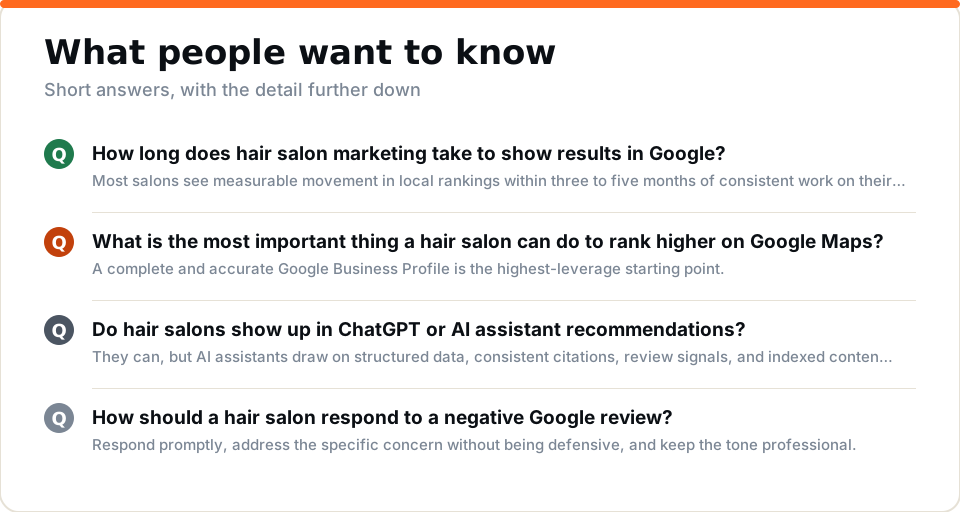
- How long does hair salon marketing take to show results in Google?
- Most salons see measurable movement in local rankings within three to five months of consistent work on their Google Business Profile, citations, and content. Faster results are possible when foundational problems like conflicting business information or an incomplete GBP are corrected first. No ethical provider can guarantee a specific timeline.
- What is the most important thing a hair salon can do to rank higher on Google Maps?
- A complete and accurate Google Business Profile is the highest-leverage starting point. That means the correct primary category, every service listed with a description, current photos, consistent hours, and an active review profile. Citation consistency across directories reinforces the signals the GBP sends.
- Do hair salons show up in ChatGPT or AI assistant recommendations?
- They can, but AI assistants draw on structured data, consistent citations, review signals, and indexed content rather than social media activity. A salon with a well-built GBP, accurate listings across directories, and regularly updated web content is better positioned to appear in AI-generated local recommendations than one with only an Instagram presence.
- How should a hair salon respond to a negative Google review?
- Respond promptly, address the specific concern without being defensive, and keep the tone professional. A thoughtful reply signals to every future reader that the business takes feedback seriously. Avoid generic apologies that could apply to any complaint, and never argue with the reviewer publicly.
- Does a hair salon need a blog to rank in local search?
- Not necessarily, but content that targets service-specific search terms, such as technique names, care guides, or seasonal service questions, can capture clients who are still deciding where to book. A GBP and citation foundation matters more immediately, but consistent content compounds over time and supports AI assistant visibility.
See where your own business stands.
We measure your local rankings, your listings, your website, and how AI assistants answer for your business. No signup required.
Or jump straight to pricing →