
Notes
HIPAA Compliant Marketing for Healthcare Practices: What You Can Do, What You Can't, and How to Grow Anyway
Picture this: a front-desk coordinator at a chiropractic office spots a five-star Google review from a patient who raves about how much better their back feels. She starts typing a response, something warm and specific.
Reviewed by Melike Erguven, Co-founder of LocalLeadSignal · July 20, 2026 · 12 min read

Picture this: a front-desk coordinator at a chiropractic office spots a five-star Google review from a patient who raves about how much better their back feels. She starts typing a response, something warm and specific. Then a colleague leans over and says, "Wait, can we actually say that? Isn't that a HIPAA thing?" And just like that, the whole effort freezes.
That moment happens constantly in healthcare practices. And honestly, it makes sense that people pause there. HIPAA violations carry real consequences, and most practice staff are not compliance attorneys. But here is the part that does not get said enough: the uncertainty itself is the bigger problem. Practices go quiet online, skip the review responses, put off the website content, and end up invisible to the patients who are actively searching for them right now.
The rules are real. They are also a lot more workable than the hesitation suggests. Most of what makes a healthcare practice visible and trustworthy online sits entirely outside the territory that HIPAA actually regulates. This is a plain-language walkthrough of what the law genuinely restricts, where you have more room than you probably think, and how to build a real online presence without putting your practice at risk.
What HIPAA Actually Restricts in Your Marketing (and What It Does Not)
The core rule is straightforward once you strip away the legalese. HIPAA restricts using or disclosing Protected Health Information (PHI) for marketing purposes without a valid patient authorization. That is the line. Cross it without authorization, and you have a problem. Stay on the right side of it, and a lot of standard marketing is completely available to you.
So what counts as PHI in a marketing context? Patient names paired with health information, appointment history, diagnoses, treatment records, photos that identify a patient as receiving care, and anything else that connects a specific person to their health status or care at your practice. The key word is "specific." PHI is about identifiable individuals, not health topics in general.
That distinction matters a lot. Publishing a blog post about what to expect from a spinal adjustment is not PHI. It does not involve any patient's information. Writing an email to a named patient referencing their last visit and suggesting a follow-up treatment? That is a different situation entirely, because you are using their patient status to market to them.
General health content marketing, SEO, educational blog posts, Google Business Profile optimization, local citations, social media posts about your services, none of those inherently involve PHI. They are about your practice and the conditions you treat, not about individual patients. That is where most practices are leaving real opportunity on the table.
A common misconception is that HIPAA bans healthcare marketing altogether. It does not. What it bans is using patient data to market without proper authorization. The HHS Office for Civil Rights (OCR) enforces these rules, and state laws can layer on additional requirements depending on where your practice is located. So yes, you should know your state's rules too, but the federal floor is not as restrictive as the fear around it suggests.
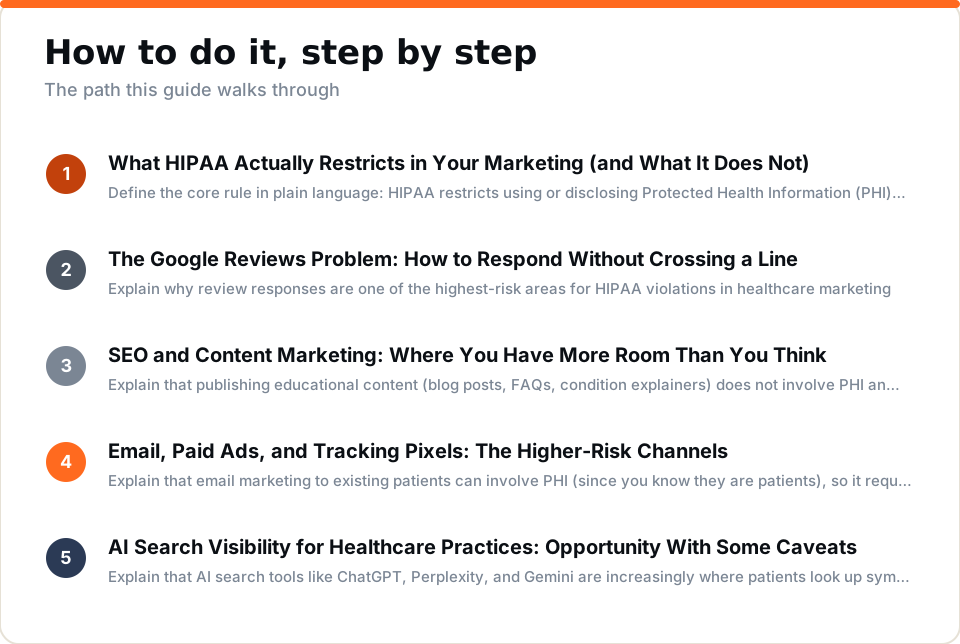
The Google Reviews Problem: How to Respond Without Crossing a Line
Review responses are genuinely one of the highest-risk spots for HIPAA violations in healthcare marketing. Not because responding is wrong, but because the instinct in the moment is to be personal, to acknowledge what the person said, to thank them by name. That impulse is understandable. It is also where things can go sideways fast.
The standard guidance from a compliance standpoint is consistent: never confirm that someone is a patient, never reference treatment details, and never respond in a way that connects a named individual to their care at your practice. Even if someone writes in a review "Dr. Smith fixed my herniated disc," you cannot respond with "We are so glad your treatment went well!" because that response effectively confirms both the patient relationship and the clinical detail.
A compliant response can still be warm and human. Something like: "Thank you so much for taking the time to share your experience. We work hard to make every visit a positive one, and it genuinely means a lot to hear feedback like this. We hope to keep earning that kind of trust." That response acknowledges the review, reflects your practice's values, and gives prospective patients a sense of who you are without touching anything that would constitute a PHI disclosure.
Negative reviews are harder, and the same rules apply in an even more frustrating way. You cannot correct the record using clinical details, even if the review is factually wrong. That feels unfair, and it is. But the goal of responding to a negative review is not to win the argument. It is to show the next person reading your profile how your practice handles feedback. A response that is calm, professional, and invites the person to contact you directly does more for your reputation than a defensive correction ever could.
Encouraging reviews in the first place is generally allowed. A sign in your waiting room, a follow-up email that invites patients to share their experience, a reminder card at checkout: all of those are standard reputation management tactics. The important thing is that you are not conditioning care on a review or pressuring anyone. General, unpressured invitations to leave feedback are fine. According to Google's guidance on managing customer reviews, responding to reviews is a meaningful part of building your presence, and it applies directly to healthcare practices too.
SEO and Content Marketing: Where You Have More Room Than You Think
Healthcare content marketing is one of the most HIPAA-friendly channels available to a practice, and it is also one of the most underused. Publishing educational content, FAQs, condition explainers, and service pages does not involve PHI at all. You are writing about health topics, not about patients. That distinction keeps you squarely in compliant territory while building exactly the kind of online presence that attracts new patients.
Local SEO basics are also safe for any healthcare practice. Optimizing your Google Business Profile with accurate hours, service categories, and photos does not touch patient data. Maintaining consistent NAP (name, address, phone number) across directories and building local citations are entirely public-facing activities. Google's tips for improving your local ranking point directly to completeness and accuracy as ranking factors, and those are things any practice can work on without a compliance concern.
Condition-specific and service-specific content serves a dual purpose. A page on your dental site titled "What to expect during your first teeth whitening appointment" educates prospective patients and ranks for the kinds of long-tail local keywords they are actually searching. Patients do not just search "dentist near me." They search "how long does it take to recover from a tooth extraction" or "is chiropractic adjustment safe for back pain." Ranking for those terms requires good content, not patient data.

Schema markup for healthcare and legal is another layer worth adding. Structured data helps search engines understand your services, your location, your specialties, and your hours without exposing any patient information. It is purely technical, and it gives you a stronger signal to both traditional search engines and the AI systems that are increasingly shaping what patients see first.
Speaking of AI search: generative engines like ChatGPT and Perplexity pull their answers from well-structured, credible, publicly available content. A practice that consistently publishes helpful, accurate educational material is more likely to be cited in those AI-generated responses. This is what generative engine optimization (GEO) looks like in practice for a healthcare provider: write clearly, answer real questions directly, and build the kind of content that signals authority. None of that requires accessing a single patient record.
Email, Paid Ads, and Tracking Pixels: The Higher-Risk Channels
Email marketing to existing patients is a different situation than general content publishing, and it is worth treating it that way. The moment you are emailing someone as a patient of your practice, you are dealing with information that qualifies as PHI: the fact that they are your patient. That means your email platform needs to be evaluated as a potential business associate, and a Business Associate Agreement (BAA) needs to be in place before you use it for patient communications.
The tracking pixel issue drew significant attention from OCR in recent years, and for good reason. Embedding a Meta Pixel or a Google Ads tag on a page where patients book appointments, view their records, or enter health-related information can inadvertently transmit PHI to a third-party ad platform. That is not a theoretical risk. It is a real compliance exposure. The practical guidance here is clear: tracking pixels should not be placed on patient-facing pages where any PHI is entered or displayed. If you have a pixel on your general marketing pages (your homepage, your blog), that is a separate question from placing one inside a patient portal or on a form that collects health information. Consult your compliance counsel before adding any tracking to patient-facing pages.
Paid search ads targeting general health conditions or geographic areas are not inherently a HIPAA problem as long as you are not using patient lists built from PHI to power your targeting. Running ads for "back pain treatment" to people in your area is standard practice. Building a custom audience from your patient records and retargeting them without proper authorization is not.

Before you scale any paid campaign, audit your current martech stack. Every vendor that could come into contact with PHI, your CRM, your analytics tools, your email platform, your chatbot, should have a signed BAA or at minimum be evaluated for whether PHI flows through it at all. That audit is not a one-time task either. New tools get added, integrations get set up, and the compliance picture can shift without anyone noticing.
AI Search Visibility for Healthcare Practices: Opportunity With Some Caveats
Patients are increasingly turning to AI tools to look up symptoms, research providers, and understand treatment options before they ever pick up the phone. ChatGPT, Perplexity, Gemini: these are real channels now, not future-state predictions. And for healthcare practices, showing up in those AI-generated answers is a genuine opportunity.
Here is the good news: appearing in AI search results is driven by content quality, not patient data. If your practice has published clear, well-structured, authoritative content that answers the questions patients are actually asking, you are already building the foundation for AI visibility. That is the core of generative engine optimization (GEO) applied to healthcare: write in plain language, answer specific questions directly, use structured data to help AI systems understand what your practice offers, and build credibility signals like reviews and local citations.
Voice search fits into this picture too. When someone asks a smart speaker "what does a chiropractor do on the first visit," the answer they get comes from content that is written conversationally, in a question-and-answer format that closely mirrors how people speak. HIPAA is not directly implicated in voice search content, but the structure of your content matters a great deal. Short, direct answers to specific questions outperform dense, clinical paragraphs in both voice and AI-generated results.
One important caveat: AI chatbots that you integrate into your own website or patient communication workflow are a different situation entirely. Any tool that handles patient inquiries, stores conversation history tied to patient identity, or assists with scheduling in ways that touch PHI needs a BAA and proper configuration. The opportunity in AI visibility is about your public-facing content, not about deploying AI inside your patient-facing systems without a compliance review.
The broader point holds across all of these channels: educational content is your safest and most scalable marketing asset as a healthcare practice. It does not require patient data, it is not a compliance minefield, and it compounds over time in ways that paid advertising does not.
How LocalLeadSignal Handles HIPAA Guardrails (and What to Verify With Your Counsel)
LocalLeadSignal focuses on SEO, listings management, review monitoring, and AI visibility. These are areas that generally do not require accessing PHI at all. The work happens on the public-facing side of your practice's digital presence: your Google Business Profile, your local citations, your content structure, your reputation signals. That is by design.
The service does not integrate with patient management systems, EHRs, appointment scheduling platforms, or any other system that holds patient records. Which means the typical PHI-exposure scenarios, the ones that require a BAA or careful data handling protocols, simply do not apply to the core work LocalLeadSignal does. Managing your Google Business Profile optimization, keeping your NAP consistent across directories, monitoring and helping you respond to reviews appropriately: none of that requires us to touch patient data.
To be straightforward about scope: if you want to run email campaigns to your patient list, set up a CRM that connects to your practice management system, or use tracking pixels inside your patient portal, that is outside what LocalLeadSignal handles. Those tools and vendors need to be evaluated on their own for BAA readiness, and that evaluation should happen with your compliance attorney or HIPAA compliance officer, not your SEO vendor.
Every healthcare practice, regardless of which marketing vendor it works with, should have a human being on the compliance side who reviews the full martech stack periodically. That is not meant to be discouraging. It is just the reality of operating in a regulated industry. The good news is that a focused local SEO strategy, the kind built around public-facing content and visibility, leaves most of that complexity off the table.
The goal here is to make compliant marketing feel achievable, not to make it feel like a legal obstacle course. Practices at every size can build real visibility online without cutting corners on compliance. Starting at $249 per month with no contract, LocalLeadSignal is set up specifically for practices that do not have a dedicated marketing team but still need consistent, competent work done.
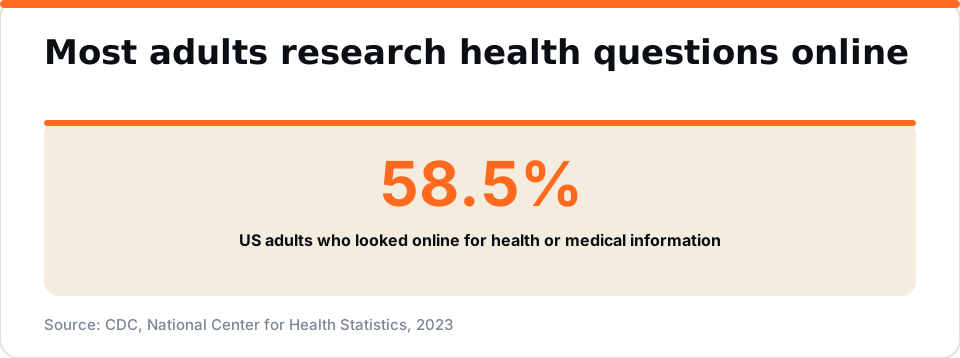
Source: CDC, National Center for Health Statistics, 2023
The Bottom Line on HIPAA and Healthcare Marketing
HIPAA compliant marketing is not a reason to go quiet online. The hesitation is understandable, but most of the work that actually makes a healthcare practice visible, searchable, and trustworthy sits entirely outside PHI territory.
Clean up your Google Business Profile. Publish helpful content that answers the questions your prospective patients are already searching. Encourage reviews the right way and respond to them thoughtfully. Build a consistent presence across local directories. Create the kind of structured, credible content that AI search tools will actually cite. None of that requires patient data, and all of it matters.
The practices that show up consistently in local search results and AI-generated answers are not necessarily the biggest ones or the ones with the biggest budgets. They are the ones that have done the unglamorous, ongoing work of keeping their digital presence accurate and helpful. That work is available to any practice willing to prioritize it.
LocalLeadSignal handles all of it starting at $249 per month, no contract, no agency overhead. There is no dedicated marketing team required on your end because we do the work, from tracking your visibility to managing your SEO, listings, reviews, and AI search presence.
See where your practice stands online with a free visibility check from LocalLeadSignal. No contract, no agency markup, just a clear picture of what is working and what to fix.
Frequently asked questions
- Can a healthcare practice respond to Google reviews without violating HIPAA?
- Yes, but carefully. You should never confirm that the reviewer is a patient, reference any treatment details, or use their name in a way that links them to care. A warm, general response that thanks the person and invites them to call your office is both compliant and effective.
- Do Google Business Profile and local SEO count as HIPAA marketing activities?
- Generally no. Optimizing your Google Business Profile, building local citations, and publishing educational content are public-facing activities that do not involve patient data. These are some of the safest and most effective marketing channels available to healthcare practices.
- Are tracking pixels on healthcare websites a HIPAA risk?
- They can be. Placing ad pixels from Meta or Google on pages where patients log in or enter appointment information may inadvertently transmit protected health information to third parties. Pixels should not appear on any patient-facing page that handles PHI, and your compliance counsel should review your setup.
- How does LocalLeadSignal handle HIPAA guardrails, and what should I verify with my compliance counsel?
- LocalLeadSignal works on the public-facing side of your practice: SEO, listings, reviews, and AI visibility. The service does not connect to patient records or EHRs. That said, your compliance counsel should review your full martech stack, especially any tools that touch patient communication or appointment data.
- Can healthcare practices use email marketing under HIPAA?
- Yes, with the right safeguards. Any email platform that may process patient information should have a signed Business Associate Agreement in place. Campaigns that use patient data for targeting or segmentation require careful review, and your compliance officer should approve the workflow before you launch.
See where your own business stands.
We measure your local rankings, your listings, your website, and how AI assistants answer for your business. No signup required.
Or jump straight to pricing →