
Notes
Birdeye vs LocalLeadSignal: Reputation Tool or Full Local SEO Platform?
Updated September 2026 with details from Birdeye's current website.
Reviewed by Melike Erguven, Co-founder of LocalLeadSignal · September 7, 2026 · 10 min read

Updated September 2026 with details from Birdeye's current website.
A local service business owner signs up for Birdeye, excited about finally getting a handle on Google reviews. Six months later, the reviews are trickling in, the dashboard looks busy, and the phone is still quiet. The Google Business Profile still isn't showing up in the map pack. Citations across the web are a mess of old addresses and wrong phone numbers. And nobody told them that was a separate problem.
That's not a knock on Birdeye. It's a description of what happens when a business buys a reputation tool expecting it to solve a visibility problem. The two things overlap, but they are not the same thing, and the confusion costs real money.
This article takes both options seriously. Birdeye has genuine strengths. LocalLeadSignal does something different. Understanding which one fits your actual situation is worth figuring out before you sign anything.
What Birdeye Is Actually Built to Do
Birdeye's core product is online reputation management. At its heart, the platform is designed to help businesses collect more reviews, monitor what customers are saying across multiple platforms, and respond without jumping between a dozen separate tabs. The automated review request campaigns are solid: a customer completes a service, a text or email goes out, and the request lands while the experience is still fresh. Response templates, sentiment tracking, and multi-location review monitoring are all part of the package.
Beyond reviews, Birdeye layers in customer messaging tools like webchat, ticketing, and surveys. These features serve a real purpose for businesses that want a centralized hub for customer communication, not just a way to chase down star ratings. If you're a large brand juggling customer interactions across ten or twenty locations, having that infrastructure in one place has obvious appeal.
Birdeye also manages listings. As of September 2026, its listings page describes native integrations with Google, Facebook, Apple, Yelp and Bing, with continuous scans and fixes applied after one-click approval. Its AI Search product tracks visibility across ChatGPT, Gemini, Claude, Perplexity and more.
The customer experience layer is genuinely comprehensive for the right buyer. Surveys, payment links, referral campaigns: these aren't SEO features. They're CX features, and businesses that need them will find value there.
Birdeye does not publish prices on its website. As of September 2026, its pricing page asks for your number of locations and contact details before it shows a quote, and says you pay for what you deploy at your locations. The best way to know the cost is to request a quote and ask what is included.
What LocalLeadSignal Is Actually Built to Do
LocalLeadSignal is a managed local SEO service with a dashboard where you can see the work, which means the work gets done for you, not handed to you through an interface.
Here is what each of our plans includes. Visibility costs $249 a month: a weekly check of how you show up in Google and in AI assistants, 15 keywords picked from real customer searches, and a new SEO blog post written for you each week. Local Dominance costs $499 a month and brings your Google Business Profile, Apple Maps and Bing Places listings under our care, cleans up citations so your name, address and phone match everywhere, and fixes on-page SEO. Growth Engine costs $1,499 a month and gives you a dedicated specialist plus review reply drafts.
The done-for-you model matters more than it might sound. Most small service businesses don't have a marketing team. The owner is also the scheduler, the estimator, and the person answering the phone. Paying for a platform that requires weekly attention and a learning curve is, in practice, paying for something that sits untouched. A managed service removes that friction entirely.
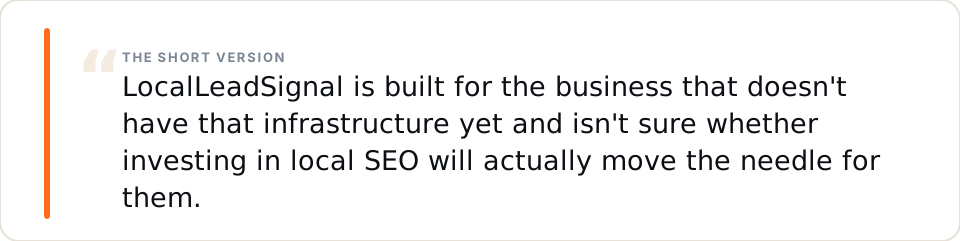
Pricing starts at $249 per month, no contract, no setup fees. That starting point is deliberate. LocalLeadSignal is built for the business that doesn't have that infrastructure yet and isn't sure whether investing in local SEO will actually move the needle for them. Month-to-month removes the risk of a long commitment before you've seen any results.
The AI visibility component deserves a specific mention. Every LocalLeadSignal plan tracks how you appear in AI assistants, including ChatGPT, Perplexity and Gemini. This is a real and growing part of how people find local businesses, and it requires a different kind of optimization than traditional search.
LocalLeadSignal is built for independent service businesses, small multi-location practices, dental offices, chiropractors, physical therapy clinics, and similar operations where the owner is close to the business and wants results without becoming their own SEO coordinator.
Reputation Management vs Local SEO: Why the Difference Matters
A reputation management platform is primarily designed to help you collect reviews, display them well, and respond to them across platforms. That's a real and valuable function. But it is one layer of a much larger system.
Local SEO covers citation building, NAP consistency, Google Business Profile signals, local keyword research, schema markup, link building, and increasingly, presence in AI-generated search results. Reviews are a ranking signal within that system, but they're one of many. A business can have hundreds of five-star reviews and still not show up in the map pack because the GBP is incomplete, the citations are inconsistent, or the local business schema markup is missing from the website entirely. According to Google's own guidance on local ranking, relevance, distance, and prominence all factor into how results are ranked, and prominence draws from far more than review volume.
Think of it this way: reputation management is one instrument in the band. Local SEO is the whole performance. You can play that one instrument beautifully and still not produce music if the rest of the band isn't there.

Businesses get into trouble when they buy a reputation tool expecting it to solve a visibility problem. The actual gap is often in citation consistency, GBP completeness, or missing structured data, and a review-only tool won't touch any of those. If you want to understand what's actually dragging down your local rankings, a quick audit of your profile will show you the gaps a review dashboard can't see.
There's also the AI search angle. Generative engines like ChatGPT, Perplexity, and Gemini don't just pull from review counts when they surface a local business. They pull from structured data, citation signals, and how well-optimized the underlying business profile and web presence actually are. Generative engine optimization is a distinct discipline, and businesses that only invest in reputation management are leaving that part of their local search presence completely unaddressed.
Pricing, Contracts, and What You Are Really Committing To
Because Birdeye quotes prices individually, ask for the monthly cost per location, the contract length and what is included before you compare. For a two-location chiropractic practice trying to figure out whether local SEO is worth the investment, it's a significant commitment before they've validated the return.
Birdeye's agents recommend and apply fixes after one-click approval, so someone on your side still reviews and approves that work.
LocalLeadSignal's model is structured differently by design. At $249 per month with no contract and no onboarding fees, the entry point is low enough that a single new patient or client covers a meaningful portion of the cost. The month-to-month structure reflects a real philosophy: if the service isn't producing results, a small business shouldn't be locked in while they wait for an annual contract to expire.
The compounding difference is in what you're actually paying for. With a tool, you pay for access, and the work is still yours to do. With a managed service, you pay for outcomes, and the work happens whether or not you have time to log in that week. For an owner who's also doing the job their business exists to do, that distinction is everything.
Worth being transparent: LocalLeadSignal isn't the right fit for businesses that want to own their dashboard and manage their own workflow. If you have a marketing team that prefers to run their own tools and pull their own reports, a managed service model might feel like giving up control. That's a legitimate preference, and it's worth knowing before you sign up.
Where Each Option Falls Short (and What to Watch For)
Every product fits some problems and not others. Knowing the limits of both options saves time and money.
Birdeye's limits depend on which products you buy. Because prices are quoted individually, the total cost is hard to compare in advance, so ask how pricing changes as you add locations and products. Its agents apply fixes after approval, so plan for someone on your side to review that work.
LocalLeadSignal has its own honest limitations. It's not a standalone software tool, so businesses that want full dashboard control or have a team that prefers to manage their own workflow may find a tool-based approach more comfortable. The service is built specifically for local service businesses, which means it's not the right fit for e-commerce brands or national companies with no local presence to optimize.
On the AI visibility side, generative engine optimization is still maturing across the entire industry. LocalLeadSignal tracks and works to improve AI search citations, but results in ChatGPT, Perplexity, and Gemini depend partly on how those platforms weight different signals, and that's outside any provider's direct control. This is worth naming clearly rather than overpromising on a frontier that everyone is still figuring out.
Comparing these options to others in the space is also useful context. If you want a deeper look at how different tools stack up for small businesses specifically, this breakdown of local SEO tools in 2026 is worth reading before you decide.
How to Tell Which One Actually Fits Your Situation
This isn't a sales pitch. It's a self-diagnosis.
Birdeye probably fits if you have a marketing coordinator or an agency already handling your local SEO foundation, and the specific gap you're trying to close is review volume, response workflow, or multi-platform reputation monitoring at scale. It also fits if you run many locations and want one system for reviews, listings, social and AI search. Those are real use cases, and Birdeye is genuinely designed for them.
LocalLeadSignal fits a different profile. If you're a single-location or small multi-location service business with no internal marketing team, and you want the whole local SEO picture handled without hiring a full-time coordinator, the managed model solves that directly. If you're showing up inconsistently in Google Maps, your citations have errors, your GBP isn't fully optimized, and you've never thought about AI search visibility, these are exactly the things LocalLeadSignal addresses from month one.
A specific pattern comes up often: business owners who've paid for a platform before, found they didn't have time to actually use it, and watched the subscription renew month after month without results. If that sounds familiar, paying for access to more tools isn't the answer. For a side-by-side look at how managed services compare to tool-based approaches, this comparison between BrightLocal and LocalLeadSignal walks through exactly that question.
Before picking either option, pull a free local SEO snapshot so you know what you're actually solving for. Deciding between a reputation tool and a managed SEO service without knowing whether your citations are broken or your GBP is incomplete is like choosing between a hammer and a wrench before you've looked at what needs fixing.
Birdeye is a broad platform that started in reputation management and now also covers listings, social and AI search through AI agents. LocalLeadSignal is a managed local SEO service for small businesses: every plan covers visibility tracking and weekly content, and higher plans add listings, citation cleanup and review reply drafts.
Neither is universally better. If your reviews are your main problem and your map pack ranking is solid, a reputation tool makes sense. If the gap is visibility in Google Maps, inconsistent citations, or zero presence in AI-generated search results, a managed SEO service closes that gap faster and without requiring you to run the platform yourself.
Before you commit to any platform or service, see exactly where your local visibility stands right now. Pull your free local SEO snapshot from LocalLeadSignal and find out what's working, what's missing, and which solution actually fits your situation.
Frequently asked questions
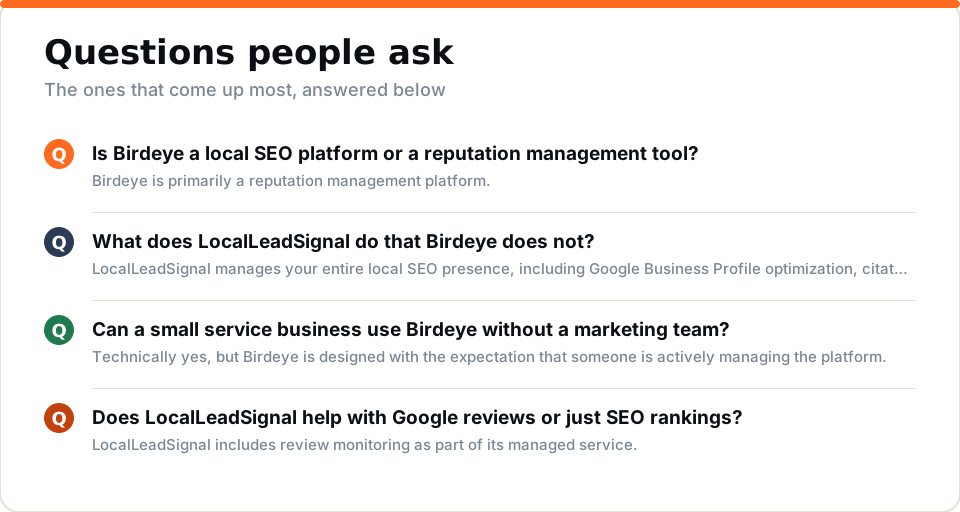
- Is Birdeye a local SEO platform or a reputation management tool?
- Birdeye started as a reputation management platform. As of September 2026, its website also describes listings management across Google, Apple, Bing, Facebook and Yelp, AI search visibility tracking, social publishing and customer messaging, with AI agents that apply fixes after you approve them.
- What does LocalLeadSignal do that Birdeye does not?
- We track your visibility in Google and in AI assistants and draft SEO blog posts for you every week. Local Dominance adds listings, citation cleanup and on-page SEO fixes, and Growth Engine adds a dedicated specialist and review reply drafts. Birdeye is software built around AI agents for reviews, listings, social and AI search.
- Can a small service business use Birdeye without a marketing team?
- Yes. Birdeye's site describes AI agents that recommend fixes and apply them after one-click approval, so someone on your side still reviews that work. If you want a service that does the weekly work for you, that is what LocalLeadSignal is built for.
- Does LocalLeadSignal help with Google reviews or just SEO rankings?
- Our Growth Engine plan drafts replies to your reviews for your approval. Birdeye specializes more deeply in review generation and response. We treat reviews as one part of a broader local SEO program.
- How much does LocalLeadSignal cost compared to Birdeye?
- LocalLeadSignal starts at $249 a month with no contract and no setup fees. As of September 2026, Birdeye does not publish prices on its website. Its pricing page asks for your number of locations and contact details to get a quote.
See where your own business stands.
We measure your local rankings, your listings, your website, and how AI assistants answer for your business. No signup required.
Or jump straight to pricing →