
Notes
Citations vs Backlinks: What Local Service Businesses Actually Need to Rank in 2026
You've done the guest posts. You've sent the outreach emails. You've waited weeks for a link that may or may not show up.
Reviewed by Melike Erguven, Co-founder of LocalLeadSignal · September 4, 2026 · 13 min read
You've done the guest posts. You've sent the outreach emails. You've waited weeks for a link that may or may not show up. And somewhere in the middle of all that, a competitor two blocks over quietly jumped you in Google Maps, and you have no idea what they did differently.
Here's the frustrating part: backlinks probably weren't the problem. Or at least, not the main one. Most local service businesses that feel stuck in search are dealing with a citation issue, not a backlink gap. The two signals do very different jobs inside Google's local algorithm, and mixing them up means spending real time and money on the thing that matters less right now.
This article breaks down exactly what citations do, what backlinks do, and which one deserves your attention first, based on where most local service businesses actually are.
You're Chasing Backlinks While Your Listings Are a Mess
Here's a scenario that plays out constantly. A business owner puts real effort into link building, maybe a few guest posts, a mention in an industry roundup, a couple of directory submissions on high-DA sites. They've got 40 or 50 backlinks pointing at their site. But their Google Business Profile still shows an old phone number, their Yelp listing has a slightly different business name, Apple Maps has an address from before they moved two years ago, and a handful of local directories still list a suite number they stopped using when they renewed their lease.
Meanwhile, the competitor down the street has maybe 10 backlinks total but squeaky-clean listings everywhere that matters.
That competitor is ranking above them in the map pack. Every time.
Google's local algorithm treats citations and backlinks as separate trust signals. They're not interchangeable, and they don't cancel each other out. Backlinks tell Google that your site has authority and topical relevance. Local citations tell Google that your business is real, is located where you say it is, and operates under a consistent identity. If those two data points are contradicting each other across the web, Google gets cautious. A cautious algorithm doesn't reward you with map pack placement.
NAP consistency, meaning your business name, address, and phone number matching exactly across every listing, is the foundational layer that citations are built on. Without it, even a solid backlink profile doesn't carry the weight it should in local search. Think of it like a reference letter for someone who spelled their own name three different ways on the application. The reference is good, but now there's doubt.
Businesses that have moved, rebranded, or changed phone numbers are especially exposed here. Every old listing that never got updated is a small contradiction sitting in Google's index, quietly undermining the trust signals that should be working in your favor. It's not dramatic. It just adds up over time, and cleaning up those inconsistencies tends to have a faster, more visible impact on local rankings than most business owners expect.
What Citations Actually Do for Your Local Visibility (and What They Don't)
A local citation is any place on the web where your business name, address, and phone number appear together. That's really all it is. It doesn't have to be a link. It doesn't have to be a fancy directory. It just has to accurately represent your business in a way that Google can read and cross-reference.
There are two main types. Structured citations are formal directory listings on platforms like Yelp, Bing Places, Apple Maps, TripAdvisor, and similar sites. These have defined fields for your name, address, phone, hours, and category. Unstructured citations are mentions that happen more naturally, like a local blog writing about your business, a community guide that includes your address, or a news article that references your location. Both types count. Structured citations tend to be easier to build and manage. Unstructured ones tend to carry a bit more editorial weight because someone chose to mention you, not just list you.
For map pack ranking specifically, citations are a primary signal. Google uses them to confirm that your business exists at a real physical location, that the details are consistent, and that multiple independent sources are pointing to the same identity. A business with clean, consistent citations across the top directories sends a clear, confirmable signal. A business with scattered or conflicting listings sends noise.
What citations don't do is pass topical authority the way a quality backlink does. Getting listed on Yelp doesn't tell Google that you're an expert in your service area. It tells Google you exist. Those are meaningfully different things, and conflating them is where a lot of local SEO strategy goes sideways.
There's also a point of diminishing returns worth understanding. Getting your business listed accurately on the top 30 to 50 directories, things like Google, Bing Places, Apple Maps, Yelp, Facebook, and a handful of industry-specific directories, covers most of the citation value available to you. Chasing 500 low-quality directories doesn't amplify that. It introduces inconsistency risk and can actually drag your local search ranking down if those listings have outdated or conflicting data. More is not better past a certain point. Accurate and consistent is better.
Local business schema markup fits into this picture too. It's a structured data format you add to your website that explicitly tells Google and other search engines your business name, address, phone, hours, and category in machine-readable format. Google's official documentation on LocalBusiness structured data lays out exactly what fields are supported. Think of it as your citations, but on your own website, formatted in a way Google can't misread.
What Backlinks Actually Do for Your Local Visibility (and When They Become Worth Your Time)
A backlink is a link from another website to yours. When a relevant, authoritative site links to you, it passes trust and topical relevance signals to your domain. Google interprets those signals as evidence that your content, and by extension your business, is credible in a particular subject area.
The key distinction for local businesses is this: backlinks primarily move the needle on organic search rankings, not map pack position. If you're trying to rank for informational or competitive terms in the traditional blue-link results below the map pack, backlinks are a major factor. For the map pack itself, citations, GBP completeness, proximity, and reviews carry more weight.
That said, backlinks do matter for local businesses, especially once the foundational work is done. The most valuable ones for local service businesses aren't usually guest posts on national marketing blogs. They're links from locally relevant sources: a chamber of commerce membership page, a local news outlet that covered your business, a community organization you sponsor, or a partner business that links to you from their site. These carry both link authority and local relevance signals, which makes them more useful than a generic link from a site that has nothing to do with your geography or your service. You can get a sense of what this looks like in practice by reading about earning links through local relationships.
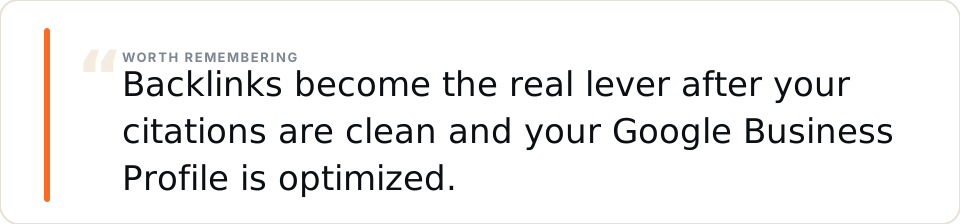
Backlinks become the real lever after your citations are clean and your Google Business Profile is optimized. At that point, two competitors at roughly the same citation level will often be separated by the quality and relevance of their backlink profiles. One well-placed link from a local industry source or a community news site can be the thing that tips the ranking in your favor. Twenty low-quality directory links won't do the same thing, even if the total link count looks better on paper.
For most small local service businesses, jumping straight to a backlink campaign before citations and GBP are handled is getting the sequence backwards. The foundational signals need to be stable before the authority signals on top of them have their full effect. Local keyword research also plays into this: understanding the specific long-tail local keywords your potential customers are actually searching helps you figure out where to focus link-building content, rather than chasing broad terms with outsized competition.
The Map Pack vs Organic Rankings Split Nobody Explains Clearly
Google's local search results actually have two distinct sections, and they respond to different signals. Most people treat them as one thing, which is part of why local SEO strategy gets confusing fast.
The map pack is the block of three local business listings that appears near the top of local search results, usually with a map. These results are driven primarily by proximity to the searcher, the completeness and accuracy of the Google Business Profile, citation volume and consistency, review signals, and local schema markup. Per Google's own guidance on local ranking factors, relevance, distance, and prominence are the three pillars, and citations feed directly into prominence.
Below the map pack sit the traditional organic results. These are driven by on-page content quality, backlink authority, topical relevance, and long-tail keyword coverage. A well-written service page with strong backlinks can rank here. A GBP listing alone won't.
This is why a business can show up in the map pack without a single backlink pointing at their website. Their citations are clean, their GBP is complete and verified, they've got solid reviews, and their physical proximity to searchers is working in their favor. None of that requires a backlink. Conversely, a business can rank on page one of organic results for competitive search terms and not appear in the map pack at all, because their GBP is incomplete or their citation data is inconsistent.
For most local service businesses, map pack visibility is where the phone calls and appointment bookings actually come from. Someone searching for a chiropractor or a plumber or a physical therapist is often going to click one of the three map pack results before they scroll down to organic listings. That's where google maps marketing matters most, and that's why citations and GBP optimization tend to generate faster, more tangible results for local service businesses than a months-long backlink campaign.
AI search is beginning to complicate this picture in interesting ways. Tools like ChatGPT, Perplexity, and Gemini are increasingly pulling from structured data, citation-style sources, and business listings when they generate answers to local queries. AI visibility for local business is no longer purely a future concern. Generative engine optimization, the practice of making sure your business is well-represented in AI-generated answers, relies heavily on the same citation consistency and structured data that drives traditional map pack ranking. So the signals you build now for Google Maps pay dividends in AI search as well.
Where Reviews, Schema, and AI Visibility Fit Into This Picture
Reviews are their own category. They're not citations in the traditional NAP sense, and they don't function like backlinks. But they're a genuine ranking signal that can amplify or undercut everything else you've built.
Review volume, recency, and diversity all factor into map pack ranking. A business with 200 reviews and a solid rating is sending a strong trust signal that a business with 12 reviews isn't, even if their citation profiles are identical. Google's guidance on how reviews factor into your presence makes clear that responding to reviews also matters, not just collecting them. Engagement signals that your business is active and paying attention, which is part of what Google's algorithm reads as "prominence."
Getting more Google reviews doesn't require a complicated system. It usually requires a consistent habit of asking satisfied customers at the right moment, making the process as easy as possible, and following up. The businesses that do this well tend to outperform competitors with better backlink profiles but thinner review histories, especially in the map pack.
Local business schema markup is the connective tissue that ties citations together on your own site. When your website explicitly identifies your business name, address, phone, hours, and service category in structured data, you're giving Google a primary source to validate against all the external citation data it's already collected. Without it, Google is cross-referencing third-party sources against each other. With it, your own website becomes an authoritative confirmation point.
As AI search trends continue to evolve through 2026 and beyond, this structured data layer is becoming increasingly important. ChatGPT, Perplexity, and Gemini don't just pull from Google's index when they answer local questions. They pull from whatever structured, verifiable data they can find. A business with clean citations, accurate schema markup, and consistent NAP data is much more likely to be named in an AI-generated local recommendation than a business with messy or contradictory listings. Generative engine optimization, or GEO, is the framework for thinking about this: make your business easy to read, confirm, and cite, for both search engines and AI engines.
Online reputation management and citation hygiene reinforce each other in both environments. A business that actively manages its listings and its reviews is building the kind of consistent, verifiable presence that both traditional and AI search reward. These aren't separate tasks. They're parts of the same signal.
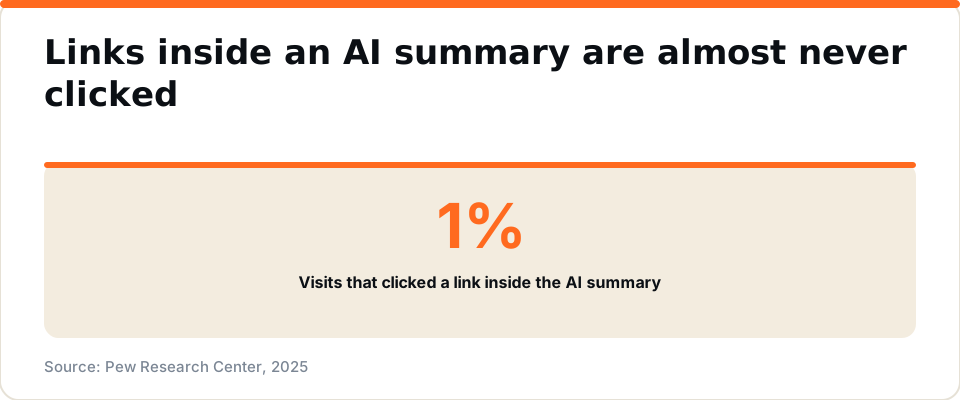
Source: Pew Research Center, 2025
A Realistic Order of Operations for Local Businesses That Don't Have Time to Do Everything
Most local business owners don't have a marketing team. They've got a business to run. So the question isn't "what should I ideally do?" It's "what should I do first?"
Start with your Google Business Profile. Claim it, verify it, fill every field completely and accurately, and keep it updated. Google has clear guidelines for representing your business on Google Business Profile, and following them isn't optional if you want map pack visibility. Choose the right primary category, add photos, write a real business description, set accurate hours. GBP verification and completeness are the single highest-leverage thing a local business can do, and a lot of businesses have never done it properly.
From there, do a citation cleanup. Audit where your business is listed, find the inconsistencies, and fix them. Focus on the top-tier directories first: Google, Bing Places, Apple Maps, Yelp, Facebook, and any industry-specific platforms relevant to your vertical. A local SEO audit will surface the mismatches that are quietly working against you. Once citations are consistent, add local business schema markup to your website.
Then build a review strategy. Not a complicated one. Just a reliable process for asking customers and making it easy for them to respond.
After those three things are solid, local link building makes sense. Keep it realistic: a chamber of commerce listing, a local sponsorship, a mention in local press, a partner business that links back to your site. These modest efforts compound over time and don't require a big agency budget or a team of outreach specialists.
Starting with backlinks before any of that is done is the SEO equivalent of painting over a cracked wall. It looks like progress. It's not.
This is exactly the sequence LocalLeadSignal works through for clients, starting at $249/mo with no contract. That includes citation management, GBP optimization, review monitoring, and AI visibility work, handled for you, without requiring you to already know what you're doing or coordinate a dozen moving pieces. The SBA notes that most small businesses operate lean, without dedicated marketing staff, which is precisely why managed local SEO exists as a category. The businesses that benefit most are often the ones doing everything themselves and just running out of hours.
The honest reality is that most local businesses stuck in search have a citations problem. Fixing that is faster, more affordable, and more immediately impactful than launching a link-building campaign from a shaky foundation.
Citations and backlinks aren't competing priorities. They're sequential ones. Citations come first because they establish the foundational trust signals that everything else builds on. Backlinks come later because they add the authority layer that separates you from competitors once the basics are solid.
For most local service businesses, the citations gap is what's actually holding rankings back. Not the backlink gap. And the good news is that citations are fixable. They don't require relationships, editorial approval, or months of waiting. They require accuracy, consistency, and follow-through.
If you're not sure where you stand right now, that's the real starting point. See exactly how your citations, Google Business Profile, and local visibility look right now with a free local SEO snapshot from LocalLeadSignal. No contract, no commitment, just a clear picture of what's working and what to fix first. LocalLeadSignal starts at $249/mo and does the work for you, so you can stop guessing and start knowing.
Frequently asked questions
- What is the real difference between local citations and local backlinks for rankings?
- Citations confirm your business exists at a specific location by spreading your name, address, and phone number consistently across directories. Backlinks pass authority and topical relevance from other websites to yours. Citations primarily influence map pack rankings. Backlinks primarily influence organic search rankings. Both matter, but they do different jobs.
- Do I need backlinks to rank in the Google map pack?
- Not necessarily. The map pack weighs Google Business Profile completeness, citation consistency, proximity, and review signals heavily. A business with zero backlinks but clean citations and an optimized GBP can outrank a competitor with dozens of backlinks. Backlinks matter more for organic blue-link rankings than for the map pack.
- How many citations does a local business actually need?
- Quality and consistency matter more than volume. Getting listed accurately on the top 30 to 50 directories, including Google, Yelp, Bing Places, and Apple Maps, covers most of the value. Chasing hundreds of low-quality directories adds little benefit and can introduce NAP inconsistencies that hurt more than they help.
- Can inconsistent citations hurt my local search rankings?
- Yes. If your business name, address, or phone number appears differently across directories, Google has a harder time confirming your location and legitimacy. NAP inconsistencies are one of the most common and underdiagnosed reasons a local business underperforms in map pack rankings despite having a solid backlink profile.
- Do citations still matter for AI search tools like ChatGPT or Perplexity?
- Yes, and increasingly so. AI search tools pull from structured data sources, directory listings, and well-cited web content when surfacing local business recommendations. Clean citations and local business schema markup make it more likely your business gets named accurately in AI-generated answers, not just in traditional Google results.
See where your own business stands.
We measure your local rankings, your listings, your website, and how AI assistants answer for your business. No signup required.
Or jump straight to pricing →