
Notes
Home Service Leads Worth Chasing: What Actually Brings in Work and What Wastes Your Budget
Most home service owners who struggle with inconsistent work are not doing anything obviously wrong. They show up, do good work, follow up with customers.
Reviewed by Melike Erguven, Co-founder of LocalLeadSignal · September 24, 2026 · 12 min read

Most home service owners who struggle with inconsistent work are not doing anything obviously wrong. They show up, do good work, follow up with customers. But the schedule still has gaps that do not track with the season, the economy, or how hard they are hustling. A week of solid home service leads gives way to two quiet weeks, and there is no clean reason why. The answer is almost never that demand dried up. More often, the signals that local buyers use to find and choose a business have shifted, and the business is still running the same playbook it used a few years ago. This piece goes through the specific places that breakdown happens and what actually moves the needle at each one.
Why Your Home Service Leads Go Quiet Even When You Are Busy
The counterintuitive thing about local search is that being fully booked right now and being invisible to next month's buyers can happen at the same time. Buyers do not call when they are ready to hire. They research days or weeks before the call, and whatever they find during that research window is what shapes the shortlist. If a business is not appearing in that window, it does not matter how good the work is.
Google's local results are weighted by recency, relevance, and proximity separately. A business that ranked well eighteen months ago can slip on any one of those axes without a single dramatic cause. A few months without new content makes the listing feel stale to Google's freshness signals. A Google Business Profile that has not been touched in a while loses points relative to competitors who are actively posting and responding to reviews. Proximity is fixed, but recency and relevance are things any business can control, and most do not.
Lead volume also rarely comes from a single channel. It is the combined output of map pack visibility, organic search rankings, review quality, directory presence, and increasingly, AI assistant recommendations. When one of those channels weakens quietly, the total drops in ways that look random. The business owner does not see "your map pack ranking slipped." They just see fewer calls.
AI assistants are now part of the research process for a meaningful share of buyers. ChatGPT, Perplexity, and Gemini all field questions about local home service providers, and they pull from what is published and structured online to generate their answers. A business with thin, inconsistent, or contradictory information across the web is harder for those tools to surface confidently. That is not a distant future problem. It is already affecting which businesses get mentioned and which get skipped.
The Listing Problems That Kill Home Service Leads Before They Start
NAP consistency is the foundation everything else sits on. NAP stands for name, address, and phone number. When those three pieces of information appear differently across directories, such as an old address on one site, a slightly different business name on another, or a phone number that was changed two years ago still showing up somewhere, search engines treat all of those versions as lower-confidence signals. Conflicting data reads as uncertainty, and search engines respond to uncertainty by ranking with less confidence.
Citation cleanup in practice means finding every directory that holds an older or incorrect version of the business's information and correcting it. That includes the major data aggregators that feed dozens of secondary directories, as well as category-specific sites and regional directories. The Google Business Profile is the anchor point: every other listing should match it exactly. This is less glamorous than it sounds, and it takes longer than most owners expect, but it is one of the most reliable ways to stabilize local search visibility.
For home service businesses specifically, the Google Business Profile fields that matter most are the service area settings, the primary and secondary categories, the business description, and the services menu. Service area businesses operate differently from storefronts, and the profile needs to reflect that accurately. Google's guidance on representing your business covers the distinction in detail. Getting the category wrong is one of the most common GBP mistakes, and it affects which searches the profile appears for at all.
Easy-to-overlook problems include unclaimed profiles, duplicate listings created when a business moved or changed phone numbers, and missing or incorrect hours. A business that looks closed because the hours field is blank or outdated loses calls it never knows it missed. Buyers do not call to ask if the business is open. They move to the next result.
Bing Places is worth a sentence of its own, because it is easy to ignore. Many buyers, especially those using Microsoft devices or certain voice assistants by default, pull local results from Bing's index. Ignoring Bing Places means leaving that share of searchers without an accurate listing to find.
When Home Service Leads Are There But Your Reviews Are Turning Them Away
Picture the moment a buyer has found two plumbers, two roofers, or two HVAC companies that look roughly comparable. They read the reviews. This is where the decision often gets made, and it happens silently before any business knows a potential customer was even looking.
An unanswered negative review does more damage than the bad rating itself. When a future buyer sees a complaint with no response, they read it as evidence that the business does not care or is not paying attention. A thoughtful reply, even to a review that is unfair, signals the opposite. It shows that someone is there, that the business takes the experience seriously, and that problems get addressed rather than ignored. Google's guidance on managing customer reviews provides the platform's own framework for how businesses should approach responses.
Review velocity matters alongside the overall star rating. A business with 80 reviews and none posted in the past four months reads as less active than a competitor with 40 reviews and three in the past two weeks. Freshness signals are real, and buyers notice the dates even when they do not consciously realize they are doing it.
Asking for reviews in a way that produces responses without violating platform terms comes down to timing, ease, and restraint. Ask when the job is done and the customer is satisfied, not days later when the moment has passed. Make the link easy to tap or click. Follow up once if they said they would and did not. Do not offer incentives, do not ask only customers you think will leave five stars, and do not ask in bulk through a third-party service that violates platform policies.
Responding to negative reviews is not about winning an argument. The goal is to reassure the next reader who encounters the review, not to convince the person who left it. Acknowledge the experience in one sentence. Move the resolution offline by offering a direct contact. Keep the reply short. Anything longer reads as defensive.
The Content Gap That Stops Buyers From Finding You Before They Are Ready to Call
Most home service businesses publish nothing online, or they publish only the broadest terms, like "plumber in [region]" or "roofing company," which are also the terms every competitor is chasing. That leaves an enormous range of long-tail local keywords completely unclaimed. These are the phrases buyers actually type when they are at the research stage, figuring out whether they need a repair or a replacement, what something might cost, or what warning signs to look for.
Useful content for a buyer at the research stage is problem-specific. It answers the question they typed, not the question the business wishes they had typed. A page about why a furnace makes a banging noise when it starts serves a buyer who does not yet know if they need a repair call. A page about how long a roof typically lasts before replacement serves a homeowner who is trying to decide whether to patch or replace. Neither of those pages competes directly with "best roofer near me." They capture the buyer earlier, build credibility, and make the business the one the buyer already trusts when they are ready to call.
Local keyword research at a practical level means identifying the service combined with the situation the buyer is in, not just the service name alone. "AC not blowing cold air" is a situation. "Water heater pilot light won't stay lit" is a situation. Buyers searching those phrases are actively looking for help, and a business with a page that addresses the question directly has a real shot at appearing.
AI assistants pull from published content when they answer home service questions. When someone asks ChatGPT or Perplexity which signs indicate a roof needs replacing, or what a fair price for a water heater installation looks like, those tools generate answers from what is published and indexed online. A business with no useful content has nothing to be cited from. It is simply absent from those answers, no matter how good the work it does.
A weekly content draft, even a short one, compounds. Each piece captures a search phrase the business was previously invisible for. Over a quarter or two, the aggregate effect on home service lead volume is larger than any single post because the business is appearing in more searches at more stages of the buyer's decision process.
What Happens to Lead Volume When You Ignore Structured Data and Schema
Local business schema markup is a way of giving search engines a structured, unambiguous version of a business's key facts. Without it, search engines have to infer those facts from unstructured text, and inference introduces uncertainty. Schema removes the guesswork by stating explicitly what type of business this is, where it operates, what hours it keeps, what services it offers, and what its aggregate review rating is.
For a home service business, the schema fields that matter most are business type (using the appropriate schema type for the service category), service area, hours of operation, aggregate rating pulled from reviews, and a list of specific services offered. Getting these fields into the markup means a search engine does not have to guess whether the business serves the surrounding area or only a single neighborhood, or whether the business is open on weekends.
Schema markup does not produce an immediate ranking jump on its own. What it does is reduce the ambiguity that causes search engines to rank a page with lower confidence. A page that is clear and structured ranks more consistently than one that requires interpretation, especially in competitive local search results.
AI assistants use structured data differently than traditional search engines. They are looking for clear, citable facts they can extract and include in a generated answer. Schema makes those facts easy to find and attribute. A business without schema is relying on AI tools to figure out its service area, its hours, and its categories from prose text, which is less reliable and less likely to produce a confident recommendation.
Implementing basic schema does not require a developer. The fields to prioritize are business type, address and phone (even for service area businesses), hours, and services. The markup can be added to the site's HTML directly or through a plugin on most content management systems. Google's free Rich Results Test tool can verify that the markup is being read correctly.
How to Keep Home Service Leads Steady Instead of Chasing Them in Bursts
The businesses with the steadiest lead flow share one trait: they treat local SEO as ongoing maintenance rather than a one-time project. They are not running campaigns that spike activity and then go quiet. They are running a process that runs every week, checks what needs checking, and makes small corrections before small problems become invisible-for-months problems.
A practical quarterly rhythm looks like this: check ranking positions for the business's key search terms, review the Google Business Profile for any fields that have drifted or gone stale, audit citations for new inconsistencies that may have crept in, and refresh any content that has slipped in performance or gone factually out of date. None of those tasks is complicated, but all of them require showing up on a schedule, which is exactly what most owners do not have bandwidth for.

AI assistant visibility requires its own check separate from Google rankings. A business can rank well in Google's results and still be absent from what ChatGPT, Perplexity, or Gemini recommend when someone asks a buyer-intent question. Those tools draw on different signals, and the only way to know where a business stands is to actually ask the tools the questions a buyer would ask. We have run those checks on our own presence since June 2026, asking AI assistants whether they recommend LocalLeadSignal for buyer questions. Over that period, more AI assistants began naming us when asked directly, but for competitive buyer questions they still favored older, more established brands. That is honest, and it is the kind of finding that tells you where to put effort.
The bottleneck for most owners without a marketing team is time and attention, not knowledge. Most owners understand, at least intuitively, that listings need to stay accurate, reviews need responses, and content helps visibility. The problem is that no one is running the process consistently. The fix is a system that handles the weekly checks without requiring the owner to remember to run them.
Platforms built for owners without marketing staff, like LocalLeadSignal starting at $249 a month with no contract, are designed around exactly this problem. The content engine drafts weekly SEO content so the owner reviews rather than writes from scratch. The dashboard tracks Google visibility and AI assistant visibility in the same place. Higher plans add listing management, citation cleanup, review reply drafts, and a dedicated specialist. The goal is that the process runs whether or not the owner had bandwidth that week.
One thing worth saying plainly: we have seen ads promising a guaranteed number one ranking on Google, Google Maps, and AI search within three months for a few hundred dollars a month. When we read the terms of service on one such offer, the same document stated that the company makes no guarantees about the performance of its services. We have also received cold outreach that, after we replied, forwarded us to a white-label team delivering work under an agency's brand, with unbranded reports the agency marks up and resells. These arrangements exist, and they are worth knowing about before signing anything.
The gaps behind an unpredictable lead schedule are almost always traceable. A listing with conflicting information somewhere in the directory ecosystem. A review profile that went quiet four months ago. A content gap on a phrase buyers type every day. A schema field that left search engines making their best guess. None of those are permanent problems, and none of them require a big budget to fix. What they require is someone looking for them on a regular schedule.
Before you adjust a budget or hire anyone, find out which signals are actually working against you. Pull a free local SEO audit on your business and see exactly where the gaps are.
Frequently asked questions
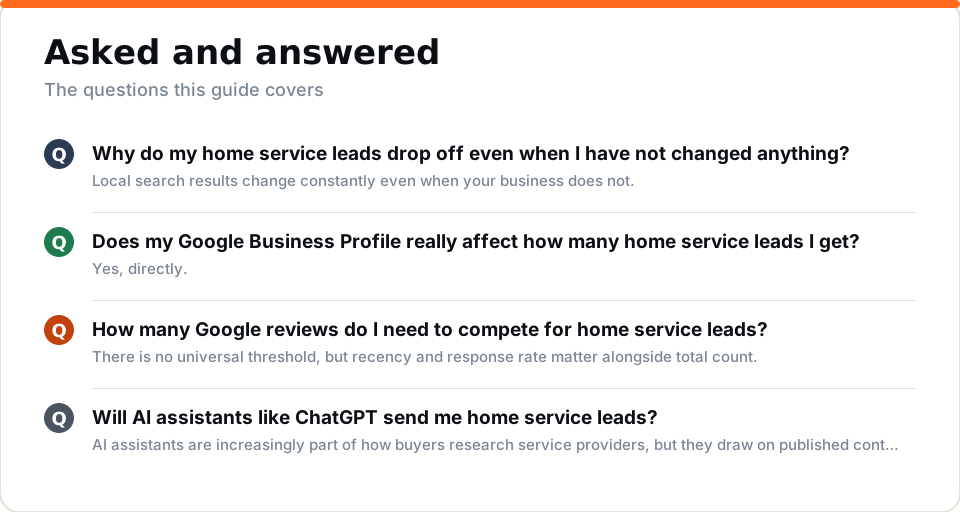
- Why do my home service leads drop off even when I have not changed anything?
- Local search results change constantly even when your business does not. Competitors add reviews, update listings or publish new content, and your relative visibility shifts. A business that ranked well six months ago can slip without any single cause, which is why regular checks matter more than a one-time setup.
- Does my Google Business Profile really affect how many home service leads I get?
- Yes, directly. Your Google Business Profile controls whether your business appears in the local map results that buyers see before they visit any website. Incorrect categories, missing service area settings, or inconsistent contact details all reduce how often your profile is shown to people searching for what you offer.
- How many Google reviews do I need to compete for home service leads?
- There is no universal threshold, but recency and response rate matter alongside total count. A profile with 30 reviews posted in the last three months and consistent replies typically outperforms one with 150 older reviews and no recent activity. Steady, honest accumulation beats a one-time push.
- Will AI assistants like ChatGPT send me home service leads?
- AI assistants are increasingly part of how buyers research service providers, but they draw on published content and structured data rather than paid listings. A business with accurate listings, consistent information and useful content online is more likely to be cited. Visibility in AI tools is a separate check from Google rankings and worth tracking on its own.
- What is the fastest thing I can fix to improve my home service lead flow?
- Audit your Google Business Profile and your top directory listings for NAP inconsistencies first. Conflicting name, address or phone information across directories undermines trust signals across the board and is often the fastest single fix available, especially for businesses that have moved or changed their phone number in the past few years.
See where your own business stands.
We measure your local rankings, your listings, your website, and how AI assistants answer for your business. No signup required.
Or jump straight to pricing →