
Notes
How to Tell an Honest SEO Offer From One That Is Too Good to Be True
Two offers reached us this month, and both were built to sound safe. One promised a guaranteed top ranking. The other offered to do SEO work that someone else would put their name on. Neither is unusual.
Reviewed by Melike Erguven, Co-founder of LocalLeadSignal · September 21, 2026 · 7 min read

Two offers reached us this month, and both were built to sound safe. One promised a guaranteed top ranking. The other offered to do SEO work that someone else would put their name on. Neither is unusual. Offers like these reach small business owners every week, and most owners do not have time to read the fine print behind them.
We read it for both. This article walks through what we found, why a ranking guarantee is harder to keep honestly than it sounds, and the questions that separate a careful provider from a risky one. We will not name either company. The point is to help you recognize the pattern, not to single anyone out.
The ad that promised number one
This month an online ad caught our attention. A local SEO service promised a number one ranking on Google, on Google Maps and in AI search within three months, or your money back, for a few hundred dollars a month.
It is an attractive offer, and it is easy to see why it works. A business owner wants certainty, and a guarantee with a refund sounds like the seller is taking the risk.
Google's own guidance on hiring an SEO is direct about this. It says no one can guarantee a #1 ranking on Google. There are three practical reasons.
No outside company controls the order. Google decides which pages to show and in what order, and it does not hand that decision to any outside company.
Map results change with the person searching. Google says local results depend mainly on relevance, distance and prominence, and distance means how far the business is from the searcher. A business can sit at the top of the map for someone standing outside its door and much lower for a customer a few miles away.
AI answers are not fixed either. An AI assistant can answer the same topic differently depending on how the question is phrased, and a new conversation can produce a different list of names. A promise to be "first in AI search" needs to say which question it means.
How a guarantee can still be met on paper
A guarantee can be honored in a narrow sense and still bring you nothing. Three details decide that.
Who picks the keyword. Ranking first for a long, specific phrase that almost nobody searches is often achievable. Ranking first for the phrase your customers actually type is a different job. If the agreement does not list the keywords, along with how often each one is searched, the promise can be satisfied with terms that bring nobody to your door.
Where the ranking is checked. A map ranking measured from your own address will look much better than what a customer across town sees. Ask where each check is taken from.
Which document you sign. In the offer we read, the ad and the contract said different things. The published terms of service said the company makes no guarantees about the performance of its marketing services. A guarantee applied only if it was written into the individual order form, and only while the client met a list of conditions. The refund policy ended refund eligibility once the kickoff call had taken place.
None of that is hidden. It is simply in a different place from the ad. The ad sells the promise. The terms define it. Read the one you sign, and ask for any guarantee to be written into it with the keywords, the locations and the measurement method named.
The cold email that turned into a reseller chain
Around the same time, we received a generic cold email offering SEO, local SEO and link building from a team that said it had more than 15 years of experience, and asked whether it could send packages and pricing. We replied to see the offer. The answer came from a different company, with our thread forwarded to it.
That company described itself as a white label team that delivers SEO under an agency's brand, with unbranded reports the agency can put its own logo on. Its wholesale rates were a few hundred dollars a month per local client, and a pricier national package included a set number of what it called high DA contextual backlinks each month.
White label work is legal and common. Plenty of agencies use outside specialists. What matters for a small business is what the arrangement can hide.
You may not know who does the work. The agency you meet sells the plan. A separate team you never speak to may carry it out. If something goes wrong, the people who can explain it are two steps away from you.
The report may not tell you who did what. A report with the agency's logo on it can be produced by someone else entirely. That is not wrong in itself, but it means the report alone does not show you who made each change.
The margin has to come from somewhere. When a plan is bought at a wholesale rate and resold, the budget that reaches the actual work is the smaller number. Ask what you are paying for, line by line.
What link packages can cost you
Packages that promise a fixed number of backlinks every month deserve a careful look. "DA" usually refers to domain authority, a score calculated by third party SEO tools. It is not a number Google publishes.
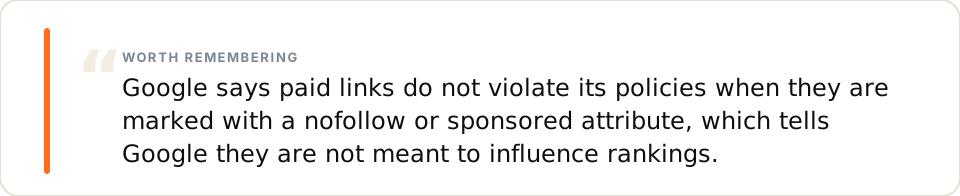
The bigger issue is how the links are obtained. Google's spam policies describe link spam as creating links mainly to manipulate rankings, and they list buying or selling links for ranking purposes as an example. Google says paid links do not violate its policies when they are marked with a nofollow or sponsored attribute, which tells Google they are not meant to influence rankings. The same policies say sites that violate them may rank lower or not appear in results at all.
A provider who sells a guaranteed count of links each month should be able to tell you where those links come from and whether any money changed hands for them. If they cannot, the risk sits with your website, not theirs.
Five questions to ask any SEO provider
Google's guidance suggests asking a provider for examples of previous work, their experience in your industry and how long results take. These five questions build on that.
- Who does the work? Ask whether the team you are talking to makes the changes, or whether the work is passed to another company.
- What exactly will you change? A clear answer names the pages, the listings and the content, not just "optimization".
- What do you measure, and where can I see it myself? You should be able to check rankings, traffic and calls in tools you control, such as your own Search Console account, not only in their report.
- What happens if a guaranteed phrase is not one anyone searches? Ask for the search volume of every keyword in a guarantee before you sign.
- Is the contract month to month? If it is not, ask what happens if you want to leave and what you keep when you do.
A trustworthy provider will answer all five without hesitation. Vague answers are information too.
What we promise, and what we do not
It is fair to ask the same questions of us.
We do not guarantee rankings. Our terms of service say plainly that we do not guarantee specific outcomes, because search engines, competitors and local demand are outside our control. Our plans have no contract, and monthly plans can be cancelled at any time from the dashboard.
What we can promise is transparency about what we do. We automate the repeatable work and bring the decisions that need a person to a person. Since June we have run LocalLeadSignal on our own website the same way it runs for our customers, and we have written openly about what that taught us, including the mistakes, in our experiment results.
Source: Pew Research Center, 2025
Where to start
If you are weighing an offer right now, start with the five questions and ask for the answers in writing. If you want to see where your own business stands before you talk to anyone, our walkthrough of what a local SEO audit actually looks at explains each check, and you can run a free local SEO audit on your own site. It measures what is there today and promises nothing about tomorrow.
Frequently asked questions
- Can an SEO company guarantee a #1 ranking on Google?
- No. Google's own guidance on hiring an SEO says no one can guarantee a #1 ranking on Google. If an offer promises one, ask which keyword, which location and which signed document the promise is written in.
- What is white label SEO?
- White label SEO is work done by one company and sold under another company's brand. It is legal and common, but it means the agency you hire may not be the team doing the work, so ask who makes the changes.
- Are monthly backlink packages safe?
- Google's spam policies treat buying links for ranking purposes as link spam, and sites that violate the policies may rank lower or not appear in results. Ask any provider where each link comes from and whether it was paid for.
See where your own business stands.
We measure your local rankings, your listings, your website, and how AI assistants answer for your business. No signup required.
Or jump straight to pricing →