
Notes
Physical Therapy Marketing in 2026: From Google Map Pack to AI Search Visibility
Most physical therapy practices run on referrals. A few good relationships with orthopedic surgeons or primary care physicians, and the schedule stays full.
Reviewed by Melike Erguven, Co-founder of LocalLeadSignal · July 10, 2026 · 14 min read
Most physical therapy practices run on referrals. A few good relationships with orthopedic surgeons or primary care physicians, and the schedule stays full. That model works right up until it doesn't, and when the referral pipeline slows down, whether a key doctor retires, a competing clinic opens two blocks away, or a hospital system starts steering patients in-house, you feel it fast.
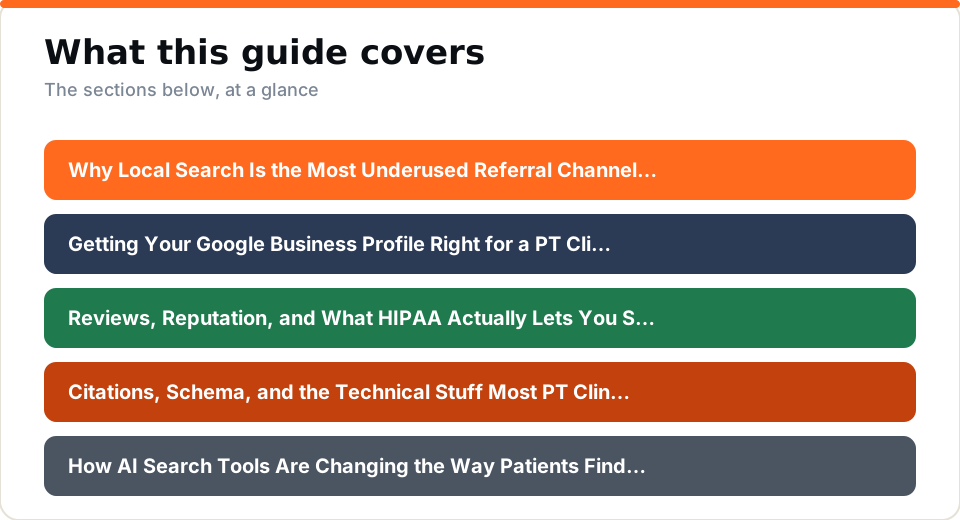
The good news is that organic search is genuinely winnable for PT clinics right now. Most practices are either ignoring local SEO completely or doing just enough to stay mediocre: a half-filled Google Business Profile, a few old reviews, and a website that hasn't been touched since 2021. The bar is low, and clearing it doesn't require a massive agency retainer. This guide covers what actually moves the needle in 2026, from showing up in Google's map pack to getting mentioned in AI tools like ChatGPT and Perplexity, in plain language without the agency jargon.
Why Local Search Is the Most Underused Referral Channel for PT Practices
Patients don't wait for a referral slip to start researching. Before they ever call your front desk, most of them have already searched something on their phone, read a few reviews, looked at photos, and formed an opinion about whether your clinic feels right. That's the actual decision-making process in 2026, and it happens mostly outside the referral relationship.
Physical therapy marketing has historically leaned hard on physician referrals and word of mouth because those channels work. But they're also completely outside your control. Local search is different. You can influence it, measure it, and improve it over time, and when you do it well, it generates patient inquiries around the clock without you having to maintain a relationship with every doctor in a twenty-mile radius.

Local SEO and traditional SEO look similar on the surface but operate differently in practice. Traditional SEO is mostly about ranking pages on Google's main results for broad, competitive terms. Local SEO is about showing up in the map pack, the local finder, and location-based queries for people who are actively looking for a service near them right now. For a single-location PT clinic or a small multi-location practice, the map pack is where the action is. Ranking for "physical therapist" nationally is irrelevant to you. Ranking in your town's map pack for "physical therapist near me" or "PT for shoulder pain" is everything.
Local keyword research for physical therapy looks a lot different from what most SEO guides describe. You're not chasing high-volume national keywords. You're looking for long-tail local keywords that reflect what real patients type when they're ready to book, things like "PT for shoulder injury near me," "sports rehab after ACL surgery," or "physical therapist accepting Medicare." These queries have lower search volume but much higher intent. Someone searching "PT for lower back pain" isn't casually browsing, they're ready to make an appointment.
That's also why local SEO levels the playing field against hospital-affiliated clinics. A large health system has more brand authority and a bigger marketing budget, but they're often slow to optimize individual location profiles and rarely collect reviews at the same pace an independent or small group practice can. A well-optimized Google Business Profile with steady recent reviews from real patients can absolutely outrank a hospital clinic in the local map pack, and it does so on a fraction of the budget.
Getting Your Google Business Profile Right for a PT Clinic
Your Google Business Profile is the most valuable piece of digital real estate your practice has, and most PT clinics are leaving most of it empty. Google uses your profile to decide whether you're relevant and trustworthy enough to show in the map pack, so every blank field is a missed signal. According to Google's own guidance on improving local ranking, businesses that provide complete and accurate information are more likely to appear in relevant searches.
The fields that matter most for a PT practice go beyond your name, address, and phone number. Your services section should list specific treatments you offer, manual therapy, dry needling, post-surgical rehab, vestibular therapy, whatever applies to your clinic. Don't leave it generic. The business description should use natural language that reflects how patients actually describe their problems, not clinical jargon. Your hours need to be accurate and updated for holidays, because a patient who shows up when you're closed doesn't come back.
Common GBP mistakes in physical therapy practices cluster around a few recurring issues. Keyword-stuffing the business name, something like "City PT Clinic, Back Pain, Sports Rehab, Insurance Accepted," is a direct violation of Google's guidelines for representing your business and can get your listing suspended. Leaving the services section blank is probably the most common mistake. Skipping the Q&A section entirely is another one, because those questions populate whether you answer them or not, and the answers can come from anyone.
Posts, photos, and Q&A are easy wins most clinics ignore. A photo of your treatment area, your team, your equipment, tells Google your profile is active and tells patients what to expect. A post about your telehealth options or a new therapist joining your team is a signal that you're engaged. Answering questions in the Q&A section with useful information, hours, parking, what to bring to a first appointment, keeps you in control of what patients see before they call.
Healthcare local SEO has one layer traditional businesses don't deal with: HIPAA. When you're responding publicly to reviews or posting content on your profile, you cannot confirm or deny that someone is a patient, and you cannot reference any detail about their care, even if they've already disclosed it in their review. The right approach in healthcare is to thank the reviewer for their feedback, invite them to contact your office directly, and keep your response generic enough that it works for any patient. Never mirror back what they said or engage with clinical specifics in a public reply.
Reviews, Reputation, and What HIPAA Actually Lets You Say
Online reputation management is more complicated for physical therapy practices than it is for a restaurant or a landscaping company. The stakes are higher, the rules are stricter, and patients are often sharing personal health information in their reviews whether you asked them to or not. That combination makes a lot of PT owners nervous, so they do nothing, which is a mistake.
Your star rating matters. Your review count matters. But what actually drives map pack ranking is review velocity and recency, meaning how often you're getting new reviews and how recent they are. A clinic with 200 reviews from three years ago is being outranked by a competitor with 40 reviews from the last six months. Google interprets fresh reviews as a signal that your business is active, credible, and relevant. Recency is one of the most underestimated factors in google map pack ranking.

Getting more Google reviews from happy patients doesn't require a complicated system or an expensive tool. The most effective approach is also the simplest: ask at the right moment. For most PT clinics, that's at discharge, when a patient has just finished a course of treatment and is feeling the results. A brief verbal ask followed by a text message with a direct link to your Google review page converts well because the emotional high point and the request land close together in time. According to Google's review management guidelines, you can ask patients to leave reviews, but you cannot incentivize them or set up review stations on your premises.
HIPAA-compliant marketing means you have to be careful about how you frame the ask. You're not asking patients to describe their diagnosis or their treatment plan, you're inviting them to share their experience with your clinic, your staff, your environment. That's fair game. What you want to avoid is coaching them to include clinical details, and what you need to manage carefully is your response if they include those details on their own.
Responding to negative reviews in a healthcare setting is its own skill. The HIPAA-safe response formula is simple: acknowledge that you heard the concern, express that you take feedback seriously, and invite them to reach out directly so you can address it offline. You do not confirm they're a patient. You do not address the specific claim. You do not get defensive. Reputation recovery from negative reviews in healthcare is almost always slower than the damage, so the goal is to prevent the one-star review from being the last word, not to win an argument publicly.
A natural review follow-up process doesn't feel pushy because it's timed correctly and framed correctly. A text message that says "We loved working with you, if you'd be willing to share your experience on Google it would really help other patients find us" is honest, brief, and easy to act on. That's the whole system.
Citations, Schema, and the Technical Stuff Most PT Clinics Skip
Local citations are mentions of your practice's name, address, and phone number across directories, listing sites, and healthcare platforms. They're not glamorous, but they matter because Google cross-references your information across sources to verify that your business is real and consistently located where you say it is. NAP consistency, having exactly the same name, address, and phone number everywhere, is one of the foundational signals in local search.
Inconsistencies seem trivial until you realize how many of them exist in the wild. "Suite 101" versus "Ste 101" versus no suite number at all across different directories sends conflicting signals. An old phone number on a citation you forgot about routes patients to a dead line. These aren't catastrophic individually, but collectively they depress your local rankings and create friction for patients trying to contact you.
Citations versus backlinks is a question that comes up a lot, and the honest answer is that they serve different purposes. Citations validate that you exist and are who you say you are. Backlinks pass authority and indicate that other credible sites consider your content worth referencing. For a new or underperforming PT practice, citations come first. Get your basic information right and consistent across the important directories before you start worrying about building links.
For physical therapy specifically, the directories that matter extend beyond the standard citation sources. Healthgrades, Zocdoc, Vitals, Psychology Today's therapist directory, and WebMD's physician finder are all worth claiming and keeping accurate. These healthcare platforms get real search traffic from people looking for providers, and a complete profile on each one is both a citation and a potential direct source of new patients.
Local business schema markup is a piece of structured data you add to your website that helps search engines understand exactly what kind of business you are, where you're located, what your hours are, and what services you offer. For PT clinics, schema markup for healthcare providers can include the types of conditions treated, the accepted insurance types, and the medical specialty. Google doesn't always display this data visibly, but it uses it when building its understanding of your site.
Local link building for a PT clinic doesn't require cold outreach to obscure websites. The strongest local links come from relationships that already exist: the gym your therapists work with, the youth sports league your clinic sponsors, the chiropractic office that refers patients to you, the corporate wellness program your practice participates in. When those organizations mention you on their websites and link to yours, that's a local backlink with genuine relevance. A few of those are worth more than dozens of generic directory links.
How AI Search Tools Are Changing the Way Patients Find PT Clinics
ChatGPT, Perplexity, and Gemini are no longer just tools for writing emails and summarizing documents. Patients use them to ask health-related questions, compare treatment options, and increasingly, to find local providers. Someone might ask Perplexity "what should I look for in a physical therapist for rotator cuff rehab" and receive a response that names specific practices in their area. That's happening now, not in some future version of search.
Generative engine optimization, or GEO, is the practice of making your business more likely to appear in AI-generated answers. It's different from standard SEO in a meaningful way: search engines return a list of links and you compete for position, while AI tools synthesize information and either mention you or they don't. The signals that influence whether you get mentioned are different too. It's less about keyword density and more about the quality and consistency of information that exists about your practice across the web.
Your website content plays a significant role. AI tools are trained on and retrieve from publicly available text, so a PT practice with a website that clearly explains what conditions it treats, what methods it uses, what makes it different, and where it's located is more likely to be cited in a relevant AI response than one with five lines of boilerplate copy. If you want to understand the full picture of how to show up across AI tools like ChatGPT and Perplexity, understanding AI visibility for local business is worth a close read, because the signals are layered and some of them aren't obvious.
Third-party mentions matter a lot for AI visibility. When reputable health directories, local news sites, or community organizations mention your practice by name in context, that information feeds into what AI tools know about you. It's essentially the same principle as local link building, but the goal isn't just Google authority, it's becoming part of the information record that AI systems draw from.
Voice search local SEO for PT practices follows a similar pattern to AI search, because voice queries are conversational and usually intent-heavy. Someone asking their phone "find me a physical therapist who treats running injuries" isn't browsing, they're ready to act. Optimizing for these queries means writing content in the same natural, question-and-answer style that patients use when they speak, not the compressed keyword strings people typed into search boxes in 2015. FAQ sections, clearly written service pages, and a detailed GBP all contribute to how well you show up in voice and AI-driven results.
The practical steps to improve your AI visibility as a PT clinic aren't wildly different from good local SEO: keep your GBP accurate and active, build out your website with clear and specific content about your services, earn mentions on reputable third-party platforms, and maintain NAP consistency everywhere your practice appears. The difference is that AI tools weight content quality and third-party corroboration more heavily than raw link counts. A practice that's well-described across multiple credible sources is one that AI can confidently recommend.
What a Physical Therapy Marketing Plan Actually Looks Like at $249 a Month
Most SEO companies that work in healthcare start their pricing at $500 to $1,000 per month per location, and that's before you factor in setup fees. They also tend to assume you have a marketing coordinator who can handle the day-to-day tasks, someone to upload photos, respond to reviews, manage listings, and track what's working. Independent PT practices and small group practices usually don't have that person. The owner is also the director of rehab, the HR department, and the person fielding calls about insurance.
That's the gap LocalLeadSignal was built to fill. Starting at $249 a month with no contract, the service covers the work that most PT clinics either aren't doing at all or paying far too much to outsource: tracking your local visibility, managing your business listings, handling reviews, and building out your AI visibility so that you're more likely to appear when patients use tools like ChatGPT or Perplexity to search for care.
The comparison to tools like BrightLocal or Birdeye is worth being direct about. Those platforms are useful, but they're tools, not services. You still have to log in, interpret the data, decide what to fix, make the fixes, and repeat the cycle. If you have someone on staff who can do that consistently, great. If you don't, you're paying for a dashboard that doesn't move the needle on its own.
A physical therapy SEO case study, when done honestly, usually follows a predictable first-90-day arc. The early work is almost always foundational: fixing the GBP, correcting citation inconsistencies, getting the website to meet basic technical requirements as outlined in the Google Search Essentials, and establishing a review request process. Visibility improvements start showing up in local search within weeks for clinics that had significant gaps, longer for ones that were already partially optimized. There's no shortcut, but there's also no mystery.
Thinking about healthcare local SEO as a one-time project is the mistake that keeps most PT practices stuck. Your competitors are changing, Google's algorithm is changing, AI tools are evolving, and your profile and content need to keep pace. A no contract SEO arrangement at a price point that makes sense for a single-location clinic is designed to be the kind of thing you keep running in the background rather than the kind of thing you sprint through once and abandon. Affordable local SEO isn't about cutting corners, it's about right-sizing the effort so that a PT practice owner can sustain it without a major financial commitment.
PT practices don't need a massive agency or an in-house marketing team to compete online. The tactics are clear, the tools are accessible, and the clinics winning in local search right now aren't necessarily the biggest or the best funded, they're just the ones that showed up and did the work consistently.
The cost of doing nothing is real and specific: patients searching for PT in your area are finding your competitors, forming impressions before they ever call, and booking appointments at practices that took the time to optimize their profiles, collect reviews, and make their websites useful. That's fixable.
See how LocalLeadSignal handles physical therapy marketing for you, from your Google Business Profile to AI search visibility, starting at $249 a month with no contract at /pricing.
Frequently asked questions
- How do I get my physical therapy clinic to show up on Google Maps?
- Start by fully completing your Google Business Profile, making sure your name, address, and phone number match every other directory listing you have. Consistent citations, recent patient reviews, and relevant content on your website all contribute to map pack visibility. Proximity, relevance, and prominence are the three factors Google weighs.
- Can I ask patients for Google reviews without violating HIPAA?
- Yes, you can ask patients to leave a review as long as your request does not reference their treatment, diagnosis, or any protected health information. A general ask like 'if you had a good experience, we would appreciate a Google review' is typically fine. Never respond to reviews in a way that confirms someone is your patient.
- What is the difference between local SEO and regular SEO for a PT practice?
- Local SEO focuses on ranking in map pack results and 'near me' searches, which is where most physical therapy patients start. Traditional SEO targets broader organic rankings. For a single-location PT clinic, local SEO almost always delivers faster, more relevant results because it targets people who are ready to book.
- Will AI tools like ChatGPT recommend my physical therapy clinic?
- They can. AI tools pull from your website content, third-party mentions, review platforms, and structured data when forming local recommendations. Clinics that have strong Google Business Profiles, consistent citations, and authoritative content are more likely to surface in AI-generated answers about physical therapy providers.
- How much should a physical therapy practice spend on local SEO?
- Most agencies start at $500 or more per month and expect you to manage your own listings and reviews on top of that. LocalLeadSignal starts at $249 per month with no contract and handles tracking, listings, reviews, and AI visibility for you, which makes it a realistic option for solo or small PT practices.
See where your own business stands.
We measure your local rankings, your listings, your website, and how AI assistants answer for your business. No signup required.
Or jump straight to pricing →