
Notes
Plumber SEO Works Differently Than Most Marketing Advice Suggests
If you run a plumbing business, you have probably gotten the calls. An agency reaches out, promises page-one rankings, quotes you a monthly fee, and offers very little explanation of what they will actually do.
Reviewed by Melike Erguven, Co-founder of LocalLeadSignal · November 6, 2026 · 16 min read

If you run a plumbing business, you have probably gotten the calls. An agency reaches out, promises page-one rankings, quotes you a monthly fee, and offers very little explanation of what they will actually do. You hang up, go back to work, and three months later you still have no clear idea whether the SEO you paid for is doing anything. That frustration is not a sign that plumber SEO is too complicated to understand. It is a sign that most of the people selling it are not explaining it honestly.
The mechanism is not mysterious. Plumbing searches tend to be urgent, hyper-local, and concentrated in a very short window of intent. The signals that determine who shows up in that window are specific and measurable. But the signals are layered, and that layering is exactly what makes it easy to work on the wrong thing. You can have a clean website and still be invisible on the map. You can rank on the map and still lose planned-work jobs to a competitor with better content. Understanding which layer is broken, and in what order to fix the layers, is what separates plumber SEO that works from plumber SEO that feels like a black box.
This article walks through the mechanism clearly, so by the end you know what the signals are, how they interact, and what a realistic sequence of work looks like.
Why Plumbing Leads Come From a Very Short Window of Search Intent
Most plumbing searches are not research projects. A pipe is leaking. The water heater stopped working at 6 a.m. The toilet is backing up before guests arrive. The searcher types something fast, looks at the first two or three results, and calls whoever appears credible and available. They are not comparison shopping. They are not reading blog posts. The window from search to phone call can be under two minutes.
That urgency compresses the ranking opportunity in a specific way. For emergency and same-day queries, the Google Map Pack captures the majority of attention. Those three businesses in the map result, with their star ratings and phone numbers visible before anyone clicks through, are where most of the calls come from. If a plumbing business is not in that pack for its primary service area, it is essentially invisible for the most high-value queries it could be winning.
This makes map pack ranking the first priority for most plumbers, not organic rankings, not a blog, not social media. The organic results below the map pack still matter, but they matter more for a different kind of query.
Not every plumbing search is urgent. Planned work follows a longer path:
- Water heater replacement queries often start with cost research, comparison of options, and a look at reviews before anyone calls
- Bathroom remodel plumbing or fixture upgrades involve a homeowner in early research mode who may not call for days or weeks
- Slab leak detection searches sometimes come from people who noticed a symptom and are trying to understand what they are dealing with before they commit to a service call
For those queries, organic rankings and informational content start to carry real weight. A plumber who shows up in the map pack for emergencies but has no content presence will win the urgent jobs and lose the planned ones to competitors who have both.
Understanding which query type you are targeting changes which lever you pull first. If your business primarily handles emergency calls, GBP optimization is where the return is. If you want to grow the remodel and replacement side of the business, content and organic rankings need to be part of the plan.
Voice search and AI assistant queries are also pulling more local searches into a channel that is easy to overlook. When someone asks a smart speaker or an AI assistant to find a plumber nearby, the response draws on a different set of signals than a traditional search results page. We will cover that later in this article, but the short version is that it is becoming part of the same conversation as traditional local SEO rather than something separate.
The Google Business Profile Signals That Determine Whether a Plumber Appears in the Map Pack
Google Business Profile optimization is the single highest-leverage task for most plumbing businesses. Not website code, not backlinks, not a blog. The GBP is what Google reads to decide whether a plumber is eligible for the local pack and how prominent it should be within that pack.
Google's own documentation on local ranking describes three factors: proximity, relevance, and prominence. Proximity is how close the business is to the searcher, and it is largely outside a plumber's control. Relevance and prominence are not. Relevance is how well the profile matches what someone is searching for. Prominence is how well-known and trusted the business appears across the web. Both of those are directly improvable through the GBP itself and through the broader citation and review ecosystem.
The GBP mistakes that suppress map pack rankings for plumbers are surprisingly consistent:
- Wrong or vague service area settings that tell Google the business serves a region too broad to be relevant for a specific neighborhood query, or too narrow to capture adjacent areas where the plumber actually works
- Missing or uncategorized services, which leaves Google guessing about what the business actually does rather than matching it confidently to searches for drain cleaning, water heater installation, or leak repair
- Incomplete hours, especially for emergency availability; if a plumber takes after-hours calls but has no hours listed, that information is not visible to searchers or to Google's ranking logic
- Generic or irrelevant photos that do not show actual work, actual equipment, or the actual service area; Google's systems and searchers both use photos as a relevance signal
NAP consistency is foundational. NAP stands for name, address, and phone number, and the version of each that appears on the GBP needs to match exactly what appears across the rest of the web. Even small variations, a shortened business name in one directory, an old phone number still live on a data aggregator, create conflicting signals that erode the profile's authority in Google's eyes.
GBP posts, Q&A responses, and service listings are not optional extras. They are relevance signals. A plumber who keeps service listings current, answers questions publicly, and posts occasionally is giving Google more to work with when matching the profile to a search. Google's tips for improving local ranking, documented in the Business Profile Help resources, consistently point to profile completeness as a factor in how well a business performs in local results. You can find those tips directly in Google's Business Profile Help.
Reviews are a prominence signal, and the mechanics are worth understanding honestly. Volume matters. Recency matters more than most people expect. A plumber with eighty reviews from three years ago and nothing recent will be outpaced by a competitor with forty reviews spread across the last twelve months. Response behavior also matters, not because replying to reviews directly boosts rankings, but because it signals an active and engaged business. The practical goal is steady review velocity over time, not a burst campaign that stops. Asking satisfied customers to leave a review at the moment of service completion is the highest-conversion point in the review cycle because the positive experience is fresh.
"Most of the time, the customer has an emergency with their plumbing, and they need to pick the best plumbing service in the shortest time possible."
Melike Erguven, Co-founder of LocalLeadSignal
Local Citations and Why Inconsistent Listings Quietly Suppress Rankings
A local citation is any mention of a business's name, address, and phone number on a site that is not the business's own website. Directories, data aggregators, review platforms, trade association listings, home services marketplaces. For plumbers, these citations exist in dozens of places, many of which were populated automatically and have never been checked.
The aggregators matter most. A handful of major data companies compile and distribute business information to a large network of downstream directories and apps. If the aggregator has an old address or a disconnected phone number, that bad data propagates across dozens of sites without anyone doing anything. The GBP can be perfectly optimized and still lose ranking authority to a competitor whose citation ecosystem is cleaner.
It is worth being clear about what citations actually do versus what backlinks do, because these are frequently conflated:
- Citations confirm that a business exists, is located where it claims to be, and operates under a consistent name and phone number. They tell Google the business is real and locally rooted.
- Backlinks carry authority from other websites to your own. They tell Google that other sources find your content credible enough to reference. They serve a different function in the ranking algorithm and require a different kind of effort to build.
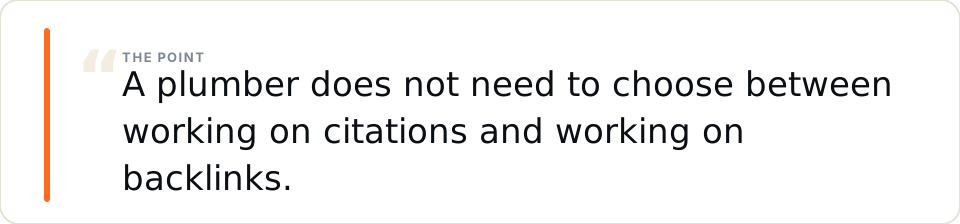
A plumber does not need to choose between working on citations and working on backlinks. Both matter. But citation cleanup comes first, because you cannot build authority on top of a foundation of conflicting signals.
What a citation audit actually looks for:
- Duplicate listings on the same platform, which split signals and confuse search engines about which listing is authoritative
- Name variations across directories, like using "Smith Plumbing LLC" on the GBP but "Smith Plumbing" or "Smith Plumbing and Drain" elsewhere
- Address mismatches, especially for plumbers who have moved, rebranded, or added a location
- Outdated phone numbers still live on older directory entries
- Missing listings on directories that competitors have claimed and you have not
Remediation means claiming unclaimed listings, correcting the data, requesting removal of duplicates, and submitting corrections to the major aggregators directly. That process takes time. Each platform has its own workflow. Some accept corrections quickly, others take weeks. This is one of those areas where the work is not technically difficult but is genuinely tedious, which is why many plumbers either leave it undone or hand it off to someone who handles it for them.
Content and On-Page SEO for Plumbers Who Are Not Writers
A well-optimized GBP and clean citations get a plumber into the map pack for emergency searches. They do not, on their own, drive organic rankings for the longer-tail queries where planned work decisions get made. That requires content, and for plumbing businesses it requires a specific kind of content.
Service pages are the foundation. A single generic "services" page does not give Google enough to work with. Individual pages for drain cleaning, water heater installation, water heater replacement, slab leak detection, and fixture work each give Google a clear target to match against specific queries. Location pages serve the same function for geographic coverage. A plumber serving multiple towns benefits from individual pages that address each area specifically, not a single page that lists them all in a paragraph.
Long-tail local keywords are where the real organic opportunity lives. Not "plumber" as a broad term, which is brutally competitive. Instead:
- Cost and comparison queries like questions about water heater replacement cost, tankless versus traditional, or what a service call typically includes
- Problem-specific searches where a homeowner describes a symptom and is trying to identify the cause before calling anyone
- Urgency-adjacent queries like same-day availability or emergency service for specific issues
Local keyword research, done practically, means thinking through what real customers ask before and during the decision to hire. You can use keyword tools to find search volume estimates, but the more important input is often a list of the questions your phone calls and estimate conversations actually start with. Those questions are the content brief.
Local business schema markup is a technical signal that tells search engines exactly what the business is, where it operates, and which services it offers. It is added to a website's underlying code rather than displayed directly on the page. Many plumbing websites are missing it entirely, which means Google has to infer that information rather than read it directly. It is not difficult to implement, but it requires someone who knows what they are doing to set it up correctly. Getting it right helps both traditional search rankings and AI assistant citations, which we will cover next.
Refreshing underperforming service pages is often more valuable than publishing new content from scratch. A page that already ranks on page two for a target query is closer to the first page than a new page with no history at all. Updating it with more complete information, better internal links, and clearer answers to the questions a searcher is likely to have can move it significantly without starting over.
For a plumber without a marketing team, the hardest part of content is not knowing what to write. It is consistency. One well-written service page does not build ranking authority by itself. The value accumulates over time through a steady cadence of useful, accurate content. That is why we designed LocalLeadSignal's content engine to draft that content each week, so the cadence happens even when the owner is on a job site.
If you want a broader view of how local SEO works across all these layers, our 2026 guide for single-location service businesses covers the framework in depth.

How AI Assistants Are Changing the Way Plumbers Get Found and What to Do About It
The channel shift is real. AI assistants like ChatGPT, Perplexity, and Gemini are answering local service queries directly, and in some cases the user never sees a traditional search results page at all. They ask the assistant which plumbers in their area handle emergency calls on weekends, and the assistant returns a list. The question for a plumbing business is whether it ends up on that list.
Generative engine optimization, often called GEO, is the practice of making a business more likely to be cited when an AI assistant answers a relevant question. For local service businesses, it is a newer layer on top of traditional local SEO. Not a replacement. The signals AI systems appear to draw on for local recommendations overlap significantly with traditional ranking signals: consistent citations, strong review volume and sentiment, authoritative content, and structured data that makes the business's information machine-readable.
Since June 2026, we have run our own platform on LocalLeadSignal's own website, using the same checks we run for customers. Part of that involves weekly visibility checks asking AI assistants which businesses they recommend for relevant queries. Our experience has been that for highly competitive buyer-intent questions, established brands with longer track records tend to surface more reliably than newer entrants. AI assistants appear to weight authority that has accumulated over time, not just recent signals.
What that means for a plumber: the work of building traditional local SEO signals is also the work of building AI visibility. They reinforce each other. A business with clean citations, strong reviews, consistent structured data, and useful content on its website is better positioned in AI results than a business that has been trying to shortcut those fundamentals.
AI search citations rely heavily on structured data as connective tissue. When a business's website clearly communicates its name, location, service area, service types, and contact information in a machine-readable format, an AI assistant can cite it with more confidence. When that information is absent or inconsistently presented across the web, the assistant may omit the business entirely, not because it dislikes the business, but because the signal is not strong enough to act on confidently.
Voice search fits into this same picture. A voice query asking for an emergency plumber nearby is processed by the same AI-driven systems that power assistant responses. The plumbers who appear in those responses are the ones whose information is cleanest, most consistent, and most widely confirmed across authoritative sources.
What Plumber SEO Actually Costs and What to Watch Out For When Evaluating Offers
The cost range for local SEO for plumbers is genuinely wide. On one end, a plumber who is willing to learn can do much of the foundational work themselves using free or low-cost tools. On the other end, full-service agency retainers can run well into four figures per month for strategy, content, citations, and reporting. In between, software platforms like LocalLeadSignal handle the repeating tasks automatically at a fraction of agency pricing, and that model is genuinely viable for an owner who does not have a marketing team, as long as the owner actually reads what comes back and takes action on it.
Knowing the range is useful. Knowing the warning signs is more useful.
We reviewed an ad for a local SEO service that promised a guaranteed number-one ranking on Google, on Google Maps, and in AI search, within three months, for a few hundred dollars a month. That kind of guarantee should trigger skepticism immediately. When we read the terms of service for that specific offer, the company explicitly disclaimed any guarantee of performance in the legal text. The headline promise and the contractual reality were direct contradictions. The guarantee was in the marketing. The disclaimer was in the fine print.
A separate pattern involves white-label fulfillment. We received a cold email offering SEO services, and when we replied to learn more, the thread came back forwarded to a different company that described itself as a white-label team doing the actual work under the original sender's brand, with unbranded reports the agency could put its own logo on. This arrangement is legal and common in the industry. But a plumber paying for SEO services deserves to know who is actually doing the work, what their process is, and how they will be held accountable. Asking that question directly is reasonable.

The honest questions to ask any provider:
- What exactly do you measure, and how often do I see the report? Map rankings, search impressions, review velocity, citation consistency, and AI visibility are all measurable. Vague references to "traffic" or "leads" without a clear measurement framework are a warning sign.
- Who is doing the work? If the answer is unclear, that is worth pressing on before you sign anything.
- What happens if I want to stop? A contract that locks you in for twelve months on promises of future results is a different arrangement than a month-to-month service where your rankings either improve or they do not.
Google's own guidance on hiring an SEO is worth reading before you engage anyone. Google Search Central's tips on evaluating an SEO are blunt about the kinds of guarantees that reputable providers do not make.
LocalLeadSignal was built specifically for this situation: a plumbing business owner who does not have a marketing team and does not want to become one. Our plans start at $249 a month with no contract. Every plan tracks visibility in Google and in AI assistants and drafts SEO content each week. Higher plans add listings management, citation cleanup, review reply drafts, and a dedicated specialist. The goal is that the work actually happens, week after week, rather than sitting on a to-do list.
Source: Pew Research Center, 2025
What Comes Next
Plumber SEO is a stack of reinforcing signals. The most common reason it does not work is that one layer in the stack is broken while the others look fine on the surface. A beautiful website with good content and no citation consistency will underperform. A clean GBP with strong reviews and no content presence will lose planned-work queries. A business with everything in order but no AI visibility strategy will become less findable as that channel grows.
The three layers are worth naming plainly:
- GBP and map pack signals, including profile completeness, service listings, review velocity, and NAP consistency on the profile itself
- Citation consistency, meaning the accuracy and uniformity of business information across directories, aggregators, and trade sites
- Content and AI visibility, including service pages, location pages, schema markup, and the structured data that lets AI assistants cite a business confidently
The fastest way to know which layer is the problem is to measure what is actually there rather than guess. That is why we built a free local SEO audit tool. Point it at your plumbing business and it will show you which visibility signals are healthy, where citation or listing problems are quietly suppressing your map pack ranking, and whether AI assistants are naming you when someone nearby asks for a plumber. Start there. The gaps it finds are the specific work to do, not a generic list of SEO tasks, but the actual problems in your actual stack.
Frequently asked questions
- How long does plumber SEO take to show results?
- GBP improvements and citation cleanup can affect map pack visibility within a few weeks. Organic content rankings typically take three to six months to build. AI assistant visibility follows a similar timeline to organic SEO and depends on how consistently the business publishes credible, structured content.
- What is the most important SEO signal for a plumbing business?
- For most plumbers, Google Business Profile optimization is the highest-leverage starting point because it governs map pack eligibility. After that, NAP consistency across citations and a steady flow of genuine reviews are the next most influential signals for local search visibility.
- Do plumbers need to blog to rank in local search?
- Not for emergency queries, where map pack signals dominate. For planned-work searches like remodels, water heater replacements, or drain inspections, service and informational pages do help. Consistency matters more than volume: a small number of well-maintained pages outperforms a large number of abandoned ones.
- What should I watch out for when an SEO company guarantees rankings?
- Read the terms of service before signing anything. We reviewed an offer guaranteeing number-one rankings in Google, Google Maps, and AI search within three months; the terms explicitly disclaimed any performance guarantee. Any provider worth hiring will describe what they measure and how, not just what they promise.
- Will showing up in ChatGPT or Perplexity actually bring in plumbing leads?
- AI assistants are increasingly used for local service queries, so visibility there is worth building. The signals that help AI assistants recommend a business overlap heavily with traditional local SEO signals: consistent citations, review volume, and authoritative content. Strengthening those signals serves both channels at once.
See where your own business stands.
We measure your local rankings, your listings, your website, and how AI assistants answer for your business. No signup required.
Or jump straight to pricing →