
Notes
Generative Engine Optimization: How to Get Your Local Business Found in AI Search in 2026
Imagine this: someone in your town needs a chiropractor after a minor car accident.
Reviewed by Melike Erguven · June 22, 2026 · 12 min read

Imagine this: someone in your town needs a chiropractor after a minor car accident. They skip Google entirely, open ChatGPT, and type "who's a good chiropractor near me for whiplash?" ChatGPT gives them a confident, conversational answer with two or three specific recommendations. Your practice isn't one of them. You didn't do anything wrong. You just weren't set up for this new kind of search.
That's the gap that generative engine optimization, or GEO, is designed to close.
GEO isn't a replacement for local SEO. It's the next layer on top of it. The same trust signals that help you rank on Google, accurate listings, strong reviews, clear content, also help AI-powered tools like ChatGPT, Perplexity, and Gemini decide which local businesses are worth mentioning. The difference is in how you structure and present that information so AI can actually use it.
This guide is for service business owners, not developers. No jargon, no six-figure agency talk. Just a practical look at what GEO means for local businesses in 2026, what you need to do about it, and how to get it done without burning through your marketing budget.
What Generative Engine Optimization Actually Means (And Why Local Businesses Should Care)
Generative engine optimization is the practice of structuring your online presence so that AI-powered search tools can find, understand, and confidently recommend your business. That's really it. When someone asks ChatGPT for a recommendation or asks Perplexity which physical therapy clinic in their area handles sports injuries, those tools are pulling from indexed web content, structured data, and signals that indicate a business is real, credible, and relevant. GEO is about making sure your business sends those signals clearly.
It helps to understand how this differs from traditional SEO and local SEO, without dismissing either. Traditional SEO is broadly about ranking in search engine results pages. Local SEO narrows that focus to geographic relevance, things like your Google Business Profile, local citations, and map pack ranking. GEO adds a third layer: optimizing so that AI-generated answers include or reference your business when someone asks a question your business could answer.
For a long time, search looked like ten blue links. You typed something, you got a list, you clicked. That model still exists, but it's no longer the only game in town. AI search tools generate answers directly. They don't just point to sources; they synthesize them. And in that synthesis, a lot of local businesses quietly disappear.
Local service businesses are especially vulnerable here. If you're a dentist, a family law attorney, or a physical therapy clinic, you're probably not publishing the kind of high-volume content that trains AI models to recognize your expertise. Your website might be well-designed and technically solid, but if your information is scattered, inconsistent, or buried in formats AI can't easily parse, you're invisible in AI search. That's a real problem as more people shift toward conversational search tools.
The good news: GEO is learnable, actionable, and doesn't require a big agency retainer. Most of it builds on work you should already be doing for local SEO. Getting the foundation right puts you ahead of the majority of local service businesses that haven't even thought about this yet.
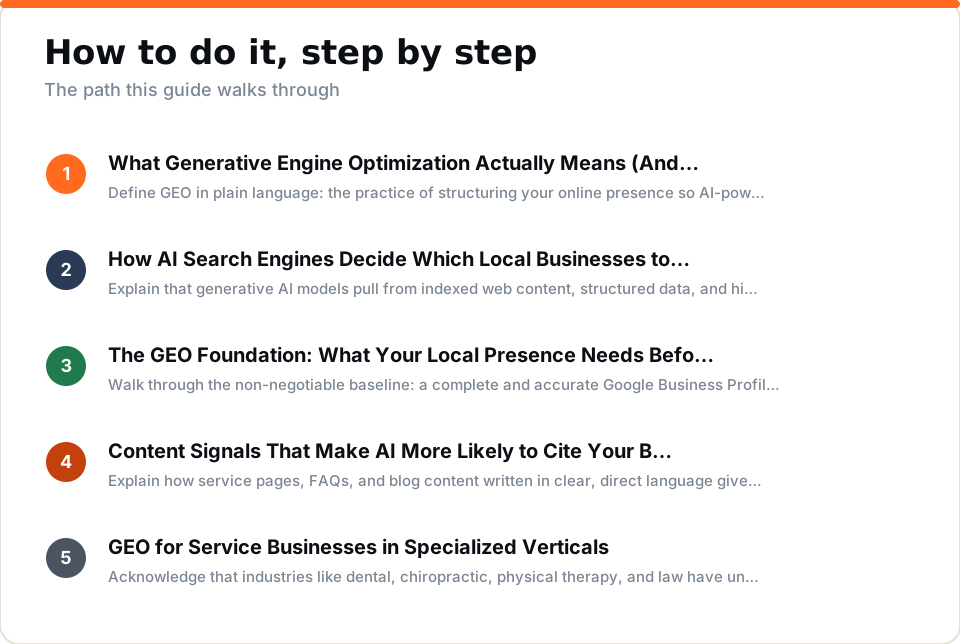
How AI Search Engines Decide Which Local Businesses to Mention
AI search tools don't run on ad spend. They don't care how much you've bid on keywords or whether you've signed a contract with a big agency. What they care about is signal quality. When a generative AI model gets a question about a local service, it's drawing from indexed content, structured data, and the collective credibility of what's been written about your business across the web.
AI search citations are a big part of how that credibility gets established. When your business is referenced accurately across multiple trusted sources, whether that's industry directories, local news sites, professional associations, or well-structured review platforms, AI models start to recognize your business as a legitimate, reliable entity. One citation won't move the needle. A consistent pattern of accurate, credible references across many sources signals that your business is real and worth mentioning.
Not all AI tools work the same way. ChatGPT, Perplexity, and Gemini each have different data sources and retrieval methods. Perplexity leans heavily on live web search and tends to cite sources directly. Gemini integrates tightly with Google's own data, which means your Google Business Profile and map pack presence carry extra weight there. ChatGPT pulls from its training data and, in some configurations, live browsing. Understanding how each of these platforms surfaces local business information matters when you're thinking about where to invest your optimization energy.
The concept of "answer-worthy" content is worth pausing on. AI models are more likely to cite content that is clear, factual, and consistently formatted. If your service pages are vague, your FAQs are buried, or your business description reads like a brochure from 2012, you're not giving AI much to work with. Short declarative sentences, specific service descriptions, and direct answers to common questions all make your content easier for AI to paraphrase or quote with confidence.
NAP consistency, meaning your business name, address, and phone number matching exactly across every directory and listing, matters here just as much as it does for traditional local SEO. Inconsistent data confuses AI models the same way it confuses Google's local algorithm. If your address is listed three different ways across your listings, an AI tool can't confidently cite you because it can't confirm you're a single, stable business.
The GEO Foundation: What Your Local Presence Needs Before AI Can Recommend You
Before you think about sophisticated content strategies or schema markup, you need the basics in order. Think of it as cleaning up your digital paper trail so AI has accurate, confident information to draw from. If the foundation is shaky, everything built on top of it is unstable.
Start with your Google Business Profile. A complete, accurate, and regularly updated GBP is still one of the strongest trust signals in local search, and Gemini in particular draws heavily from Google's own ecosystem. Your categories, services, hours, and business description all need to be current and specific. Common GBP mistakes, like leaving your service area blank, using a generic business description, or ignoring the Q&A section, hurt your map pack ranking and your AI visibility at the same time.

Don't stop at Google. Bing Places is worth maintaining because Microsoft's AI tools pull from Bing's index. Yelp, Apple Maps, and industry-specific directories all contribute to the broader citation footprint that AI models use to validate local businesses. Each accurate listing is one more data point confirming your business is real and consistent.
Local business schema markup is where things get a little more technical, but the concept is straightforward. Schema markup is structured code on your website that tells search engines and AI tools exactly who you are, what you offer, where you operate, and how to reach you. Without it, AI has to guess at context from your copy. With it, you're handing AI a clearly labeled profile. For service businesses, implementing LocalBusiness schema with accurate details about your specialty, service area, and contact information is a non-negotiable step.
Reviews are another pillar. AI models factor in reputation signals when deciding which businesses to surface, and a healthy review profile directly supports your AI visibility. Quantity matters, but so does recency and the presence of detailed, descriptive reviews that mention specific services. A business with dozens of recent, specific reviews is a much more confident recommendation for an AI tool than one with a handful of vague five-star ratings.
Content Signals That Make AI More Likely to Cite Your Business
Once your listings and schema are clean, the next lever is your website content. AI models need text they can quote, paraphrase, or use as the basis for a confident answer. If your service pages are thin, your FAQs are nonexistent, or your blog posts circle around topics without ever landing on a clear point, you're not giving AI much to work with.
The structure of your content matters as much as the substance. Numbered steps, definition-style answers, and short declarative sentences all mirror how AI tools generate responses. If you want AI to recommend you for "physical therapy after knee surgery," your site should have a page that clearly explains what that service involves, who it's for, and what someone should expect from the process. That kind of content isn't just good for GEO; it's good for patients trying to make decisions.

Long-tail local keywords and conversational phrasing are natural bridges between voice search and AI search. People asking Siri or Alexa a question phrase it the same way they'd phrase it to a friend. "Who does pediatric dental cleanings near downtown?" is very different from "pediatric dentist." Writing content that addresses those conversational queries, in plain language, makes your pages more useful for both voice search and generative AI retrieval. Good local keyword research will surface these phrases, and building them into your FAQs and service descriptions pays dividends across multiple search channels.
Refreshing underperforming content is an underused tactic here. If you have blog posts or service pages that used to get traffic but have gone quiet, the answer isn't always to delete them. Often, updating them with clearer structure, more specific answers, and better keyword alignment can bring them back to life. The standard for "good content" has shifted as AI search changes how answers get surfaced, so content that met the bar two years ago may need a tune-up to meet GEO standards today.
For regulated verticals like healthcare and legal, accuracy and authoritative sourcing matter even more. AI models are more cautious about surfacing health and legal recommendations, so content that makes unsupported claims or lacks clear professional context is more likely to be skipped. Writing with precision, citing credentials where relevant, and keeping every claim defensible isn't just good compliance practice; it actively supports your GEO credibility.
GEO for Service Businesses in Specialized Verticals
Healthcare and legal service businesses face a specific challenge in GEO. AI models are built to be cautious when recommending providers in industries where bad advice could cause real harm. That caution isn't a bad thing, but it does mean that dental practices, chiropractic clinics, physical therapy providers, and law firms need to work a little harder to give AI the confidence signals it needs.
Schema markup is especially important in these verticals. For healthcare providers, using MedicalBusiness or HealthAndBeautyBusiness schema, and specifying your specialty, accepted insurance types, and practitioner credentials, helps AI tools accurately categorize and present your services. For law firms, LegalService schema with clear practice area descriptions gives AI the structured context it needs to include you in relevant answers. Schema markup for healthcare and legal businesses isn't just a technical nicety; it's a credibility signal that directly affects whether AI feels confident enough to recommend you.
HIPAA-compliant marketing guardrails apply in GEO contexts too. You should not include patient-identifiable information in any public-facing content, and testimonials or case examples need to follow the same rules online that they do in print. The good news is that HIPAA-conscious content, written carefully around patient education rather than patient stories, tends to be exactly the kind of authoritative, factual content that AI models prefer to cite. Clear explanations of conditions, services, and treatment approaches work well in both compliance and GEO terms.
For dental practices and chiropractic clinics, GEO visibility comes from using clear specialty language across your entire digital presence. A chiropractor who clearly describes services like spinal decompression, pediatric chiropractic, or sports injury care on their website, GBP, and directory profiles gives AI specific vocabulary to match against specific user queries. The same principle applies to dental SEO: if your site doesn't mention specific procedures like clear aligners or same-day crowns, AI can't surface you when someone asks about those specifically.
Law firm GEO has its own nuances. Personal injury, family law, and estate planning practices each need content that clearly describes what they do without making specific legal promises or crossing into territory that could be read as advice rather than information. UPL-conscious content framing, meaning content that educates without advising, also happens to be the kind of measured, authoritative content that AI tools trust. It's a case where ethical guardrails and good GEO practice point in the same direction.
How LocalLeadSignal Handles GEO So You Don't Have To
Here's where a lot of small service businesses get stuck. They understand that GEO matters, they've read enough to know the basics, but actually doing it, maintaining listings, updating schema, managing reviews, auditing content, is a job on top of an already full schedule. And most SEO agencies that offer this kind of work start at $500 or more per location, with the assumption that you already have a marketing team handling the strategic layer.
LocalLeadSignal was built specifically for this gap. GEO isn't a separate add-on that gets bolted on after you've paid for everything else. It's baked into how the team manages your SEO, listings, schema, and reputation from day one. When you're a service business owner running a clinic or a law office, you don't want to project-manage your own digital marketing. You want it handled.
The $249/mo no-contract model exists because small service businesses shouldn't have to choose between proper visibility and financial flexibility. No long retainer, no agency minimums, no setup fees that eat your first three months of value. The work starts immediately: tracking your AI and local search visibility, keeping your listings accurate and consistent, managing your review presence, and flagging when content needs to be updated to stay competitive.
"We do the work" means something specific in a GEO context. It means your Google Business Profile stays current. It means your schema markup reflects your actual services. It means your citation footprint is clean enough that AI models can confidently pull from it. And it means someone is watching your AI visibility, not just your traditional rankings, so you know when something shifts.
AI search trends in 2026 are moving fast. New tools are launching, existing ones are updating their retrieval logic, and the businesses showing up in AI-generated answers today are mostly those that got the basics right early. The compounding advantage here is real: a business with a clean, consistent, well-structured digital presence builds AI credibility over time. The longer you wait to start, the more ground you give up to competitors who didn't.
Generative engine optimization sounds technical. In practice, it's mostly a new application of principles that have always mattered in local marketing. Accurate information. Clear content. A healthy reputation. Consistent presence across the platforms people use to make decisions. The tools asking the questions have changed; the underlying trust signals haven't.
Service businesses that keep their listings accurate, their content specific, and their review profiles healthy are already most of the way there. GEO closes the gap between where you are and where AI search needs you to be. It doesn't require a six-figure budget or a dedicated marketing team. It requires consistency and someone who knows what to watch for.
That's exactly what LocalLeadSignal is built for: service businesses that want this handled without the enterprise price tag or the learning curve.
Generative answers still draw on the open web, so the same standard applies, the approach Google describes in its helpful content guidance.
See where your own business stands.
We measure your local rankings, your listings, your website, and how AI assistants answer for your business. No signup required.
Or jump straight to pricing →