
Notes
BrightLocal vs LocalLeadSignal: Which One Actually Does the Work for You?
Updated September 2026 with BrightLocal's current published pricing and features.
Reviewed by Melike Erguven, Co-founder of LocalLeadSignal · August 31, 2026 · 10 min read
Updated September 2026 with BrightLocal's current published pricing and features.
You sign up for a local SEO tool, you get access to the dashboard, and then you sit there staring at a rank tracking graph wondering what, exactly, you are supposed to do next. Nobody walks you through it. Nobody flags the problems. The data is there, but the action is entirely on you.
That experience is more common than any software company wants to admit. And it is exactly where BrightLocal and LocalLeadSignal go in completely different directions. One is a tool. The other is a service. Both are legitimate options, but they solve different problems, and picking the wrong one means paying for something that does not actually move your business forward.
This is a straight-up comparison for the small business owner who wants to know what they are getting before they hand over a credit card.
What BrightLocal Is Built to Do
BrightLocal is a well-regarded local SEO platform, and that reputation is earned. Agencies use it. In-house marketing coordinators use it. As of September 2026, its pricing page lists three self-serve plans (Track, Manage and Grow) covering rank tracking, local SEO audits, citation monitoring, Google Business Profile audits, listing sync, Google post scheduling and review management. Its Track plan includes a Local AI Visibility Tracker that checks how a business appears in ChatGPT and Google's AI answers.
The toolset is genuinely solid for someone who knows what to do with it. A local SEO audit inside BrightLocal can surface NAP consistency issues across directories, flag citation gaps, and show you where your Google Business Profile optimization is falling short. For an SEO professional managing ten clients, that kind of data at a glance is exactly what makes their job tractable.
The key phrase there is "someone who knows what to do with it." BrightLocal's self-serve plans are built on the assumption that the person looking at the dashboard has the knowledge, the time, and the capacity to translate those reports into actions. On those plans, BrightLocal surfaces the problem and gives you tools to fix it, and doing that work is up to you.
That is a reasonable design for its core audience. For a solo practice owner, a single-location chiropractor, or a family law firm where the attorney is also the person answering emails, that assumption breaks down pretty fast. A best local SEO tools conversation always has to start with: who is actually going to use this, and what happens after they log in?
BrightLocal also sells a Managed SEO Service, listed at $1,299 a month and up on its pricing page, where its own team handles strategy and ongoing optimization. That option is a separate purchase from the software plans.

What LocalLeadSignal Is Built to Do
LocalLeadSignal is a managed local SEO service with a dashboard where you can see the work. The point is that the weekly work is done for you. That distinction is the whole point.
Our Visibility plan, at $249 a month, tracks where you stand in Google and in AI assistants and drafts one SEO blog post for you every week. Local Dominance, at $499 a month, adds listings on Google Business Profile, Apple Maps and Bing Places, citation cleanup and on-page SEO fixes. Growth Engine, at $1,499 a month, adds a dedicated specialist, review reply drafts and listings on seven platforms. The goal is that a business owner gets the results of a well-run local SEO operation without needing to understand how any of it works under the hood.
The no-contract model is deliberate. It signals that the service is expected to earn its place every month, not lock you in and coast. For an owner who has been burned by long-term agency contracts that produced reports but not results, that structure matters. You are not signing a year of your life away to find out whether this actually works.
Google's own tips for improving your local ranking point to factors like relevance, distance, and prominence, and prominence is directly tied to citations, reviews, and how completely your profile is filled out. Managing all of that consistently is what takes time. LocalLeadSignal handles the consistency piece so business owners do not have to build a second job around it.
The service is designed for owners who do not have a marketing coordinator and are not planning to hire one. We also track how AI assistants such as ChatGPT, Perplexity and Gemini answer questions about businesses like yours, and we write content those assistants can understand and cite.
Pricing, Contracts, and What You Are Really Paying For
As of September 2026, BrightLocal's pricing page lists Track at $41, Manage at $54 and Grow at $65 a month for one location on monthly billing, or $31, $40 and $49 a month billed annually. It offers a 14-day free trial with no credit card, sells citations separately from $2 each, and lists a Managed SEO Service from $1,299 a month. For the software plans, the cost of the tool is not the total cost. When you use a self-serve platform, you are also buying the time it takes to learn it, interpret it, and act on it correctly.
Managed SEO pricing varies widely, and many providers expect someone on your side to coordinate the work. LocalLeadSignal starts at $249 per month with no contract, and the work in your plan is included, not billed separately.

The hidden cost of a DIY tool is real and rarely talked about. Local keyword research, citation building, citations vs backlinks decisions, figuring out which GBP fields matter most, understanding why your rankings shifted last month: each of those is a rabbit hole. If you are spending four hours a month trying to understand your local SEO data, that time has a dollar value. For most small business owners, that hourly rate is high.
A managed service removes those hours from your plate. You are not paying someone to generate a prettier report. You are paying someone to do the thing the report was pointing to.
The no-contract piece is worth repeating because it functions as a trust signal. A service that knows it needs to deliver results in order to keep your business has a different incentive structure than one that locks you into 12 months upfront. If you are comparing options and want to start by understanding what a real local SEO audit surfaces before committing to any tool or service, that context helps you ask better questions.
Who Each Option Is Actually a Good Fit For
BrightLocal makes a lot of sense for a digital marketing agency that manages local SEO for multiple clients. It also fits an in-house marketing coordinator at a multi-location brand who has been hired specifically to own the SEO process. And honestly, it works for the rare business owner who genuinely enjoys working in dashboards and has blocked off time every week to review reports and execute on them.
LocalLeadSignal is built for everyone else. The physical therapist running three practitioners and a front desk staff. The chiropractor who just wants to show up when someone in their area searches for chiropractic care. The family law attorney who knows their Google Business Profile matters but has no interest in learning what NAP consistency means.
Healthcare local SEO and dental SEO have their own wrinkles, including reputation sensitivity and the weight reviews carry in those verticals. Chiropractor SEO and physical therapy marketing often depend heavily on google map pack ranking because patients are searching close to home and clicking the first result they trust. Local SEO for law firms carries a similar dynamic. These are service businesses where visibility is everything and the owner's time is already consumed by the actual work of the business.
Some businesses do try a hybrid approach: use BrightLocal for reporting and hire someone separately to execute. That can work, but it adds coordination overhead and often doubles the cost without doubling the accountability. You end up managing the tool and managing the person, which is its own part-time job.
The simplest frame is this: do you want to see the data, or do you want someone to act on it? Your answer tells you everything.
The Features That Matter Most for Local Visibility in 2026
The fundamentals of local SEO have not changed much. Google Business Profile optimization still drives a significant portion of your local visibility. NAP consistency across directories still matters for trust signals. Local citations, local link building, and review management are still the levers that move google map pack ranking in a meaningful way.
What has changed is where people are finding local businesses. AI-generated answers in ChatGPT, Perplexity, and Gemini are surfacing business recommendations in ways that traditional rank tracking tools do not capture. If someone asks an AI assistant for a chiropractor near them and your business is not structured for AI search citations, you are invisible in that result even if you rank on page one of Google.

This is where the gap between a reporting tool and a managed service becomes most visible. BrightLocal's toolset is strong for traditional local SEO signals, and for an experienced practitioner, it covers the core well. Its Local AI Visibility Tracker now shows how a business appears in ChatGPT and Google's AI answers, with suggested fixes. On the self-serve plans, acting on those suggestions is still your team's job.
LocalLeadSignal builds AI visibility into the managed service. That means your business schema markup, your structured data, your citation profile across web sources that AI systems reference: From our Local Dominance plan, that includes schema and on-page fixes, citation cleanup, and your Bing Places listing, which many businesses neglect.
The honest answer about local business schema markup, bing places local SEO, and AI search citations is that most small business owners would never touch these on their own. Not because they are not capable, but because the information lives across a dozen different technical guides and none of it comes with a clear action list. A managed service handles it. A tool reports on it and leaves the next step to you. If you want to compare tools on pure features before deciding, an honest look at the local SEO tool landscape in 2026 is worth reading.
How to Make the Call Without Overthinking It
Here is a clean way to think about this. If you have a dedicated person on your team whose job is local SEO, or who has the bandwidth to own it, BrightLocal gives them a capable platform to work from. The reporting is solid, the citation audit tools are useful, and for an experienced operator, the data is actionable.
If you are the owner and the operator and the person who answered the phone this morning, adding a local SEO dashboard to your week is not a solution. It is another task on a list that is already too long. A managed service removes the task entirely instead of giving it a better interface.
LocalLeadSignal's $249/mo no-contract starting point is designed to make trying it low-risk. There is no long-term commitment to work through, so if results do not show up, you are not stuck. The switching cost in either direction is low by design. That matters more than people give it credit for, because one of the most common local SEO traps is staying in a tool or service that is not producing results because leaving feels like admitting a sunk cost.
The same logic applies to GBP mistakes that go uncorrected for months, or a local SEO quarterly recap that keeps showing the same flat ranking trends with no explanation of why. A managed service should be catching those problems and fixing them, not just documenting them. That is the difference between a report item that says you need more Google reviews and a service that drafts your review replies for your approval, which our Growth Engine plan does.
Before committing to either path, it is worth seeing what managed local SEO actually looks like in practice. What gets done every month, what gets tracked, and what changes as a result.
The Bottom Line
Both BrightLocal and LocalLeadSignal are legitimate options. They just solve different problems. BrightLocal's self-serve plans give you the data and the tools, and its managed service is a separate purchase. LocalLeadSignal does the weekly work for you, starting at $249 a month. The right fit depends entirely on whether your business has someone ready to act on local SEO insights every week, or whether the owner is already wearing enough hats.
The clearest signal is simple: if you need a tool to inform decisions, BrightLocal is worth considering. If you need a team to make the decisions and execute on them, that is what LocalLeadSignal is built for.
See exactly what LocalLeadSignal does for your business. No contract, no setup fees, just managed local SEO starting at $249/mo. Get started today.
Frequently asked questions
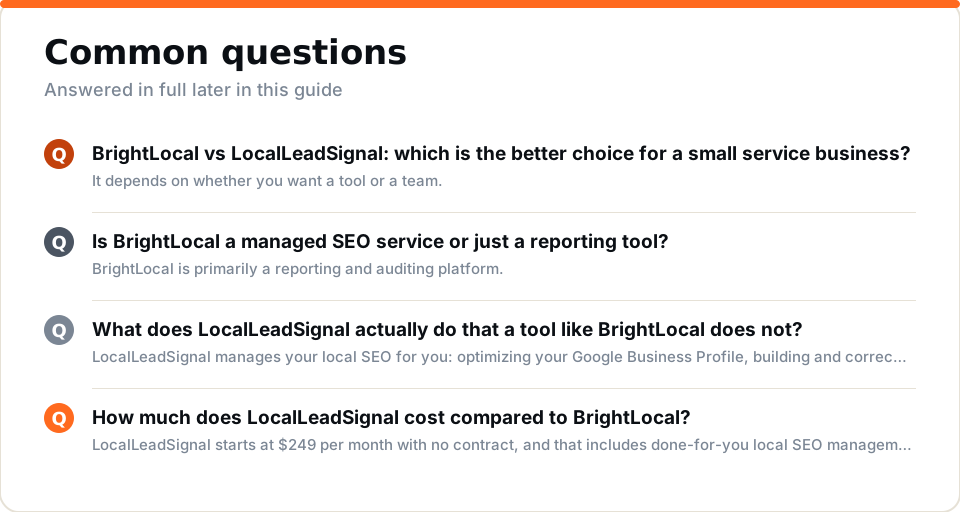
- BrightLocal vs LocalLeadSignal: which is the better choice for a small service business?
- It depends on whether you want software you run yourself or a service that does the work. BrightLocal sells self-serve plans and, separately, a Managed SEO Service. LocalLeadSignal does the weekly work for you, starting at $249 a month with no contract, and listings and citation cleanup start on our Local Dominance plan.
- Is BrightLocal a managed SEO service or just a reporting tool?
- Both options exist. As of September 2026, BrightLocal's pricing page lists self-serve plans (Track, Manage and Grow) and a separate Managed SEO Service starting at $1,299 a month, where its own team handles the work.
- What does LocalLeadSignal actually do that a tool like BrightLocal does not?
- We track your visibility in Google and in AI assistants such as ChatGPT, Perplexity and Gemini, and we draft SEO blog posts for you every week. From our Local Dominance plan, we also handle listings on Google Business Profile, Apple Maps and Bing Places and clean up citations. Growth Engine adds a dedicated specialist and review reply drafts. BrightLocal's self-serve plans give you tools to do similar work yourself, and its managed service is a separate purchase.
- How much does LocalLeadSignal cost compared to BrightLocal?
- LocalLeadSignal starts at $249 a month with no contract. As of September 2026, BrightLocal's pricing page lists its Track plan at $41 a month for one location on monthly billing, or $31 a month billed annually, and its Managed SEO Service from $1,299 a month. Check each pricing page for current numbers.
- Do I need a marketing team to use LocalLeadSignal?
- No. We built LocalLeadSignal for owners without an in-house marketing team. We handle the tracking and the content drafts, and higher plans take on listings, citation cleanup and review reply drafts, so you can focus on running your business.
See where your own business stands.
We measure your local rankings, your listings, your website, and how AI assistants answer for your business. No signup required.
Or jump straight to pricing →