
Notes
ChatGPT vs Perplexity vs Gemini: Where Are Your Local Customers Actually Searching in 2026?
Imagine someone in your area picks up their phone, opens ChatGPT, and types: "Who's the best physical therapist near me that takes Blue Cross and has weekend hours?" They get a confident, well-organized answer back in about three seconds.
Reviewed by Melike Erguven, Co-founder of LocalLeadSignal · July 15, 2026 · 13 min read
Imagine someone in your area picks up their phone, opens ChatGPT, and types: "Who's the best physical therapist near me that takes Blue Cross and has weekend hours?" They get a confident, well-organized answer back in about three seconds. No scrolling through a results page, no clicking around, no comparing ten different tabs. Just an answer, with sources attached.
That is not a hypothetical. It is happening right now, every day, across every service category you can think of, from chiropractors and dentists to personal injury lawyers and HVAC companies. And the businesses showing up in those AI answers? They got there through consistent, deliberate visibility work, not luck.
This piece breaks down the three AI tools your local customers are most likely using: ChatGPT, Perplexity, and Gemini. Not in a technical, developer-facing way, but in a way that actually helps you decide where to focus. We will look at how each one decides what to recommend, where they overlap, and what a local service business without a dedicated marketing team can realistically do to show up in all three.
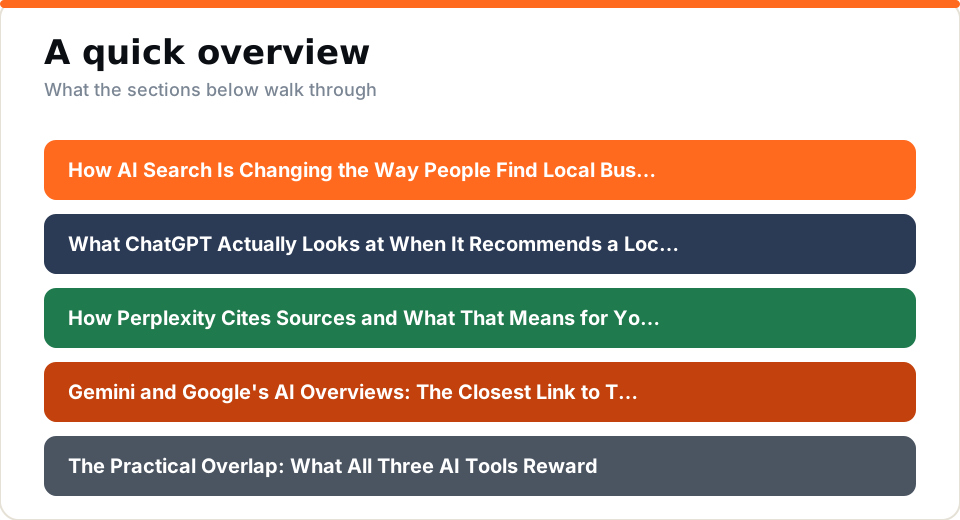
How AI Search Is Changing the Way People Find Local Businesses
There is a real shift happening in how people search, and it is worth understanding before you pour more budget into tactics that were built for a different era. Traditional search was built around short keyword strings. People typed "chiropractor near me" and got a list of results they could scroll through. Now they are asking full questions: "Who is the best chiropractor near me that takes my insurance and has good reviews for back pain?" That is a conversational query, and AI tools are specifically built to answer it.
ChatGPT, Perplexity, and Gemini each handle these questions differently. They pull from different data sources, weigh different signals, and surface different businesses. None of them ranks results the way Google's traditional algorithm does, which means the rules of the game have genuinely shifted. Understanding that gap is the first step toward doing something about it.
The concept behind adapting to this shift is called generative engine optimization, or GEO. It is the practice of making sure your business information, content, and citations are structured in a way that AI systems can find, trust, and repeat. AI search citations, specifically the sources that AI tools reference when they build their answers, are the currency of this new visibility layer. Getting cited is not the same as ranking. It is actually more valuable in some ways, because a cited recommendation in an AI response tends to feel authoritative and final.

AI search trends through Q3 2026 reflect a sharp increase in what researchers call zero-click AI search: queries that get answered entirely inside the AI interface, with no click to a traditional results page at all. For local service businesses, that means a meaningful portion of potential customers may never see your Google listing, your ads, or your website unless you are already part of the AI's answer. The businesses that will feel this the most are those in high-consideration service categories where people ask detailed, specific questions before picking up the phone.
The good news is that you do not need to start over. The fundamentals that make a local business visible in AI search are extensions of what good local SEO has always required. But the margin for error is thinner now, and the businesses that get this right sooner will build a compounding advantage that is genuinely hard to catch up to.
What ChatGPT Actually Looks at When It Recommends a Local Business
ChatGPT does not have a map interface the way Google does. There is no pin-drop, no local pack, no distance radius baked into its core experience. What it has instead is a massive language model trained on web content, combined with browsing capabilities that let it pull from live sources when it needs to. That combination shapes exactly how it decides what to recommend.
When someone asks ChatGPT about a local service business, it is leaning on a few things simultaneously: the quality and clarity of your website content, how consistently your business information appears across the web, and what third-party sources like review platforms and directories say about you. NAP consistency, meaning your business name, address, and phone number matching exactly across every listing, turns out to matter a lot here. ChatGPT is not verifying your information directly. It is reading the web, and if the web gives it conflicting signals about who you are and where you are, it tends to either hedge or skip you entirely.

Structured data is another factor that genuinely moves the needle. Businesses with local business schema markup on their websites give AI systems a machine-readable signal that says, clearly and formally, "this is who we are, what we do, where we are located, and when we are open." Without that structured layer, ChatGPT has to infer your information from plain text, which introduces room for error. Google Search Central documents exactly how LocalBusiness structured data should be implemented, and it is worth doing correctly the first time.
Think about a dental practice trying to show up in AI search. If their website has a thorough FAQ page that answers real patient questions, "Do you take Medicaid?" or "How long does a crown take?" and their listings are consistent across Google, Yelp, and a handful of healthcare directories, ChatGPT is far more likely to surface them than a competing practice with a thin, five-page brochure site and mismatched phone numbers scattered across the web. The textual authority has to be there because that is all ChatGPT has to work with.
Local citations, meaning mentions of your business across directories, review platforms, and local web sources, also factor into this picture. They are not just a traditional SEO signal anymore. They are part of how AI systems build confidence that your business is real, established, and relevant to a given location and service category.
How Perplexity Cites Sources and What That Means for Your Visibility
Perplexity operates differently than ChatGPT in one important way: it shows its work. Every answer Perplexity generates comes with source citations directly visible to the user, which means the way it surfaces information is more transparent, and the stakes for appearing as a cited source are higher. If your business or a piece of your content gets cited in a Perplexity answer, the user can see exactly where that information came from and click through.
That transparency shapes everything about how Perplexity selects its sources. It pulls from real-time web results and tends to prioritize review platforms, directory listings, and authoritative local content pages. A business that has solid local link building, meaning legitimate mentions and references from other trusted websites in your area or industry, will show up more frequently as a citation than one that relies only on its own website. Perplexity local business citations are essentially votes of confidence from sources the AI already trusts.
Here is where long-tail local keywords start earning their keep. Service pages and blog posts that naturally address specific questions, "What should I expect from my first physical therapy appointment?" or "How much does a personal injury consultation cost?" are exactly the kind of content Perplexity surfaces when someone asks those questions conversationally. The match is not about keyword density. It is about relevance, clarity, and whether a piece of content actually answers the question being asked.
Content freshness also plays a role. Perplexity is pulling from the live web, not a static training snapshot. That means older, stale content is at a disadvantage relative to updated, recently refreshed pages. It is one of the clearer practical reasons to invest in refreshing underperforming blog posts rather than just publishing new ones and ignoring the existing archive. A well-updated service page from two months ago often outperforms a newer post with thinner content.
Businesses that show up consistently in Perplexity answers tend to have a combination of things working together: clean, accurate listings across the major directories, content that answers real questions from real potential clients, and enough external references to their business that Perplexity treats them as a trusted local source. None of those things require a big agency. They require consistency.
Gemini and Google's AI Overviews: The Closest Link to Traditional Local SEO
Of the three AI tools covered here, Gemini is the one that local service businesses with existing SEO habits will find most familiar. That is because Gemini is Google's AI, and it draws heavily from the same index that powers traditional Google Search. Your Google Business Profile, your map pack ranking, your on-site signals, all of it feeds directly into what Gemini knows and trusts about your business.
Google's AI Overviews, which appear at the top of search results and are generated by Gemini, have a compounding effect on local visibility. When an AI Overview answers a query, it often pushes the traditional map pack and organic results lower on the page. That means businesses that were counting on their map pack position to drive traffic are seeing that position matter less in raw click volume, even if they have not dropped in rank. Showing up in the AI Overview itself is increasingly what gets you seen.

Google Business Profile optimization is the most direct lever you have for Gemini visibility. A complete, accurate, regularly updated GBP sends strong trust signals to Gemini, which leans on Google's own data more than the other AI tools do. Google's own guidance on what helps your local ranking emphasizes relevance, distance, and prominence, and Gemini is essentially operationalizing those same factors when it builds its AI-generated responses. Review signals matter here in a specific way: not just volume, but recency and response patterns. A business with a hundred reviews, the most recent of which is fourteen months old, looks different to Gemini than one with sixty reviews and a steady cadence of new ones coming in.
Voice search local SEO adds another dimension to Gemini's reach. On Android devices and through Google Assistant, voice queries route through Gemini by default. Someone asking their phone "find me a dentist nearby who takes new patients" is, in effect, asking Gemini. The answer they get back is shaped by the same signals that influence AI Overviews: a complete GBP, schema markup on the business website, and strong review signals. The reach of Gemini extends well beyond the browser, and that reach is only growing.
Schema markup deserves specific attention here. Adding proper local business schema to your site gives Gemini a structured, unambiguous data layer to work with on top of the content itself. If you want to understand how LocalBusiness structured data should be formatted, Google Search Central lays it out clearly.
The Practical Overlap: What All Three AI Tools Reward
Once you look at ChatGPT, Perplexity, and Gemini side by side, a clear pattern emerges. They each have different architectures, different data sources, and different ways of surfacing information. But the signals they reward at the foundation level are remarkably consistent.
All three favor businesses with accurate, consistent information across the web. All three reward authoritative content that directly answers real questions. All three respond positively to strong review volume and recency. And all three treat local citations, mentions of your business across trusted directories and platforms, as a signal of legitimacy rather than just a relic of old-school SEO. That alignment is genuinely good news if you are a local service business without a full marketing team behind you.
AI visibility for local business is not a separate discipline from local SEO. It is the same discipline, applied with more precision and more consistency. The businesses that show up in ChatGPT recommendations, get cited in Perplexity answers, and appear in Gemini's AI Overviews are, almost universally, businesses that got the basics right: a complete and optimized Google Business Profile, consistent NAP information across their listings, a website with real content and proper schema markup, and a steady flow of genuine customer reviews.
Online reputation management is part of this picture in a way that often gets underestimated. Review platforms are source material for all three AI tools. A business with a strong, recent, well-responded-to review profile looks trustworthy to an AI system for the same reason it looks trustworthy to a potential customer reading it directly. If you want to understand how Google's own guidelines for managing reviews frame this, the documentation is worth a read.
One thing worth emphasizing for local service businesses specifically: you do not need three separate AI optimization strategies. You need one solid local SEO foundation applied consistently over time. Getting that foundation right, and keeping it maintained, is the actual work. Everything else follows.
How to Show Up in AI Search Without a Big Agency Budget
The action list here is not complicated, but it does require consistency. Start with your Google Business Profile. If it is incomplete, out of date, or sitting unclaimed, fix that first. Every field matters: category, services, hours, photos, and the Q&A section. A complete GBP is table stakes for Gemini and a meaningful trust signal for the other AI tools as well.
From there, audit your local citations. Look at how your business name, address, and phone number appear across the major directories, and fix anywhere they are inconsistent or missing. This is the kind of detail that feels tedious but compounds over time. Inaccurate citations create conflicting signals that AI systems simply do not know how to resolve in your favor.
Add local business schema markup to your website if it is not there already. This is a technical step, but it is a one-time setup that keeps working on your behalf long after it is done. Pair that with content that answers the actual questions your potential clients are asking before they call, and you start building the kind of textual authority that earns citations in Perplexity and ChatGPT answers.
Build a review generation habit. Not a one-time push, but a consistent process where satisfied clients are regularly asked to leave a review and recent reviews are getting responses. This matters for Gemini most directly, but it shapes how all three AI tools perceive your credibility. If you want to understand how showing up in AI search connects to the broader visibility picture, the fundamentals apply across all three platforms.
Here is where most local service business owners run into a wall: they know what needs to be done, but they do not have the bandwidth to do it consistently. Running a chiropractic practice, a law firm, or a physical therapy clinic is a full-time job. Monitoring your listings, managing your reviews, keeping your content fresh, and tracking how all of it is performing is a second one. That is the gap LocalLeadSignal was built to fill.
Starting at $249 per month with no contract, LocalLeadSignal handles the tracking, SEO, listings, reviews, and AI visibility work for you. Most SEO agencies start at $500 or more per location and assume you already have someone in-house managing the strategy. That is a reasonable assumption for a mid-sized company. It is not a reasonable assumption for most local service businesses, and it is exactly why so many of them fall behind on visibility while they are busy doing the actual work of serving their clients. For local service businesses specifically, understanding how ChatGPT local visibility fits into the broader picture is a good starting point, and then having someone handle the execution is what makes it stick.
Getting into AI search results is not a mystery. It is a consistency game. The businesses winning are the ones treating visibility as an ongoing process, not a project they did once and moved on from.
The Core Is the Same Across All Three
ChatGPT, Perplexity, and Gemini each work differently under the hood. ChatGPT leans on textual authority and consistent web presence. Perplexity rewards cited, real-time sources and fresh authoritative content. Gemini draws directly from Google's index and treats your GBP and review signals as primary inputs. But strip away the mechanics, and they all reward the same underlying habits: accurate information, genuine reviews, authoritative content, and consistent visibility across the web.
You do not need to become an AI search expert to benefit from this shift. You need the fundamentals handled correctly and kept up to date. That is a doable thing, especially when you are not doing it alone.
If you want to see what it looks like to have your local SEO and AI visibility managed for you, LocalLeadSignal handles all of it starting at $249/mo, no contract, no marketing team required.
Frequently asked questions
- ChatGPT vs Perplexity vs Gemini: which one are local customers using most to find businesses?
- All three are growing fast, but Gemini reaches the most local searchers because it powers Google's AI Overviews and Assistant. Perplexity is popular with research-oriented users. ChatGPT has a massive user base but is less tied to real-time local data. Smart local businesses optimize for all three at once.
- Do I need a different SEO strategy for each AI search tool?
- Not really. ChatGPT, Perplexity, and Gemini all reward the same core signals: accurate business listings, consistent citations, strong reviews, and authoritative content. A solid local SEO foundation covers most of what each AI tool looks for when deciding which businesses to recommend.
- How does Perplexity decide which local businesses to cite in its answers?
- Perplexity pulls from live web sources and surfaces businesses that appear in trusted directories, review platforms, and well-structured website content. Strong local citations, long-tail content that answers real customer questions, and consistent NAP data all improve your odds of being cited.
- Does having a Google Business Profile help me show up in ChatGPT or Perplexity?
- Directly, no. ChatGPT and Perplexity do not read your GBP the way Google does. But an optimized GBP improves your visibility on third-party review sites and directories that these AI tools do pull from, so it still matters as part of your overall AI search presence.
- Can a small local business realistically show up in AI search results without a big marketing budget?
- Yes. AI search tools favor accuracy, consistency, and genuine reputation over ad spend. A business with complete listings, steady reviews, and helpful website content can outperform a bigger competitor with a neglected online presence. Affordable services like LocalLeadSignal are built specifically for this situation.
See where your own business stands.
We measure your local rankings, your listings, your website, and how AI assistants answer for your business. No signup required.
Or jump straight to pricing →