
Notes
Family Law Marketing: What Actually Works for Sensitive, High-Stakes Practices
It is midnight. A parent just found out their co-parent is threatening to take the kids across state lines, and they grabbed their phone and typed "divorce attorney near me." They are scared, they are moving fast, and they are going to…
Reviewed by Melike Erguven, Co-founder of LocalLeadSignal · September 2, 2026 · 12 min read

It is midnight. A parent just found out their co-parent is threatening to take the kids across state lines, and they grabbed their phone and typed "divorce attorney near me." They are scared, they are moving fast, and they are going to call whoever shows up in front of them. Your firm has a clean website, maybe even a Google Ads campaign running. But if your name does not appear in the local map results, and if a nervous parent asking ChatGPT or Perplexity for a recommendation in your area gets no mention of you, none of that investment matters in that moment.
This is not really a guide about tactics. It is more of a myth-examination, because most family law practices are operating on beliefs about marketing that are not exactly wrong. They just leave out the layer that actually drives local visibility. Each of those beliefs has a kernel of truth. The full picture is a little different.
You Think a Nice Website Is Enough to Get Found. Here Is What It Is Missing.
A professional, mobile-friendly website absolutely matters. For a sensitive practice area like family law, where prospective clients are vetting you emotionally before they ever pick up the phone, a polished site is table stakes. No credible family law attorney should operate without one.
The problem is not the website. It is the assumption that the website does the whole job.
A website, on its own, does not tell Google where you physically are, which neighborhoods you serve, or whether your location information is consistent across the broader web. It is a destination, not a signal. And local search, especially the kind that produces a map with three attorney listings at the top of the results page, runs almost entirely on signals that live outside your website.
Google Business Profile optimization is where family law attorney SEO actually starts. Your GBP listing is what populates the map pack, fills in your hours and phone number, surfaces your reviews, and tells Google that your firm is a real, active business at a specific address. According to Google's own guidance on improving local ranking, the three main factors that influence local results are relevance, distance, and prominence, and your website alone addresses only a fraction of relevance. Distance and prominence depend heavily on your GBP and how consistently your information appears elsewhere.
NAP consistency is the unglamorous part of this. NAP stands for name, address, and phone number, and if those three things appear differently across Yelp, Avvo, your state bar's directory, and your Google Business Profile, search engines treat those as conflicting signals about whether you are who you say you are. That quiet inconsistency suppresses rankings without ever showing up as an obvious error.
The Google Map Pack, those three local results with the map pins, is where family law clients are actually clicking. Someone searching urgently at midnight is not scrolling past a map to find a blue organic link. They see a name, a star rating, and a phone number, and they call. A website without local signals underneath it is like a beautifully lit office in a building with no address on the door. People who already know where you are can find you. Everyone else cannot.
You Think Google Reviews Matter Less for Law Than for Restaurants or Doctors. They Actually Matter More.
There is a reasonable instinct behind this belief. A family law client is not picking an attorney the way they pick a lunch spot. The stakes are too high, the situation too personal, for a four-star average to feel like useful data. So it is easy to deprioritize reviews and assume the work speaks for itself.
The thing is, the higher the stakes, the more carefully prospective clients read reviews. They are not scanning for star count. They are reading for tone. Does this attorney seem like they listen? Did they respond to complaints, and if so, how? Do past clients mention feeling heard? Reviews in a family law context function less like ratings and more like character references, which means the patterns in them matter enormously.
A handful of unanswered negative reviews will quietly hurt a family law practice in two ways simultaneously. First, from a google map pack ranking perspective, review volume and recency are real signals, and practices that never engage with their reviews send a passive signal that the listing is unmaintained. Second, from a conversion perspective, a prospective client who sees a three-year-old one-star review with no response from the firm may reasonably wonder if that is how the attorney handles difficult situations generally.
Asking for reviews in a sensitive practice area requires some thoughtfulness. You are not going to ask a client to leave a Google review in the middle of a custody hearing. The better approach is timing, a brief, personal follow-up after a matter concludes, focused on making it easy rather than pressuring. Most clients who had a positive experience are willing to share it, they just need a frictionless moment to do so.
Responding to negative reviews deserves its own attention. A defensive or dismissive response to a critical review tells every future reader something about how the attorney communicates under pressure. A calm, empathetic response, even one that cannot engage with specifics due to confidentiality, signals competence and professionalism. If you want to think through what that kind of response looks like in practice, managing responses in sensitive contexts requires a different frame than a typical retail complaint. Law has its own version of that dynamic.
Learning how to get more Google reviews ethically, and how to maintain a steady cadence of new ones, is part of the infrastructure of local visibility. It is not a one-time task.
You Think Targeting 'Divorce Attorney' or 'Family Lawyer' Is How You Win Search. The Real Wins Are Narrower.
The broad head terms are not irrelevant. People do search for "divorce attorney" and "family lawyer," and those terms do reflect real intent. The problem is the competition.
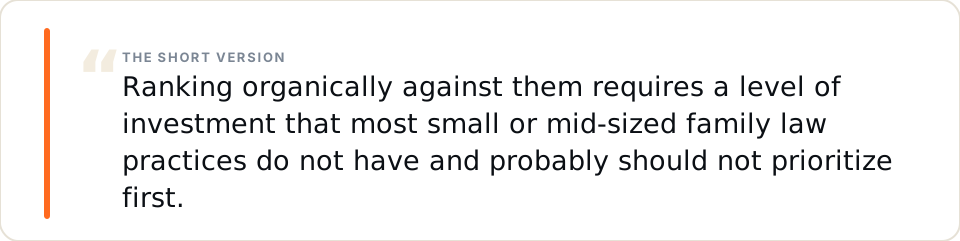
Terms like those are dominated almost entirely by large legal directories, Avvo, FindLaw, Justia, and comparable platforms that have spent years and substantial budgets building domain authority. Ranking organically against them requires a level of investment that most small or mid-sized family law practices do not have and probably should not prioritize first. Competing for "family law attorney" in a metro area is like trying to out-advertise a national brand in your first year.
Long-tail local keywords are where realistic, compounding wins happen. Think about phrases like "how to file for legal separation," "uncontested divorce process in my state," "emergency child custody attorney," "parenting plan modification after job loss," or "what happens to the house in a divorce." These phrases are longer, more specific, and far less contested.
They also match something important about the emotional state of the person typing them. Someone who searches "family lawyer" is at the beginning of a thought. Someone who searches "emergency custody attorney what do I need to bring" is a few hours away from calling someone. Long-tail searchers are further along, more ready to act, and often more relieved to find a clear, specific answer.
Local keyword research surfaces these phrases and helps map them to content your practice can actually own: a blog post that walks through the uncontested divorce process in plain language, a FAQ page that answers custody modification questions step by step, GBP posts that address common concerns. Each piece of that content builds compounding visibility over time without requiring you to beat a national directory in head-to-head ranking.
AI search tools add another reason to take this seriously. When someone asks ChatGPT or Perplexity a question like "what should I do if my co-parent refuses to follow the custody order," those tools are looking for content that clearly, specifically, and authoritatively answers the question. A practice that has written genuinely useful content around these long-tail queries is far more likely to be cited in that kind of AI-generated answer than one that has only a homepage optimized for a broad head term.
You Think Local Citations Are Just Busywork. They Are Actually a Trust Signal Google and AI Both Read.
Manually submitting your firm's information to dozens of directories does feel tedious. And you are right that any single citation, your listing on YellowPages or Yelp taken alone, is not going to move your rankings in a meaningful way. So the skepticism here is understandable.
What citations do collectively is different from what any one of them does individually. Across dozens of directories, review sites, and professional listings, a consistent record of your firm's name, address, and phone number creates a verifiable identity on the web. Both Google and AI engines use that record to confirm that your business is real, stable, and trustworthy. It is not about the directories themselves. It is about the pattern they create.
NAP consistency is where this gets concrete. If your firm's name is listed slightly differently across Avvo, your state bar directory, your GBP, and Yelp, those discrepancies create conflicting signals. Google does not know which version is authoritative. AI tools that are trying to confirm your location and contact information run into the same problem. The result is suppressed rankings and reduced confidence in your listing, without any obvious error message to tip you off.

AI search tools like ChatGPT and Gemini increasingly pull from structured, citation-rich sources when constructing local answers. A practice with sparse, inconsistent citations may simply not appear when someone asks an AI which family law attorneys operate in their area, not because the firm did anything wrong, but because the web does not have enough consistent information to confirm the firm's existence with confidence.
Citations and backlinks are often lumped together, but they do different things. Citations establish foundational identity: who you are, where you are, and how to reach you. Backlinks build authority: signals from other credible websites that your content or your practice is worth referencing. Most family law practices that have never invested in local SEO need the foundation before they need the authority. Local business schema markup reinforces these same identity signals in a format search engines can parse directly from your website, which is worth adding once the citation foundation is in place.
You Think Paid Ads Are the Fastest Path to Family Law Clients. Organic and AI Visibility Last Longer.
Google Ads and Local Services Ads can produce calls quickly, and in a competitive market where a new practice needs traction fast, they are not a bad short-term tool. That part is true. The ceiling on paid is what most practices underestimate.
Family law keywords sit among the most expensive in all of paid search. Clicks in this category can run into the tens of dollars per click, and those clicks do not compound. Stop paying, stop appearing. A firm can spend aggressively for a year and have nothing to show for it in terms of durable visibility once the budget pauses.
Organic local SEO works differently. A well-optimized Google Business Profile, consistent and clean citations, steady review growth, and content that addresses real family law questions build visibility that persists. A blog post answering "what is a parenting plan and how do I get one modified" keeps working after it is published. A pattern of recent, thoughtful reviews keeps improving your map pack position month over month. The organic layer compounds in a way that paid never does.
The AI visibility piece is where things are heading, and it is worth understanding now rather than a year from now. When someone asks an AI assistant who a good family law attorney is in their area, that answer is not generated from ad spend. It is pulled from structured, citation-rich, clearly written sources that the AI engine has indexed and can cite with confidence. Generative engine optimization, the practice of structuring content so that AI tools can understand it, cite it, and surface it in response to conversational queries, is quickly becoming a real factor in local legal search visibility.
For most small family law practices, the practical approach is to build the organic and AI layer as the durable foundation, then use paid selectively to fill gaps when you have a slow period or are launching in a new area. Paid can bridge a gap. It cannot replace the infrastructure that a solid approach to local visibility builds over time.
You Think Managing All of This Requires a Full Marketing Team or a Big Agency Budget. It Does Not.
The list does look overwhelming when you read it all at once. GBP management, citation cleanup and maintenance, review strategy, schema markup, content for long-tail keywords, AI optimization. Put it in a column and it reads like a full-time role.
Most of these tasks are not continuous, though. They require a solid initial setup, a consistent maintenance cadence, and someone paying attention when things shift. The citation audit, for example, is front-loaded work. Once your listings are consistent and accurate across the major directories, the maintenance is lighter. Review strategy is mostly about building a repeatable process and responding thoughtfully when something comes in. GBP management involves regular posts and keeping business information current, not daily intensive effort.
A managed local SEO service handles this entire layer on behalf of the practice. No in-house marketing coordinator needed, no one on your staff learning a new platform or trying to keep track of which directories have stale information. The work gets done, and you see what is happening without needing to interpret a dashboard on your own.
The cost assumption most family law practices carry is that SEO agencies targeting professional services start at $500 or more per location, often assume the client already has marketing support in place, and lock you into a multi-month contract before you have any sense of whether the work is actually moving anything. LocalLeadSignal starts at $249 per month, no contract, and covers tracking, listings, reviews, and AI visibility as done-for-you work. You can see what it covers.
The real cost to weigh here is not the monthly fee. It is the ongoing cost of invisibility. A family law practice that does not appear in the map pack, has inconsistent citations, and never shows up in AI-generated local recommendations is losing potential clients to less experienced competitors who simply put in the foundational work. Those clients do not know they made a suboptimal choice. They called whoever showed up.
That midnight searcher, the scared parent with their phone in their hand, is not comparing your firm against your competitors on merit yet. They cannot. They are evaluating based on what appears in front of them: the map pack listing, the star rating, whether an AI assistant names you when asked. Every belief this article examined had something real in it. The website matters. The keywords matter. The reviews matter. But none of them work the way you need them to without the local infrastructure layer underneath.
If you do not know what your local visibility actually looks like right now, that is the only thing worth finding out first. Not fixing, not overhauling, just seeing clearly.
Your next step is a free local SEO audit specific to your practice. See exactly how your Google Business Profile, citations, reviews, and AI presence look to someone searching for a family law attorney in your area, before spending another dollar trying to fix things you cannot yet see. Get your free audit at LocalLeadSignal.com.
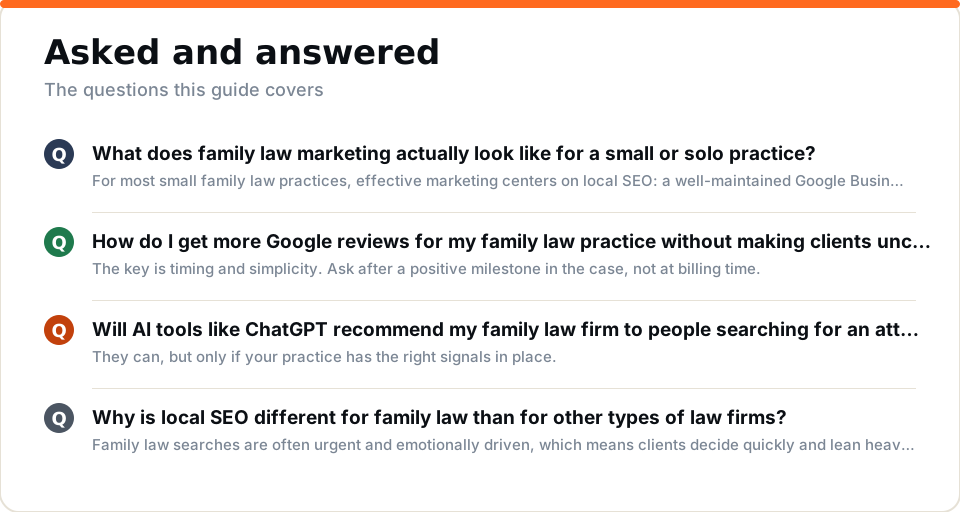
Frequently asked questions
- What does family law marketing actually look like for a small or solo practice?
- For most small family law practices, effective marketing centers on local SEO: a well-maintained Google Business Profile, consistent citations across directories, a steady flow of genuine client reviews, and content that answers the specific questions prospective clients are already searching. Paid ads can supplement, but the organic layer is what compounds over time.
- How do I get more Google reviews for my family law practice without making clients uncomfortable?
- The key is timing and simplicity. Ask after a positive milestone in the case, not at billing time. A brief, personal follow-up message with a direct review link removes friction. Most clients who had a good experience are willing to help if asked clearly and without pressure. Responding warmly to every review also signals care to future clients.
- Will AI tools like ChatGPT recommend my family law firm to people searching for an attorney?
- They can, but only if your practice has the right signals in place. AI tools pull from structured, citation-rich sources: your Google Business Profile, consistent directory listings, schema markup, and content that directly answers common legal questions. Practices that invest in those layers are more likely to be named in AI-generated local answers.
- Why is local SEO different for family law than for other types of law firms?
- Family law searches are often urgent and emotionally driven, which means clients decide quickly and lean heavily on proximity, reviews, and first impressions. The search behavior skews toward specific, question-shaped queries rather than broad head terms, making long-tail local keyword targeting and a strong Google Business Profile especially valuable for family law practices.
- How much should a family law practice expect to spend on local SEO?
- Most traditional SEO agencies targeting legal practices start at $500 or more per month and often require long contracts. LocalLeadSignal starts at $249 per month with no contract and handles the ongoing work, including listings, reviews, and AI visibility, without requiring an in-house marketing team on the firm's side.
See where your own business stands.
We measure your local rankings, your listings, your website, and how AI assistants answer for your business. No signup required.
Or jump straight to pricing →