
Notes
Local SEO for Law Firms: How to Get Found, Get Clicks, and Get Clients in 2026
It is 10 p.m. on a Tuesday and someone is typing "family law attorney near me" into their phone. They are stressed, probably scared, and ready to make a call the moment they find someone who looks legitimate.
Reviewed by Melike Erguven, Co-founder of LocalLeadSignal · August 17, 2026 · 13 min read

It is 10 p.m. on a Tuesday and someone is typing "family law attorney near me" into their phone. They are stressed, probably scared, and ready to make a call the moment they find someone who looks legitimate. They scroll through the map pack, glance at reviews, check whether the profile looks active, and pick up the phone. The firm they call is probably not the biggest one in your county. It is just the one that showed up, looked credible, and gave them enough confidence to hit the call button.
That is what local SEO actually does for law firms. And for a long time, the conversation around law firm marketing has been dominated by agencies charging steep monthly retainers and using enough jargon to make the whole thing feel out of reach for solo attorneys or small practices. The fundamentals are genuinely more accessible than most agencies want you to believe.
LocalLeadSignal was built for exactly this situation. Solo attorneys and small firms that need real help, not a $500-plus monthly retainer that competes with a paralegal salary for budget. Starting at $249 a month with no contract, LocalLeadSignal handles the actual work: tracking visibility, managing SEO, fixing listings, building review momentum, and making sure your firm shows up where clients are actually looking.
Why Local SEO Hits Different for Law Firms Than for Other Businesses
Most local businesses benefit from being visible online. Law firms depend on it in a way that is almost uniquely high-pressure. Someone searching for a restaurant might browse options casually over a few days. Someone searching for a personal injury lawyer or a family law attorney is usually ready to act right now. The search itself often comes after something difficult, a car accident, a divorce filing, a custody dispute, and by the time they type that query, they are not browsing. They are deciding.
That urgency makes local visibility especially valuable. A potential client who finds your firm in the map pack, sees solid reviews, and lands on a well-organized practice area page is already most of the way to calling you. Missing from that map pack means you are invisible at the exact moment someone is ready to hire.
The distinction between local SEO vs traditional SEO matters a lot in a legal context. Traditional SEO targets broad, often national keywords, think "how to file for divorce" or "what does a personal injury settlement cover." Those terms can bring traffic, but the people reading are often in research mode, not hiring mode. Local SEO, by contrast, puts your firm in front of people searching in your geographic area with the intent to hire soon. Ranking in the Google map pack for "family law attorney in [your county]" is often worth more than a page-one organic ranking for a generic legal question.
Google treats legal content as YMYL, Your Money or Your Life, which means it holds legal pages to a higher standard of trust, expertise, and accuracy. That designation affects how Google evaluates your content and your site overall. It does not mean you need a law school professor writing your blog posts, but it does mean thin, generic, or untrustworthy content will actively work against you. Trust signals, things like a verified Google Business Profile, consistent contact information across the web, and genuine client reviews, carry real weight in this category.
Here is the practical upside: law firm SEO is competitive, but manageable. Many competitors are sitting on outdated or neglected profiles. Their GBP has not been touched in a year. Their citations have wrong phone numbers. Their review count stopped growing when they stopped asking. That is a real opening for firms willing to do the work consistently.
And then there is AI. Tools like ChatGPT and Perplexity are increasingly where people start when they have a legal question, sometimes before they even open Google. A potential client might ask ChatGPT whether they have a case, get a general answer, and then search for a local attorney to call. Firms that are building authority and structured content now are the ones those tools will surface later. That layer of attorney local SEO is newer but it is already mattering.

The Google Business Profile Basics Every Law Firm Should Have Locked Down
Your Google Business Profile is probably doing more work for your local rankings than your website. That is not an exaggeration. For local searches, the GBP is often the first thing a potential client sees and the thing they use to decide whether to click. Getting it right is not optional.
Start with NAP consistency: name, address, and phone number. These need to be identical, not just similar, across your GBP and every directory your firm appears in. "Suite 200" on your GBP and "Ste. 200" on Avvo might look like a minor formatting difference to a human. To Google's systems, inconsistencies like that quietly erode the trust signals that help your profile rank. Google's own guidance on improving your local ranking makes clear that accurate, complete information is a foundational requirement, not a nice-to-have.
Choosing the right primary category matters more than most attorneys realize. Google uses your primary category to decide when to show your profile in local search results. "Personal injury attorney" and "law firm" are not interchangeable if your practice focuses on PI cases. The primary category should reflect your main practice area, and secondary categories can cover the rest. This is one of those small decisions that has an outsized effect on law firm map pack visibility.
The sections most attorneys leave empty are often the ones that would move the needle. Your services section, your Q&A, and the Google Business Profile posts feature all give Google more signals about what you do and who you serve. A post announcing a free consultation or answering a common legal question keeps the profile active. The Q&A section lets you pre-answer questions that prospects are already asking, and you can seed it with relevant questions yourself if none exist yet.
Photos matter too, and not just for aesthetics. Profiles with real photos of the office, the attorneys, and the team tend to look more credible to prospective clients. Office hours should be accurate and up to date, especially around holidays. A compelling business description gives Google context and gives potential clients a reason to trust you before they ever visit your website.
The most common GBP mistakes law firms make are surprisingly consistent. Using a virtual office address that does not qualify as a real service location. Letting the profile go unmanaged for months with no posts, no review responses, and outdated information. Adding service areas that are too broad to be relevant. These things do not just fail to help; they can actively hurt rankings.
LocalLeadSignal manages GBP profiles as part of its baseline service. That means attorneys are not spending Friday afternoons updating their profiles or figuring out why their listing got flagged. It gets handled.
Citations, Directories, and NAP Consistency: The Unglamorous Work That Actually Moves Rankings
Nobody talks about local citations at dinner parties. They are not exciting. But for law firms, citations are one of the most reliable levers for improving local visibility, and they are also one of the most frequently neglected.
A local citation is any mention of your firm's name, address, and phone number on another website. General directories like Yelp and Yellow Pages count. Legal-specific directories like Avvo, Justia, and FindLaw carry extra weight because they are authoritative in the eyes of both Google and potential clients. For attorney local SEO, these legal directory citations are not optional extras. They are part of the baseline infrastructure that tells Google your firm is real, established, and located where you say it is.
Understanding the citations vs backlinks distinction helps clarify why both matter. Citations build geographic relevance and trust signals. They tell Google that your firm exists at a specific address and serves a specific area. Backlinks, links from other websites pointing to yours, build domain authority and help your website rank in organic search. Law firms need both. A strong citation profile without backlinks leaves authority on the table. Solid backlinks without accurate citations can undercut your local rankings. They work together.

NAP consistency is the thread that holds citation-building together. If your firm's name appears as "Johnson & Associates" on one directory and "Johnson and Associates Law Firm" on another, that is a problem. If your phone number changed two years ago and twenty directories still list the old one, that is suppressing your rankings quietly. Before building new citations, it is worth auditing existing ones for accuracy. Find the inconsistencies, correct them, and then expand from there. Building on a shaky foundation just means you have more to clean up later.
LocalLeadSignal manages listings and citations as part of its service, which removes the manual burden entirely. For a solo attorney or small firm, that is significant, because tracking down and correcting dozens of directory listings is a real time commitment that most practices simply do not have.
Local Keyword Research for Attorneys: Finding the Searches Your Competitors Are Ignoring
"Personal injury lawyer" is a competitive keyword. So is "divorce attorney." Most firms know they want to rank for terms like these and stop thinking about keyword strategy there. That is exactly where the opportunity opens up.
Effective local keyword research for law firms goes much deeper than obvious head terms. The searches that actually convert, the ones where someone is ready to pick up the phone, tend to be longer and more specific. Think "uncontested divorce attorney in [county]," "what happens if I miss a court date in [state]," or "free consultation family lawyer near me." These long-tail local keywords get fewer searches individually, but the people typing them know exactly what they want.
For personal injury lawyer SEO specifically, county-level and neighborhood-level keyword targeting reflects how legal practice actually works. Cases are jurisdiction-specific. Someone injured in a particular county wants a lawyer who knows that courthouse, those judges, and that local legal environment. Content and landing pages that reflect this geographic specificity do not just rank better locally; they also convert better because they feel relevant to the person reading them.
Family law marketing requires a slightly different tone at the keyword level. The people searching for a family law attorney are often going through something painful. Custody disputes, divorce filings, protective orders. The keywords themselves tend to reflect anxiety and urgency. Content that feels clinical or aggressive can actually push these prospects away. Keyword research in this space should inform not just what you write about but how you write about it.
The most practical application of keyword research is content structure. Practice area pages should target the primary local terms for that area of law. FAQ pages can capture long-tail question-based searches that reflect real client concerns. Blog content and locally relevant articles can address specific scenarios, helping the firm show up for searches that a competitor with only a generic practice area page will miss entirely. Just make sure content stays general enough to be genuinely educational without crossing into giving specific legal advice, which runs straight into UPL territory. A good legal content strategy answers the question someone is asking without functioning as a substitute for an attorney-client relationship.
Reviews, Reputation, and What Potential Clients Are Really Looking For
A potential client who finds your firm at 10 p.m. is going to read your reviews before they call. This is not a hypothesis. It is just how people make decisions now, especially for something as high-stakes as hiring an attorney. Online reputation management is not a peripheral concern for law firms. It is central.
One negative review handled badly can do more damage than several negative reviews handled well. The review itself is visible. So is your response. Potential clients are reading both and forming an impression of how your firm treats people, including under pressure.
Getting more Google reviews starts with making it easy and asking consistently. After a successful matter concludes, a straightforward follow-up asking the client to share their experience is the most effective approach. No incentives, no reciprocal reviewing, no asking current clients to review your firm while representation is ongoing. Bar association rules vary by state but generally prohibit anything that looks like soliciting testimonials in a way that could be misleading. Keep it simple: a direct, personal ask after the relationship has concluded, with a link to your Google profile to make it easy.
Responding to negative reviews is its own skill. The goals are to acknowledge the concern, stay professional, avoid revealing any client information, and avoid saying anything that could be read as admitting fault. A short, calm response that thanks the reviewer for their feedback and invites them to contact the office directly is usually the right move. What you do not want to do is get defensive, go into detail, or ignore the review entirely. Silence looks like indifference.
Review volume and recency both factor into map pack rankings. A firm with forty reviews from three years ago is at a disadvantage compared to a firm with twenty reviews from the past six months. This is why review generation needs to be an ongoing process built into the firm's workflow, not a one-time push that fades after a month. LocalLeadSignal tracks review trends and surfaces issues, so attorneys can respond quickly rather than discovering a problem three weeks after it was posted.
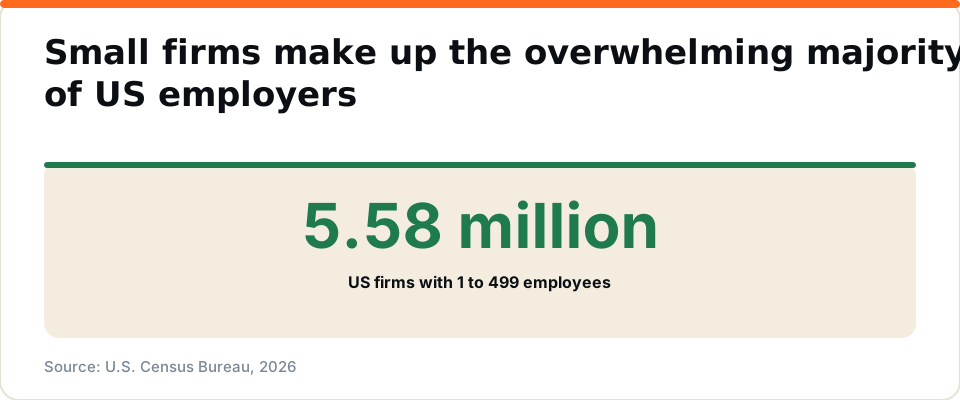
Source: U.S. Census Bureau, 2026
AI Search and What It Means for Law Firm Visibility Right Now
The way people find attorneys is changing faster than most firms are tracking. ChatGPT, Perplexity, and Gemini are no longer just curiosities. They are where a meaningful and growing number of people start when they have a legal question. AI visibility for local business, especially in a high-stakes category like legal services, is a real and present concern for attorney marketing in 2026.
Here is how it actually works. Someone asks ChatGPT whether they might have a personal injury case. They get a general explanation. Then they ask for a recommendation on how to find a local attorney. The AI tools that answer those follow-up queries pull from structured, authoritative content and verified sources. Firms that have built that foundation, clear practice area content, consistent citations, strong GBP profiles, are already better positioned to appear in those AI responses than firms that have not.
Generative engine optimization, or GEO, is the practice of structuring your content and online presence so that AI engines can accurately understand and cite your firm. This is less exotic than it sounds. It mostly means the same things that help you rank in traditional local search: structured content with clear answers to real questions, authoritative local citations, consistent business information across platforms, and a trustworthy reputation. The AI tools that power AI search citations GEO are pulling from existing web infrastructure, not from some separate universe of content.
Bing Places and Bing's underlying data power several AI tools including certain Copilot features, which means that optimizing beyond Google matters more in 2026 than it did two years ago. Law firms that are only thinking about Google are leaving part of the AI visibility picture unaddressed. It is not a massive lift to get a Bing Places profile in order, but it is something a lot of firms have not done.
The encouraging part is that a strong local SEO foundation and solid AI discoverability are not separate strategies. The trust signals that help your firm rank in Google's map pack, accurate NAP data, authoritative directory listings, genuine positive reviews, and clear schema markup, are the same signals AI engines use to evaluate whether your firm is worth recommending. Google's documentation on LocalBusiness structured data outlines exactly the kind of structured information these systems are built to read. LocalLeadSignal's AI visibility service handles this layer for firms that do not want to figure out generative engine optimization on top of everything else they are already managing.
The attorneys who are showing up in the map pack, getting named in AI search results, and filling their consultation calendars are not necessarily the most expensive firms in town. They are the ones who handled the fundamentals: a clean and active GBP, consistent citations, a steady flow of genuine reviews, and content that actually answers what potential clients are searching for.
Most SEO companies start at $500 or more per location and assume you already have a marketing team managing the details. LocalLeadSignal starts at $249 a month with no contract, and the team does the actual work, including GBP management, citation building, listings, review monitoring, and AI visibility. For a solo attorney or small firm, that is the difference between getting help and getting overwhelmed.
If you are ready to be the firm that shows up when someone in your area needs an attorney, see what LocalLeadSignal does for law firms starting at $249/mo, no contract required.
Frequently asked questions
- How do smaller personal injury firms compete for local SEO in crowded counties?
- Smaller personal injury firms can compete by focusing on neighborhood and county-level long-tail keywords, keeping their Google Business Profile active and fully optimized, and building a consistent stream of genuine client reviews. Local citations on legal directories like Avvo and Justia also help establish credibility in competitive markets.
- What is UPL risk in law firm content marketing and how can firms avoid it?
- UPL stands for unauthorized practice of law. It becomes a risk when blog content crosses from general legal education into specific legal advice. Law firms should keep content informational, include clear disclaimers, and work with a content service that understands where that line sits before publishing anything on their behalf.
- Is local SEO for family law practices different from other practice areas?
- Yes, in tone and targeting. People searching for family law help are often in stressful situations, so content and messaging need to feel supportive rather than aggressive. Keywords tend to be more sensitive and question-based, and reputation signals like reviews and a professional profile carry even more weight in building initial trust.
- Does a law firm need a separate strategy for AI search tools like ChatGPT or Perplexity?
- Not a completely separate one. A strong local SEO foundation, accurate citations, a well-maintained Google Business Profile, and clear structured content are the same signals AI tools use to surface local businesses. Firms that have those basics in place are already better positioned for AI visibility than most of their competitors.
- How much does local SEO for a law firm typically cost?
- Most SEO agencies start at $500 or more per location and expect you to have an in-house team coordinating the work. LocalLeadSignal starts at $249 per month with no contract, and handles everything including GBP management, citations, reviews, and AI visibility, so the firm does not need a dedicated marketing staff to see results.
See where your own business stands.
We measure your local rankings, your listings, your website, and how AI assistants answer for your business. No signup required.
Or jump straight to pricing →