
Notes
How to Respond to Negative Reviews in Healthcare (Without Making Things Worse)
Picture this: it's Monday morning, you've got a full schedule ahead, and before you even finish your first cup of coffee, you open your Google Business Profile to find a one-star review.
Reviewed by Melike Erguven, Co-founder of LocalLeadSignal · July 22, 2026 · 11 min read

Picture this: it's Monday morning, you've got a full schedule ahead, and before you even finish your first cup of coffee, you open your Google Business Profile to find a one-star review. The patient says they felt rushed and that nobody seemed to care. Your first instinct is probably to defend yourself, explain what actually happened, or just close the tab and deal with it later. All three of those instincts are understandable. None of them are the right move.
The truth is, a negative review is not a verdict. It's a data point, one moment in a patient relationship that didn't land the way you intended. What happens next, specifically what you write in that response box, matters far more to future patients than the star rating itself.
This walkthrough is for healthcare practice owners who want to handle reviews the right way: in a way that sounds like a real person, holds up under HIPAA scrutiny, and actually builds trust instead of burning it. No legal lecture, just a practical approach you can put to use today.
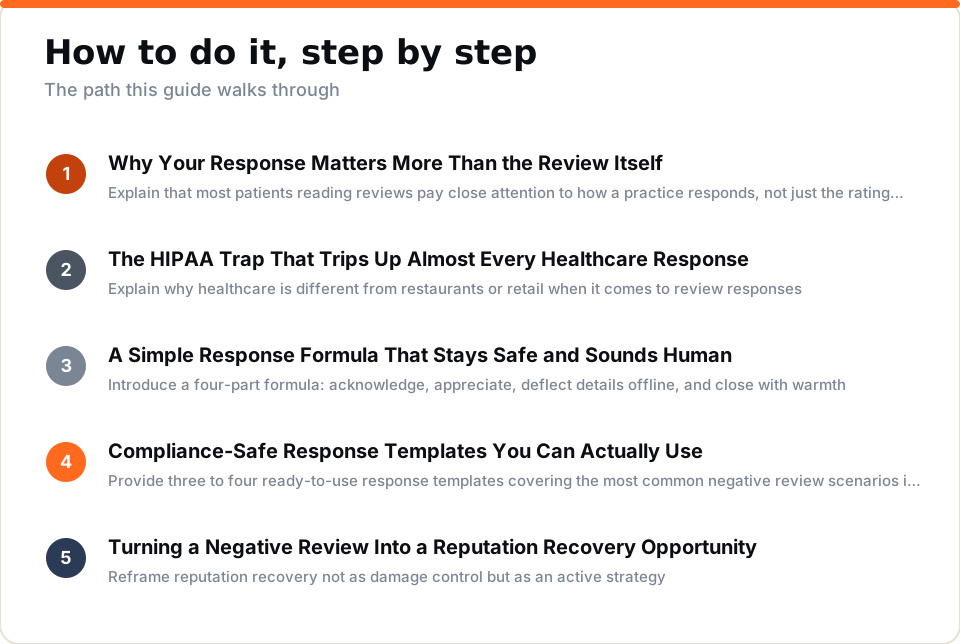
Why Your Response Matters More Than the Review Itself
Most people reading reviews aren't just looking at ratings. They're reading the conversation. A thoughtful, professional response to a difficult review signals something about your practice that a string of five-star ratings alone cannot: that you listen, that you take feedback seriously, and that a patient's experience matters to you even after the appointment is over.
Prospective patients make decisions based on this. A practice that has a handful of imperfect reviews but consistently responds with care often reads as more trustworthy than one with an identical star average and total silence.
There's also a search component worth knowing about. Your review responses are public content, and Google indexes them. According to Google's own guidance on local ranking, responding to reviews is one of the factors that signals an active, well-managed business profile. That means your response habits aren't just about patient relations; they're part of your google business profile optimization strategy and influence where you land in the local map pack.
Choosing not to respond is itself a choice. Silence reads as indifference, especially to someone who already felt dismissed. A missing response next to a frustrated review tells the next person scrolling through your profile exactly what they don't want to hear.
The HIPAA Trap That Trips Up Almost Every Healthcare Response
Healthcare is in a different category from restaurants, retail shops, and service businesses when it comes to responding to reviews. A coffee shop owner can say "Hey, we're so sorry your latte was cold, here's what we'll do differently." A healthcare provider cannot be nearly that specific, and the reason is HIPAA.
The core rule is simpler than it sounds: in any public response, you cannot confirm or deny that someone was your patient, reference anything about their visit, mention a diagnosis or treatment, or include any detail that could be linked to a specific person's health information. That's what makes patient review response so different from standard online reputation management.
Here's where practices slip up. Someone leaves a review saying "I waited 45 minutes and never saw the doctor." The well-meaning response goes something like: "We're sorry your appointment on the 14th ran long. We had an emergency that afternoon, and our team did their best to reach out." That response just confirmed the person was a patient and referenced details of their visit. That's a HIPAA problem, even though the intent was to explain and apologize.
A response that feels defensive or overly detailed can cross into protected health information territory before anyone realizes it. The instinct to correct the record or provide context is human, but in a public forum, it creates real compliance exposure. HIPAA compliant marketing more broadly requires this same discipline across all your patient-facing content, and your review responses are no exception.
The good news is that staying compliant doesn't mean sounding robotic. It just means the structure of your response looks different than what you might write for a retail business. You can still be warm, genuine, and specific in tone without touching any clinical detail.
A Simple Response Formula That Stays Safe and Sounds Human
Once you understand what you can't say, it gets easier to focus on what you can say and say it well. A four-part structure works across almost every scenario a healthcare practice encounters, regardless of specialty.
Acknowledge. Start by recognizing that the person had an experience that didn't feel right to them. You're not admitting wrongdoing; you're acknowledging that they feel the way they feel. That distinction matters. Something as simple as "We're sorry to hear this wasn't the experience you were hoping for" costs nothing and opens the door.
Appreciate. Thank the reviewer for taking the time to share their feedback. This sounds counterintuitive when someone is angry, but it signals confidence, not weakness. It says you take feedback seriously enough to be grateful for it.
Deflect details offline. This is the HIPAA guardrail built into the formula. Instead of addressing specifics publicly, invite the person to continue the conversation privately. Give a general contact method, a phone number or an email address like "our patient experience team," without referencing any detail from their actual visit.
Close with warmth. End on a note that reflects your practice's values. Keep it brief. Something like "We hope to have the chance to make this right" goes a long way.

This formula works whether you're running a dental practice, a chiropractic clinic, or a physical therapy office. The tone shifts slightly, but the bones stay the same. A chiropractor might sound a little more conversational; a specialist clinic might be a touch more formal. Neither version should ever feel like it came from a mail merge.
Length matters too. A response that runs four or five paragraphs reads as defensive, like you're trying to bury the complaint under words. Two to four sentences is usually enough. Long enough to show care, short enough to actually get read.
One hard rule: never ask the reviewer to take the review down in the response itself. It looks bad to everyone reading it, and it won't work anyway.
Compliance-Safe Response Templates You Can Actually Use
These templates are starting points, not copy-paste solutions. Every one of them should be lightly edited to match your practice's voice before you post, so it doesn't feel automated. And if a situation seems complex or involves any specific clinical detail in the original review, have someone with HIPAA familiarity review your draft before it goes live.
Scenario 1: Long wait times
"Thank you for sharing your feedback with us. We understand that your time is valuable, and we're sorry that your visit didn't run as smoothly as it should have. We'd welcome the chance to learn more about your experience. Please feel free to reach out to our team directly at [phone/email] and we'll do our best to help."
What makes this safe: it acknowledges the issue in general terms without confirming visit details, timing, or anything from a patient record. What makes it work: it shows accountability and offers a next step.
Scenario 2: Patient felt unheard or dismissed
"We're sorry to hear your experience left you feeling this way. Every person who comes through our door deserves to feel heard, and it sounds like we missed the mark. We'd love the opportunity to speak with you directly. You can reach our office at [phone/email] and someone will be happy to connect with you."
What makes this safe: no clinical details, no patient confirmation, no specifics. What makes it work: the language is personal and genuine without over-explaining.
Scenario 3: Billing confusion
"Thank you for taking the time to share this. We know billing questions can be frustrating, and we want to make sure you have clarity. Our team is available to walk through any concerns you have. Please give us a call at [phone/email] and we'll be glad to help sort things out."
What makes this safe: it doesn't reference any specific charges, claim details, or insurance information. What makes it work: it validates the frustration without confirming anything protected.
Scenario 4: Low star rating, no comment
"Thank you for the feedback. We'd love to learn more about your experience so we can do better. Feel free to reach out to us directly at [phone/email] and someone from our team will be in touch."
What makes this safe: there's nothing to accidentally confirm because you're responding to a blank review. What makes it work: even a brief, genuine response shows an active, engaged practice.
Tone adjustments by specialty are mostly about register. A dental SEO-focused practice that positions itself as friendly and family-oriented should sound that way in the response. A physical therapy clinic might emphasize their commitment to patient progress. A chiropractic office might lean into their care-first philosophy. The formula holds; the voice bends to fit.
Turning a Negative Review Into a Reputation Recovery Opportunity
Reputation recovery isn't damage control. It's an active strategy, and it starts before you ever get a bad review by building the kind of review volume and engagement that puts any single complaint in context.
One one-star review sitting among five total reviews is a problem. That same review sitting among forty, most of them positive, barely registers. Volume matters, which is why building a steady flow of honest reviews from satisfied patients is part of the same job as responding to the negative ones. They work together.

A pattern of thoughtful, professional responses to criticism can shift how prospective patients perceive the overall star rating, even before new reviews come in. People weigh engagement heavily. A practice that responds consistently and kindly signals that someone is actually paying attention, and that matters.
The operational side of this is often overlooked. Somebody needs to own the review monitoring task. Who on your team checks reviews, how often, and who approves the response before it posts? Without a simple workflow, reviews pile up unanswered, and the default is silence. That silence compounds. Building even a basic internal system, a weekly check-in, a response draft that gets a quick approval before going live, makes the whole thing manageable.
There's one more dimension worth mentioning. AI tools like ChatGPT and Perplexity are increasingly being used by patients to find and evaluate local healthcare providers. These systems synthesize publicly available information about a practice, and review content, including responses, is part of what they pull from. A practice with active, considered review engagement is more likely to come across well when AI tools summarize its reputation for a prospective patient using voice search or a generative AI query. Chiropractor AI search visibility and physical therapy SEO both benefit from the same underlying signal: consistent, credible public engagement.
What to Do When You Cannot Handle Review Management Yourself
Most healthcare practice owners and office managers are not sitting around looking for more to do. Review management sounds simple in theory, check reviews, write a response, done. In practice, it's the kind of task that gets pushed to the back of the list until a two-star review has been sitting unanswered for three weeks.
A managed approach looks like this: someone is monitoring your reviews on a regular basis, drafting responses that match your voice and meet compliance standards, flagging anything complicated for your review before it posts, and making sure nothing slips through. That's the service model, not the DIY-tool model.
Some practices try tools like BrightLocal or Birdeye to manage this themselves. Both are legitimate platforms with real utility. The catch is that a tool is only as useful as the person actively using it. If nobody's logging in and acting on what the tool surfaces, you've paid for a dashboard and nothing else.
LocalLeadSignal handles review management as part of a broader service that includes listings, local SEO, and AI visibility, starting at $249 per month with no contract. That structure was designed specifically because most small healthcare practices don't have a dedicated marketing person. The typical agency model starts at $500 or more per location and is built around the assumption that someone on your end is coordinating the work. That's not how most single-location practices operate.
Getting review management right doesn't require a big team or a big budget. It requires a consistent system that actually runs, so things don't fall through the cracks when Tuesday is slammed and Wednesday isn't any better.
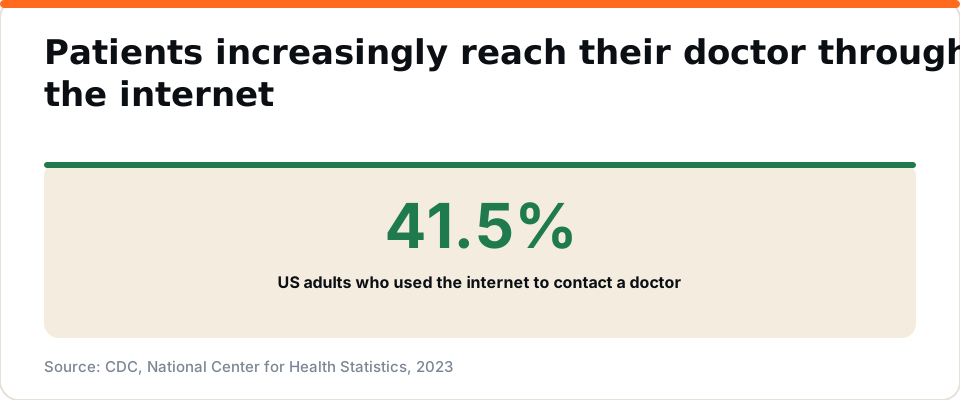
Source: CDC, National Center for Health Statistics, 2023
The Bottom Line
A negative review is a moment, not a verdict. How a practice responds to that moment communicates something real to prospective patients, to Google, and increasingly to the AI tools patients are using to make healthcare decisions. A response that's warm, specific in tone but careful with detail, and genuinely inviting further conversation does more good than any star rating can undo.
The formula is straightforward: acknowledge, appreciate, take it offline, close with warmth. The guardrail is consistent: stay out of any clinical or visit-specific detail that could constitute PHI. The habit is ongoing: review management isn't a one-time fix, it's a steady practice that compounds over time.
For practices that want this handled without adding another item to an already full plate, LocalLeadSignal manages reviews alongside listings, local SEO, and AI visibility. See how LocalLeadSignal manages your reviews, listings, and local SEO starting at $249 per month with no contract.
Frequently asked questions
- Can I respond to a negative Google review if it mentions my patient's visit details?
- You should never confirm or deny that someone is a patient, or reference anything from their visit, in a public response. Even a well-meaning clarification can violate HIPAA. Acknowledge the concern, express care, and invite them to call your office to resolve it privately.
- What should a HIPAA safe negative review response look like?
- A safe response acknowledges the reviewer's frustration, thanks them for sharing feedback, and offers a private channel to follow up. It does not reference their appointment, treatment, or any details you know from their record. Keep it warm, brief, and neutral on specifics.
- Does responding to negative reviews actually help with local SEO?
- Yes. Google treats review engagement as a signal of an active, responsive business. Consistent responses across your Google Business Profile support map pack visibility and build the kind of trust signals that both search algorithms and prospective patients look for when choosing a provider.
- Is it okay to ask a patient to take down a negative review in my response?
- No. Asking for removal in a public response looks defensive and can read as dismissive to others viewing it. Instead, invite the reviewer to contact your office directly. If the situation is resolved, some patients choose to update their review on their own.
- What is the easiest way to manage healthcare review responses without doing it all myself?
- The most practical option is a done-for-you service that monitors your reviews, drafts responses, and flags anything needing your sign-off before posting. LocalLeadSignal handles this alongside your local SEO and listings starting at $249 per month with no contract required.
See where your own business stands.
We measure your local rankings, your listings, your website, and how AI assistants answer for your business. No signup required.
Or jump straight to pricing →