
Notes
Online Reputation Management for Local Service Businesses: What Actually Works in 2026
Imagine a potential customer finds your business online. They like what they see, the services make sense, the location works, and the price seems fair. Then they scroll down to your reviews.
Reviewed by Melike Erguven, Co-founder of LocalLeadSignal · July 31, 2026 · 11 min read

Imagine a potential customer finds your business online. They like what they see, the services make sense, the location works, and the price seems fair. Then they scroll down to your reviews. A handful of old ones, a couple of unanswered complaints, and nothing recent. They click back and call your competitor instead.
That moment happens dozens of times a day for most local service businesses, and most owners have no idea it's occurring. Reputation management isn't something that happens in a crisis. It's happening right now, every time someone searches for you, and the question is whether you're shaping that experience or leaving it entirely to chance.
This guide is for service business owners who want to take control without hiring a full marketing team or spending a fortune. We'll cover what actually moves the needle in 2026, from how reviews affect your search visibility to what to do when things go sideways.
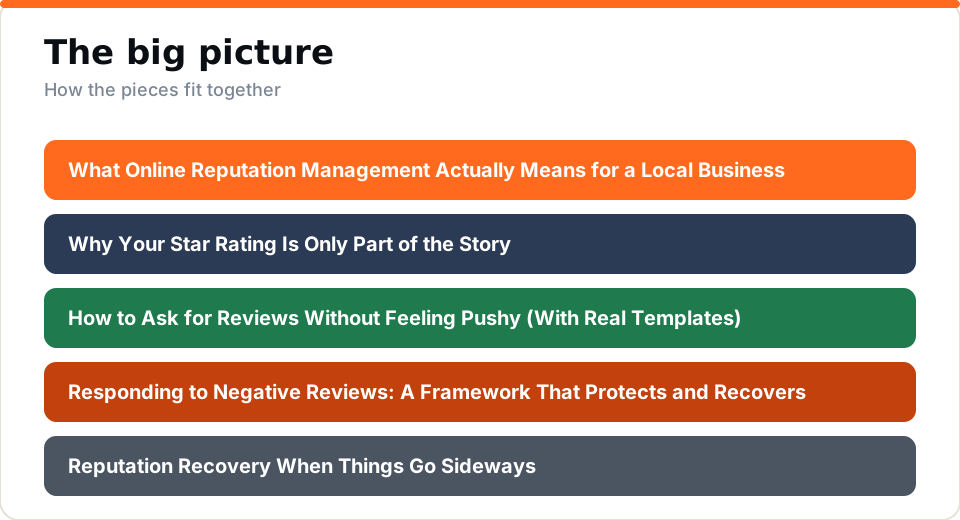
What Online Reputation Management Actually Means for a Local Business
Online reputation management, stripped of the jargon, is the ongoing practice of shaping what people see when they search for your business. That's it. For most local service businesses, it doesn't involve press releases or crisis PR firms. It's about making sure the information people find is accurate, the reviews are recent and responded to, and your business shows up where it should.
PR is mostly about controlling narrative through media. Crisis communications is about damage control at scale. Local reputation management is quieter and more constant. It's updating your hours before a holiday weekend, responding to the review someone left on a Tuesday night, and making sure the phone number on Yelp matches the one on your website.
Your reputation lives in three distinct places. First, review platforms, primarily Google, but also Yelp, Healthgrades, Avvo, and others depending on your industry. Second, your Google Business Profile, which is the listing that appears in map results and the right-side panel when someone searches your business name. Third, AI search tools like ChatGPT, Gemini, and Perplexia, which increasingly pull review sentiment and business data to answer questions like "best physical therapist near me" or "is this dentist any good."
Reputation and local SEO are not two separate strategies you can budget for independently. They're the same signal, read by both humans and algorithms. A business with strong, recent reviews and an accurate, optimized profile ranks better in map results and gets cited more favorably in AI-generated answers. Businesses that treat reputation as a marketing add-on and SEO as a technical checklist are missing the connection that ties both together.
AI search tools like ChatGPT and Google's own AI Overviews now synthesize review content alongside structured data. If your reviews consistently mention a specific service or location attribute, that language shapes how AI tools describe your business in response to natural-language queries. The businesses showing up in those answers in 2026 are the ones that have been tending to their reputation consistently, not just optimizing a page.
Why Your Star Rating Is Only Part of the Story
A 4.8-star rating sounds great until you notice the most recent review is from two years ago. Google's local ranking algorithm doesn't just care about how high your average is. According to Google's own guidance on improving your local ranking, the quality, quantity, and recency of reviews all factor into how your business ranks in local search.
Review velocity matters a lot here. A business that earns ten reviews over the past three months will often outrank a competitor with two hundred reviews that all came in during a single push three years ago. Recency signals to Google, and to potential customers, that your business is active, that people are using your services now, and that the feedback is relevant to what someone would experience today.
Unanswered reviews send a signal too, and it's not a good one. To Google, a pattern of ignored reviews suggests low engagement on the profile. To a prospective customer reading through your reviews, an unanswered complaint reads as confirmation that the business doesn't care. Your response to a bad review is often more persuasive than the review itself.
Review diversity across platforms helps your overall credibility, but for map pack ranking, Google is the priority. Yelp reviews don't move your Google ranking. Healthgrades stars don't push you into the top three map results. Spreading your energy equally across every platform is a common mistake. Build Google first, then extend to the platforms your specific industry relies on.
The connection between review signals and Google Map Pack ranking runs deep. Review quantity, recency, and response rate all play into the visibility factors that determine whether you show up in the top three local results or get buried below them. It's not just a popularity contest; it's an ongoing activity signal that tells Google your business is worth recommending.
How to Ask for Reviews Without Feeling Pushy (With Real Templates)
The discomfort most business owners feel about asking for reviews usually comes from framing it wrong. A review request isn't a sales pitch. It's an invitation for a satisfied customer to share something they probably would have said out loud anyway. You're just giving them a simple, low-friction path to say it where it counts.
Timing and context matter more than the exact words you use. The best moment to ask is right after a positive interaction, when the experience is fresh and the customer feels good about working with you. A week later, that feeling fades. So does the likelihood they'll follow through.
Here are three templates that work for different touchpoints.
SMS (post-appointment or service completion):
"Hi [First Name], glad we could help today! If you have a minute, an honest Google review means a lot to our small team. Here's a direct link: [review link]. Thanks so much."
Email (for service-based businesses):
Subject: Quick favor if you have 2 minutes
Hi [First Name],
Thanks for choosing [Business Name]. We hope everything went smoothly. If you're happy with the experience, leaving us a Google review takes about two minutes and helps other people in your area find us. [Direct link here]
No pressure at all, and thank you either way.
In-person or phone script for front-desk or field staff:
"Thanks so much for being here today. If you ever have a chance, Google reviews really help our business. We'll send you a quick text with a link, and it only takes a minute if you want to leave one."
For healthcare and legal practices, you'll want to be careful not to reference the nature of the visit or confirm a service relationship in the ask itself. Keeping the message generic ("We'd love your feedback") rather than specific ("after your appointment today") helps you stay on the right side of compliance. If you work in healthcare, the approach to collecting reviews without creating HIPAA risk deserves its own attention.
Personalization makes a real difference. Using a first name, referencing a specific team member if appropriate, and sending the request within a short window after service completion all improve follow-through. You don't need a perfect template. You need the right moment and a link that actually goes directly to your Google review form.
Responding to Negative Reviews: A Framework That Protects and Recovers
Every negative review deserves a response. Not eventually, not when you have time, and not just when the review is especially harsh. Every one, publicly, within a day or two of it appearing. This isn't about winning the argument. It's about showing the next fifty people who read that review how your business handles problems.
A response that works follows four steps: acknowledge the experience, express genuine empathy, offer to resolve things offline, then close professionally. That structure keeps your response short, constructive, and focused on resolution rather than defense.
Here's what that looks like in practice:
"Thank you for taking the time to share this. We're sorry the experience didn't meet your expectations, and we take feedback like this seriously. We'd like to make it right. Please reach out to us directly at [phone or email] so we can look into this for you. We appreciate the chance to address it."
For healthcare and legal practices, the stakes are higher. You cannot confirm that someone was a patient or client, reference any details of their case or visit, or say anything that could be read as confirming a professional relationship. A compliant response sounds something like this:
"We appreciate you sharing your experience. We take all feedback seriously and are committed to providing excellent service. Please feel free to contact our office directly so we can address your concerns appropriately."
It acknowledges, it empathizes without confirming anything, and it redirects offline. The Google guidance on managing customer reviews is worth reading if you want to understand what's acceptable when engaging with reviews on the platform.
Sometimes the right move is to flag a review rather than respond to it. If a review appears to be spam, is from someone who never used your service, or contains clearly false factual claims, you can request its removal through Google Business Profile. Don't count on that removal happening quickly or at all, but for obvious spam or fake reviews, it's worth pursuing. What you should not do is respond aggressively or accuse the reviewer publicly of lying, even if you're certain they're wrong.
When several negative reviews show up in a short window, the psychology of your responses shifts. Prospective customers reading a cluster of complaints are watching to see whether your business is aware of the pattern and doing something about it. A thoughtful, consistent response tone across all of them signals control and accountability, even before the underlying issue is fully resolved.
Reputation Recovery When Things Go Sideways
A reputation cluster event is when three or more negative reviews arrive in a compressed period, usually within a few weeks. It happens for a few reasons: a single bad experience that prompted a group of unhappy customers, an operational problem that caught up with you, or in some cases coordinated fake reviews from a competitor. The response strategy is different from handling a single one-off complaint.
The first step is to audit what you're actually looking at. Are these reviews from real customers describing a real experience? Are there patterns in the complaints that point to a specific employee, service type, or time period? Or do the accounts look new, the profiles sparse, and the language oddly similar? Knowing whether you're dealing with legitimate feedback or coordinated spam determines your next move.
Step two is to respond to each review individually and thoughtfully. Even if you suspect some of them aren't real, a measured public response protects your credibility with everyone else reading. Resist the urge to be defensive. A response that sounds angry or dismissive will do more damage than the original review.
Once you've responded, step three is to accelerate your review request cadence. Reach out to recent satisfied customers, people who've worked with you in the past few weeks, and ask for honest feedback using the templates above. You're not trying to bury the negative reviews with fake positivity. You're giving the algorithm and prospective customers a more complete picture of your business.
Step four is the one that's easy to skip: address the underlying issue if one exists. If multiple reviews mention the same problem, that's not a reputation problem. That's an operations problem with a reputation symptom. Fix the thing, then get back to building trust.
Step five is consistent monitoring. Check your rating weekly until it stabilizes and new positive reviews have created enough recency and volume to offset the cluster. Most recovery timelines are weeks, not days, so patience matters here.
One thing to be aware of: paid services that promise to remove negative reviews are almost universally ineffective and sometimes make things worse by triggering spam flags or creating additional problems with Google. There's no shortcut past the actual work of earning back trust with real customers.
How LocalLeadSignal Handles Reputation Management for You
Most reputation management tools are built for marketing agencies managing dozens of accounts. They come with complex dashboards, manual processes, and the assumption that someone on your team is going to log in every day and work through the queue. For a service business owner who is also the one doing the actual work, that model doesn't hold up.
LocalLeadSignal does the work for you. That includes monitoring your reviews across platforms, drafting responses for your approval, keeping your Google Business Profile optimized and accurate, and checking your listings for the kind of NAP inconsistencies that quietly drag down your local SEO without you ever noticing. You don't need to know what NAP consistency means or why local citations matter. We handle it.
The starting price is $249/mo with no contract. There's no setup fee tiered to your number of locations, no assumption that you have a marketing coordinator on staff, and no minimum commitment. That's a different starting point than most enterprise reputation tools, which often begin at $500 or more per location before you've even configured anything.
Tools like Birdeye and BrightLocal are genuinely useful, but they're designed for agencies managing many clients simultaneously. They give you visibility. LocalLeadSignal gives you execution. For an owner-operator who wants reviews monitored, responded to, and the profile kept in shape without adding another tool to learn, the distinction matters.
Reputation management and local SEO aren't sold as separate line items here because they aren't separate strategies. Your reviews affect your map pack ranking. Your GBP accuracy affects whether AI tools cite your business accurately. Your listing consistency affects whether Google trusts your business data enough to show it. These things work together, and they're managed together.
If you want to see what the service covers before making any commitment, take a look at what's included and how it's priced.
Reputation management doesn't have a finish line. The businesses doing well in local search and AI results in 2026 aren't the ones that ran a review campaign once. They're the ones that treat reviews as an ongoing conversation, respond consistently, keep their information accurate, and show up reliably over time.
You don't need a big budget to do this well. You don't need a marketing team or an agency retainer. You need a clear process, the right habits, and, if you want help executing, a service that's actually built for businesses like yours.
LocalLeadSignal was built for exactly this. See how it manages your reviews, listings, and local SEO starting at $249/mo with no contract.
Frequently asked questions
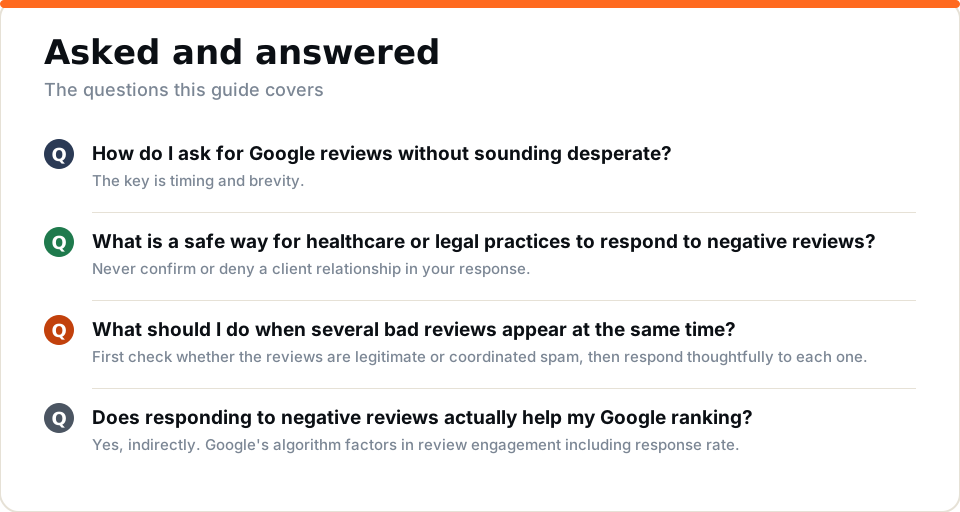
- How do I ask for Google reviews without sounding desperate?
- The key is timing and brevity. Ask right after a positive interaction, keep the message short, and make the link one tap away. A simple text like 'Glad we could help today. If you have a minute, a quick Google review means a lot to us.' works better than a long templated email sent days later.
- What is a safe way for healthcare or legal practices to respond to negative reviews?
- Never confirm or deny a client relationship in your response. Acknowledge the reviewer's experience in general terms, express that you take feedback seriously, and invite them to contact your office directly. This protects confidentiality while still showing prospective clients that you are responsive and professional.
- What should I do when several bad reviews appear at the same time?
- First check whether the reviews are legitimate or coordinated spam, then respond thoughtfully to each one. Next, reach out to recent satisfied customers and accelerate your review requests. Address any real service issue the reviews flag, and monitor weekly until new positive reviews bring your rating back up.
- Does responding to negative reviews actually help my Google ranking?
- Yes, indirectly. Google's algorithm factors in review engagement including response rate. Businesses that respond consistently signal active management of their profile, which supports local rankings. More importantly, it builds trust with the real humans reading those reviews before deciding whether to call you.
- How is online reputation management different from local SEO?
- They are closely connected but not the same thing. Local SEO focuses on ranking in search results through signals like citations, backlinks, and your Google Business Profile. Reputation management shapes what people see and feel once they find you, primarily through reviews. For local businesses, doing both together produces the strongest results.
See where your own business stands.
We measure your local rankings, your listings, your website, and how AI assistants answer for your business. No signup required.
Or jump straight to pricing →