
Notes
Reputation Recovery After Negative Reviews: What Actually Works and How Long It Takes
A handful of bad reviews show up over a long weekend. Your star rating dips from 4.6 to 4.1. By Tuesday, you notice the phone is quieter than usual.
Reviewed by Melike Erguven, Co-founder of LocalLeadSignal · September 9, 2026 · 13 min read

A handful of bad reviews show up over a long weekend. Your star rating dips from 4.6 to 4.1. By Tuesday, you notice the phone is quieter than usual. That sequence is not a coincidence, and the panic that follows is completely understandable.
The hard part is that panic usually triggers the wrong moves. Business owners delete review app notifications, draft long angry responses, or start asking every employee if they know who left that one-star post. None of that helps the ranking. None of it fixes the visibility drop. And some of it actively makes things worse.
Reputation recovery is a real process with a real mechanism. It moves slower than the damage did, and it requires doing things in a specific order. What follows is a practical explanation of what is actually happening under the hood when reviews go sideways, what the recovery sequence looks like, and where most businesses burn time doing the wrong things first.
What Your Star Rating Is Actually Telling Google (and AI Search)
Your star rating is not just a number that makes customers feel good or nervous. It is a live signal that feeds directly into how Google ranks your business in local results. Google's guidance on improving your local ranking explicitly identifies review quality, quantity, and recency as factors that influence where a business shows up. That means the map pack ranking factors you are competing on include the health of your review profile, full stop.
Review recency carries real weight. A cluster of positive reviews from three years ago does less work for your ranking than a steady trickle of fresh ones from the past 90 days. Google's algorithm is reading the review velocity on your Google Business Profile and comparing it to competitors in your local market. A sudden drop in star rating combined with a gap in new positive reviews is a signal that the algorithm picks up on, even if your overall rating technically stays above 4.0.
The response pattern on your profile matters too. Businesses that respond consistently to reviews, both positive and negative, send an engagement signal that a dormant listing does not. Google Business Profile optimization is not just about filling in your hours and uploading a photo. It includes showing up as an active, engaged business owner inside the platform.
Beyond traditional search, AI tools like ChatGPT, Perplexity, and Gemini are increasingly being used by consumers to find local service providers. These tools pull from publicly available signals, which include your review profile and overall reputation. A business with a damaged star rating and sparse responses is less likely to be surfaced confidently by an AI engine that is trying to recommend trustworthy local options. Generative engine optimization (GEO) is still a newer concept, but the inputs it relies on overlap heavily with what traditional local SEO has always measured.
One important distinction: a reputation problem can show up as three different things. A visibility problem means your listing is not showing up in the map pack as often. A conversion problem means people see your listing but do not click or call. A trust problem means they click, read the reviews, and leave. Each of those requires a slightly different fix, though they often travel together when a review cluster hits.
The Mechanism Behind Reputation Recovery: Why It Is Slower Than the Damage
Negative reviews accumulate fast. A competitor, a bad week, an unreasonable customer, or in some cases a coordinated spam attack can shave half a star off your profile in days. Building back that half-star through legitimate positive reviews takes weeks, sometimes months, of consistent effort. That asymmetry is not a flaw in the system. It is the system working as designed, because sudden bursts of reviews in either direction look suspicious.
Recency weighting is the central mechanic here. A wave of positive reviews that arrives all at once after a period of silence does not land the same way as reviews that arrive organically over time. The review velocity signal rewards consistency. Businesses that generate steady new reviews month over month build a more resilient profile than ones that run a one-time campaign and go quiet again.
Response patterns reinforce this. When you respond to every review, you are not just managing public perception. You are signaling to the algorithm that this is an actively managed listing. Businesses that respond consistently, especially to negative reviews, tend to show stronger GBP engagement signals over time.
NAP consistency plays into this too, in a way that is easy to overlook. NAP stands for name, address, and phone number, and if those details are inconsistent across local citations, directories, and your GBP, you have a trust problem baked into the infrastructure. A listing where the address reads differently on Yelp than it does on your GBP is quietly undermining the reputation work you are doing at the surface level. Local citation health and review health are not separate systems.
Be realistic about the timeline. Meaningful movement in star rating and map pack visibility typically takes 60 to 90 days of consistent effort. Not a sprint, not a weekend fix. Owners who expect a recovery in two weeks almost always underinvest in the middle of the process and then conclude that the strategy did not work. The strategy works. The timeline is just less forgiving than the damage was.
A Step-by-Step Plan When Bad Reviews Cluster at Once
The first thing to do is triage, not respond. Before you type a single word in reply, figure out what you are actually dealing with. Are these reviews from real customers you recognize? Are they vague, generic, or suspiciously similar in wording? Do the reviewer profiles look like real accounts? A coordinated spam attack and a genuine service failure require different first moves. Responding to a fake review the same way you would respond to a real one is a mistake, because one of those gets flagged for removal and the other gets acknowledged and addressed publicly.
Once you know what you are dealing with, the next step is to respond to every legitimate negative review within 48 hours. The tone should be calm and professional. Acknowledge the concern, express that you take feedback seriously, and invite the person to connect directly to resolve the issue. Do not admit liability. Do not get defensive. Do not share any private details about the interaction. Short is better than long here. A two or three sentence response that sounds like a human wrote it performs better than a paragraph of corporate-sounding damage control.
For reviews that appear to violate Google's policies, flag them through your GBP dashboard and submit a removal request. Go in with realistic expectations. Google does not remove reviews simply because the business owner finds them unfair. The review has to violate a specific content policy, and even then removal is not guaranteed. The flagging process is worth doing, but it is not a strategy on its own.
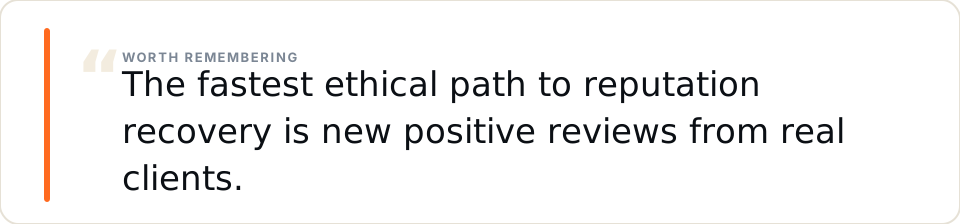
Step four is activating your satisfied customers. The fastest ethical path to reputation recovery is new positive reviews from real clients. Build a simple, direct ask into your normal follow-up process. A short text or email after a completed service, asking the customer to share their experience on Google if they were happy, is entirely within Google's guidelines. What is not allowed is offering incentives or telling people what to say. Keep the ask clean and let the customer decide what to write.

While you are in your GBP working on responses, audit the rest of the listing. A neglected profile with outdated hours, missing services, or no photos compounds the damage from bad reviews by giving prospective customers even more reasons not to call. Google business profile optimization is basic blocking and tackling, but it often gets skipped when everything feels urgent.
For healthcare practices and law firms, there is an extra layer of care required. Responding to a patient review without inadvertently confirming that someone is a patient can be genuinely tricky. If you work in dental, chiropractic, physical therapy, or any other regulated healthcare vertical, a generic acknowledgment response is safer than a specific one. The same principle applies to family law and personal injury practices, where client confidentiality limits what you can say publicly. A template response that stays general and invites a direct conversation gives you something to say without crossing a line you cannot uncross.
What Does Not Work (and Where Most Businesses Waste Their Time)
Ignoring the reviews is the most common non-strategy. The logic behind it sounds reasonable: if you just wait long enough, the bad reviews will age out and newer positive ones will dilute them. The problem is that recency weighting works in both directions. A negative review from six months ago with no response, and no new positive reviews to offset it, stays visible and stays relevant to the algorithm longer than most owners expect. Silence reads as disengagement.
Buying fake reviews is worse than ignoring the problem. The risks stack up fast. Google has systems designed to detect inauthentic review patterns, and a listing flagged for fake reviews can lose its review profile entirely or have its ranking suppressed in ways that are difficult to trace. Beyond the policy risk, actual customers notice when a business with 11 reviews suddenly has 60 and half of them sound like they were written by the same person. Fake review risk is real and the downside is severe enough that no short-term rating bump is worth it.
Long, defensive responses do not help either. A business owner who writes four paragraphs rebutting a one-star review in exhaustive detail does not look thorough. They look reactive. And in AI-generated summaries of local businesses, lengthy negative exchanges in the review section can be summarized in ways that make the business look combative. Short responses win, every time.
Chasing a 5.0 star rating is a trap. A 5.0 with 14 reviews is weaker than a 4.6 with 200, both in terms of consumer trust and map pack ranking factors. Review volume and review recency matter more to ranking than perfection. A business that redirects all its energy toward flawless ratings instead of steady review volume is optimizing for the wrong number.
Probably the most expensive mistake is treating reputation as separate from local SEO. Reviews, GBP signals, local citations, NAP consistency, and local business schema markup are all part of the same ecosystem. Fixing your reviews while your citations are a mess, or responding to every review while your GBP sits half-filled and your business hours are wrong, produces partial results at best. The local SEO audit you probably skipped when things were good is the foundation the recovery strategy needs to stand on.
Who Reputation Recovery Is Hardest For (and Why Vertical Matters)
Healthcare practices carry the highest stakes and the tightest constraints. A dental practice with 40 reviews can feel a single one-star post acutely. Chiropractic and physical therapy businesses often have a smaller review base than people assume, which makes them more vulnerable to rating swings. And because prospective patients are often making decisions under some degree of physical discomfort or health anxiety, a low star rating on a healthcare GBP has an outsized effect on whether someone calls. HIPAA considerations mean the response options are limited, so the best defense is a consistently high volume of genuine positive reviews before a crisis hits.
Healthcare practices navigating this situation can find more specific guidance on how to handle negative reviews without creating a compliance problem. The response constraints are real, but they are workable once you know what they are.
Law firms face a different version of the same challenge. Family law clients are often going through the hardest stretch of their lives. Personal injury clients are dealing with physical and financial stress. A prospective client in either situation is going to read reviews more carefully and weigh negative ones more heavily than someone shopping for a plumber. A cluster of bad reviews for a law firm does not just hurt ranking. It kills conversions at the decision stage, even when the firm's actual track record is strong.

Service businesses with a small review base are structurally the most fragile. A business sitting at 12 reviews is one bad week away from a rating collapse. A business with 200 reviews can absorb a few negative ones and barely move. The math is straightforward, but the implication often does not register until the damage is already done. Building review volume before a crisis is not optional in competitive local markets.
In a map pack where competitors have 150 reviews and a 4.7 star rating, dropping to 3.9 is not just a trust problem. It is almost certainly an exit from the three-pack. The local keyword research you do to understand your competitive landscape should include a look at the review profiles of the top three listings in your category. That context tells you exactly how much cushion you have and how much catching up you need to do.
The recovery path itself does not change dramatically by vertical. Respond promptly, generate consistent new reviews, clean up your GBP, and maintain citation health. But the timeline and the response constraints differ enough that a one-size-fits-all approach will leave money on the table. Or in the case of a regulated industry, create a compliance problem.
Keeping Your Reputation Stable After You Have Recovered It
The instinct after recovering from a bad review cluster is to stop thinking about reviews. You hit a rating you feel okay about, the phones start ringing again, and reputation management slides off the priority list. That is exactly when a lot of businesses end up back where they started three months later.
Review velocity matters more than any single rating milestone. A consistent stream of new reviews, even a modest one, keeps your profile fresh and signals ongoing activity to both Google's ranking systems and to AI tools that pull from reputation data. Reputation damage recovery is a timeline issue, but reputation maintenance is a systems issue. Build the review request into your normal workflow, whether that is a follow-up text after a service call, a quick email after a project closes, or a prompt at checkout, and let it run in the background rather than waiting until things go wrong.
The AI search angle is increasingly relevant here. Tools like ChatGPT, Perplexity, and Gemini are being used to recommend local businesses, and they are pulling signals from publicly available data, including your reviews and your GBP. AI visibility for local businesses is not a separate channel to optimize for in isolation. It is a function of having a well-structured, consistently active, and trustworthy local presence. That means generative engine optimization starts with the same basics: clean listings, consistent NAP, strong review health, and accurate schema markup.
Local business schema markup ties into this more than most owners realize. Structured data helps search engines, and increasingly AI engines, confirm basic facts about your business quickly and confidently. If you want AI search citations to include your business in a recommendation, the structured data guidance from Google Search Central gives a clear picture of how review and rating data gets read and surfaced. Schema is not a magic ranking fix, but it is part of what makes a local business legible to automated systems at scale.
Building a review generation strategy and keeping your GBP current are not marketing projects with a finish line. They are ongoing operations, the same way answering the phone is an ongoing operation. For a deeper look at what sustainable reputation management for service businesses looks like month over month, that piece covers the longer game in detail. The short version is that your reviews, citations, content, and listing health all reinforce each other, and the businesses that stay in the map pack consistently are the ones treating all of them as connected systems rather than separate to-do items.
Reputation damage moves fast. Recovery moves slowly. That gap is why the order of operations matters so much.
The sequence is not complicated, but it has to be followed in sequence. Respond to every review first, because the responses are public and they signal engagement immediately. Then build a steady, compliant review generation process to bring in fresh positive signals over time. Then make sure your GBP is fully built out and your citations are consistent, because a listing with conflicting information or missing details quietly cancels out the reputation work happening at the surface.
If your rating just took a hit and you are not sure where to start, begin with the two moves that matter most this week: respond to every review still sitting unanswered, and get an honest read on where your profile, reviews, and citations stand right now. The recovery plan in this article is the work. Doing it steadily, week after week, is what closes the gap.
Frequently asked questions
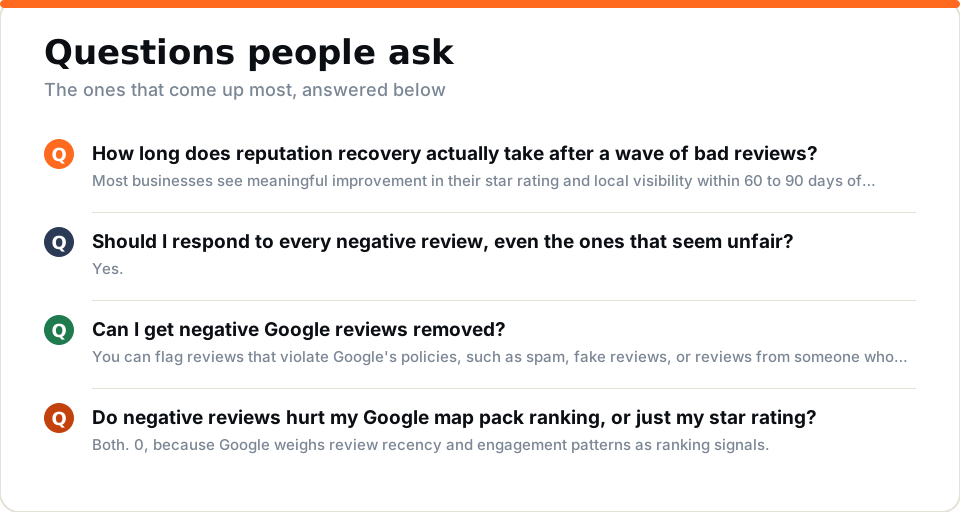
- How long does reputation recovery actually take after a wave of bad reviews?
- Most businesses see meaningful improvement in their star rating and local visibility within 60 to 90 days of consistent effort. Recovery depends on how many new positive reviews you generate, how quickly you respond to negatives, and whether your Google Business Profile is in good shape. There is no shortcut that works reliably faster.
- Should I respond to every negative review, even the ones that seem unfair?
- Yes. Responding to every negative review signals active engagement to Google and shows prospective customers that you take feedback seriously. Keep responses short, calm, and professional. Avoid sharing specific details about the situation. A measured response to an unfair review often makes your business look better, not worse.
- Can I get negative Google reviews removed?
- You can flag reviews that violate Google's policies, such as spam, fake reviews, or reviews from someone who was never a customer, and request removal through Google Business Profile. Removal is not guaranteed and can take time. Reviews that are simply critical but honest are very unlikely to be removed.
- Do negative reviews hurt my Google map pack ranking, or just my star rating?
- Both. A sudden cluster of negative reviews can suppress your map pack visibility even if your overall rating stays above 4.0, because Google weighs review recency and engagement patterns as ranking signals. A low review volume makes the impact worse, since a few bad reviews shift your average more dramatically.
- How is reputation recovery different for healthcare or legal practices?
- Healthcare and legal businesses face compliance constraints on what they can say in review responses. Healthcare providers must avoid confirming whether someone is a patient. Law firms must avoid discussing case details. Both should use brief, empathetic responses rather than detailed rebuttals, and consider having a compliance-aware template reviewed before publishing.
See where your own business stands.
We measure your local rankings, your listings, your website, and how AI assistants answer for your business. No signup required.
Or jump straight to pricing →