
Notes
Long-Tail Local Keywords: How to Find the Phrases Your Competitors Are Missing
Imagine a chiropractor who has been in practice for eleven years. Good reputation, solid reviews, a steady stream of referrals.
Reviewed by Melike Erguven, Co-founder of LocalLeadSignal · August 3, 2026 · 14 min read

Imagine a chiropractor who has been in practice for eleven years. Good reputation, solid reviews, a steady stream of referrals. But every time she checks her rankings, she is buried on page three for "chiropractor near me" while two large multi-location clinics sit at the top. She has tried optimizing her homepage. She has tweaked her Google Business Profile. Nothing moves the needle on that big head term.
Here is the thing: she is fighting the wrong battle. The businesses pulling consistent, high-converting traffic from local SEO are not winning on "chiropractor near me." They are winning on phrases like "chiropractor for lower back pain after car accident" or "same-day chiropractic adjustment for pinched nerve." Those phrases have a fraction of the search volume, but the person typing them is already in pain, already motivated, and already looking to book.
This article is a practical walkthrough of long-tail local keywords: what they are, where to find them, how to decide which ones are worth your time, and how to put them to work on a real website without a marketing team or a big agency budget.
What Long-Tail Local Keywords Actually Are (and Why They Convert Better)
A long-tail keyword is simply a search phrase of three or more words that gets specific about a service, a situation, or a location context. "Dentist" is a head term. "Affordable family dentist accepting new patients" is a long-tail keyword. The first one is short and broad. The second one is narrow and loaded with intent.
Head terms attract massive competition. Every dental practice in the country, plus insurance comparison sites, national directories, and dental chains, is fighting for the top spots on "dentist." A single-location practice cannot outspend or out-link those players. Long-tail phrases are a different environment. Because the search volume is lower, bigger competitors tend to skip them entirely. That leaves real space for a local practice to rank.
The conversion rate story is just as important as the competition story. Someone who types "dentist" might be a dental student doing research, a parent looking for information about their kid's teeth, or someone who just moved and is vaguely thinking about finding a new provider. Someone who types "pediatric dentist open Saturday mornings" is a parent with a specific need and a time constraint, ready to pick up the phone. The specificity of the phrase signals proximity to a decision.
Local SEO naturally generates long-tail opportunities because every search query is a combination of at least a few variables: the service, the location, the situation, and sometimes the urgency. A family law attorney in a midsize town might rank easily for "divorce attorney serving [county name]" but struggle for "family lawyer." Physical therapy marketing content built around "PT for rotator cuff recovery after surgery" targets a patient who is post-op and has a referral in hand. That is a very different conversion scenario than someone browsing "physical therapy exercises."
Lower search volume does not mean lower value, especially in service businesses. A personal injury lawyer, a family law firm, or a dental practice can generate thousands of dollars in revenue from a single new client. If a long-tail phrase sends one qualified lead per month, that phrase is doing real work, even if only forty people searched it.
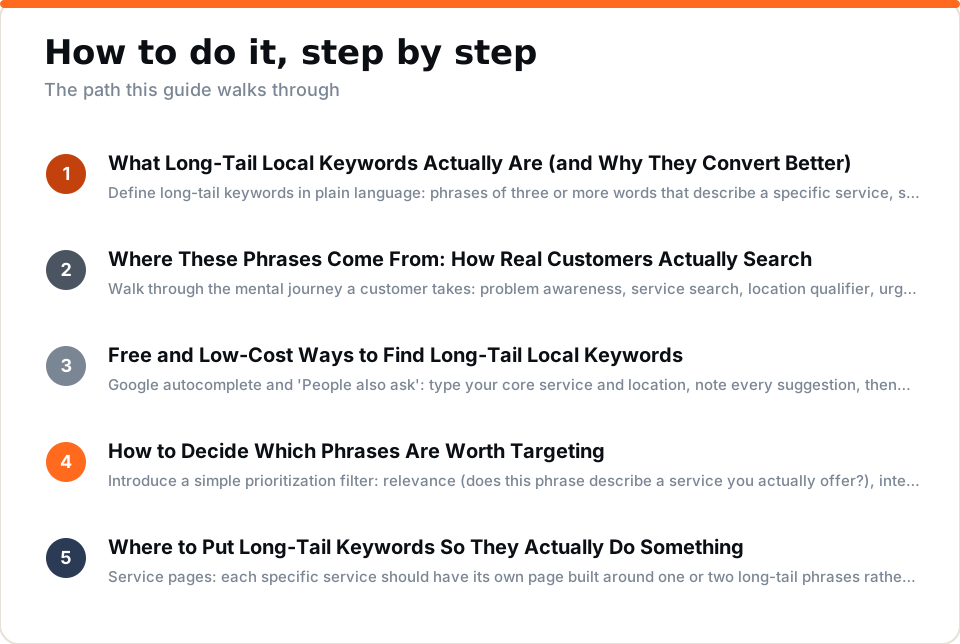
Where These Phrases Come From: How Real Customers Actually Search
Most people do not sit down and brainstorm a search query. They type the way they think. The mental journey usually goes something like this: first, something goes wrong or a need surfaces. Then they start searching for a category of service. Then they add a location or proximity signal. Then, if they do not find something fast, they get more specific with their situation or their urgency.
Take HVAC as an example. Someone's air conditioner stops working in August. They might start with "HVAC repair" and immediately get overwhelmed by national service websites. So they type "HVAC repair near me," still too broad. Then: "emergency HVAC repair same day." Then "HVAC company that takes financing." Or "HVAC tune-up before winter schedule." Each refinement is a long-tail keyword, and each one reflects a different point in that person's decision process, a different situation, a different barrier they are trying to clear.
One service can generate dozens of these variants. A chiropractor could map phrases around the type of pain (back, neck, sciatica), the cause (car accident, sports injury, pregnancy), the urgency (same-day, walk-in), the patient type (pediatric, adult, seniors), and the desired outcome (pain relief, posture correction, maintenance). Most of those combinations have real search volume and very little competition at the local level.
Voice search is accelerating this trend. When someone asks their phone a question out loud, they speak in full sentences: "Who is a good personal injury lawyer near me that works on contingency?" That is a long-tail phrase, and it is formatted as a natural question rather than a compressed keyword string.
One of the most underused research sources for long-tail language sits right inside your Google Business Profile. The Q&A section, the reviews customers leave, and the posts you publish all surface the exact words real customers use when they are describing their problem and what they needed. A family law firm might find that multiple clients mention "custody arrangement during school year" in reviews. That is a long-tail phrase worth targeting. It came straight from the people who hired you.
Free and Low-Cost Ways to Find Long-Tail Local Keywords
Google Autocomplete is where most people should start because it is free, real-time, and pulling directly from what actual users are searching. Open an incognito browser, type your core service and a partial location context, and watch the suggestions drop down. Write down everything. Then add a letter after your service name and repeat. Do it again with a different phrasing. In fifteen minutes you can have fifty phrase variations you had never thought about.
"People also ask" boxes are equally valuable. When you search a broad term, Google shows questions real users are asking nearby in the search journey. Those questions are usually long-tail goldmines, especially for FAQ and blog content. Answering them thoroughly is one of the most direct paths to featured snippet real estate.
Google Search Console is the most underused free tool a local business owner has access to. Pull up your Performance report and filter the queries by position. The phrases ranking in positions 5 to 20 are particularly interesting: you are already visible for them, but not yet on page one. Many of those will be long-tail phrases that just need a targeted page update or a content addition to break through. Start with a structured look at your existing queries to understand how Google is already reading your site, then use that data to find the phrases where a small push would move the needle.
Review mining is simple but effective. Read through your recent Google reviews and scan your competitors' reviews too. Customers describe their problems in their own words, not in SEO vocabulary. That unfiltered language is a direct window into the long-tail phrases people associate with your service. A physical therapy practice might notice that several reviews mention "therapist who explains what they are doing" or "PT that works with my insurance schedule." Those are content opportunities.
Bing Places and Bing Webmaster Tools are often skipped by small businesses, which is exactly why they are worth checking. The query data in Bing Webmaster Tools sometimes surfaces different long-tail patterns than Google, and the competition on Bing for local terms is often lower. Setting up your Bing Places listing for local SEO is a quick win that most competitors have not bothered with.
LocalLeadSignal tracks keyword positions for clients as part of the core platform, so you can see which specific phrases are driving impressions and which ones are stalled just outside the top rankings without purchasing a separate SEO tool subscription. For businesses comparing options, tools like BrightLocal are solid alternatives for standalone tracking. The difference with LocalLeadSignal is that the research, tracking, and optimization work is done for you, starting at $249/mo with no contract, which is a very different proposition from a software license that requires you to do your own analysis.
How to Decide Which Phrases Are Worth Targeting
Not every long-tail phrase you find deserves a page or a content update. A simple three-part filter keeps you focused: relevance, intent, and competition.
Relevance is the obvious one. Does the phrase describe a service you actually offer? "Dental SEO audit" is a useful phrase for a marketing company. It is irrelevant for an actual dental practice. Stick to phrases that map to real services on your menu.
Intent is trickier but more important. Transactional local keywords signal that someone is ready to act: words like "hire," "cost," "near me," "open now," "same-day," "free consultation," and "accepts insurance" all indicate a buyer. Informational local keywords like "how to" and "what is" indicate someone who is learning, not yet deciding. Both have value, but they belong on different content types. Transactional phrases belong on service pages and your Google Business Profile. Informational phrases belong in blog posts and FAQ pages, which is also where AI overviews and featured snippets tend to pull their answers.
Local citation strength acts as a quiet multiplier for all of this. Businesses with consistent NAP consistency across directories and strong local citations tend to rank for more long-tail variants organically, because Google has more confidence in the legitimacy and location specificity of the business. Google's own guidance on improving your local ranking highlights completeness and accuracy as core ranking signals, and that same completeness signals to search engines that a business is a reliable result for specific local queries.
Competition assessment for a single-location business means being realistic about domain authority and link profile. A solo family law marketing effort is not going to outrank a regional law firm's homepage for "family lawyer" right away. But that same practice can absolutely rank for "modification of child custody agreement after job loss" if they write a thorough, well-structured page targeting that phrase. That is keyword gap analysis at its most practical: find where the big players are not playing.
Refresh underperforming content quarterly. Search patterns shift, especially with AI search trends evolving quickly. A phrase that was informational six months ago might now have strong transactional signals attached to it. Building keyword research into a quarterly routine, rather than treating it as a one-time task, keeps your content aligned with how customers are actually searching right now.
Even a phrase with thirty monthly searches can justify a full page when your service produces a high-value client relationship. A personal injury lawyer SEO strategy built around twenty niche long-tail phrases, each generating one or two calls per month, adds up to a significant new client volume. The math changes completely when you account for what each client is actually worth.
Where to Put Long-Tail Keywords So They Actually Do Something
The most common mistake in local SEO is having one giant "Services" page that tries to cover everything. Search engines, and customers, benefit from specificity. Each meaningful service variation you offer should have its own dedicated page built around one or two long-tail phrases. A dental practice does not need one page titled "Dental Services." It needs pages for "teeth whitening for sensitive teeth," "dental implants for missing back teeth," and "emergency tooth extraction same day." Those pages can actually rank. The catch-all page usually cannot.
Blog and FAQ content is where your informational long-tails live. If someone searches "how long does it take to recover from a rotator cuff repair," that is a question a physical therapy practice should be answering in a detailed blog post. These posts are also where AI overviews pull citations from. To surface in those generative results, your content needs to directly answer the question in clear, structured prose, not bury the answer after three paragraphs of preamble.
Your Google Business Profile is more powerful for long-tail visibility than most businesses realize. The services section, business description, and GBP posts are indexed by Google and can rank for specific queries directly in the map pack. Writing a GBP post about "same-day appointments for back pain relief" is not just an engagement tool; it is a local SEO signal. Google's guidelines for representing your business on Google make clear that accurate, complete, and category-specific information improves how your profile performs in local results.
Local business schema markup tells search engines exactly what kind of business you are, what services you offer, and where you operate. Adding structured data for your service offerings using the LocalBusiness schema format helps search engines understand the specificity of what you do. This specificity matters for AI search citations, where the systems are parsing structured content to build answers to detailed queries.
The long-tail phrase needs to appear in the page title tag and the H1. Not crammed in awkwardly, but naturally placed at the front. Body copy matters, but search engines weight the title and the first heading heavily when determining topical relevance. If your page is about "affordable dental implants for seniors on Medicare," that phrase should be in the H1 and the title tag, not just mentioned once in paragraph four.
Internal linking connects your long-tail content together and reinforces topical authority. A chiropractor with pages covering back pain, neck pain, sports injuries, and pregnancy chiropractic care should be linking those pages to each other where it makes sense contextually. This helps crawlers understand the breadth of your expertise and helps readers find adjacent information they might need. A strong internal linking structure built around related long-tail content signals to both Google and AI search tools that your site is a substantive source on the topic.
A Simple Workflow for Ongoing Long-Tail Keyword Research
Keyword research is not a task you do once and file away. Here is a repeatable quarterly process that works for a service business without dedicated marketing staff.
Step 1: Pull your current ranking phrases from Google Search Console or your LocalLeadSignal dashboard. Look at everything, not just your top ten. The full list of impressions shows you which phrases Google is already associating with your site.
Step 2: Filter for positions 5 to 20. These are your best near-term opportunities. You are already visible for those phrases, but a stronger page, a better title tag, or a more direct answer to the implied question could push you onto page one. Prioritize these for content updates before you start building new pages from scratch.
Step 3: Check your most recent Google reviews and any new GBP questions for fresh language patterns. Customers do not use the same vocabulary forever. New trends in how people describe their problems show up in reviews before they show up in keyword tools. This step takes fifteen minutes and consistently surfaces long-tail phrases you would not have thought to research. Part of a solid local keyword research process is paying attention to the language customers actually use, and reviews are one of the most direct sources of that language.
Step 4: Open ChatGPT, Perplexity, or a similar AI tool and ask your core service questions conversationally, the way a customer would speak them. "What should I look for in a family law attorney for a contested divorce?" "How do I find a chiropractor who takes walk-ins?" Note how the AI phrases its answers and what questions it assumes the user has. These reflect real conversational search patterns and are increasingly how AI search citations GEO is being shaped.
Step 5: Assign every phrase you find to one of three buckets: an existing page that should be updated, a piece of content already planned that needs a focus adjustment, or a new page brief. Set a calendar reminder to run this same process again in ninety days.
None of this requires a full marketing department. But it does require consistency. For businesses that want this handled without managing it themselves, LocalLeadSignal does the keyword tracking, visibility monitoring, and SEO management for clients starting at $249/mo with no contract. The quarterly review of ranking data, the content strategy, the listings, the reviews, all of it is covered.
Long-tail local keywords are where single-location service businesses can genuinely compete. The bigger players are focused on high-volume head terms because their scale makes that the logical play. They are not writing content about "pediatric chiropractor for scoliosis screening" or "family law attorney for parenting plan modification." That space is open. You can own it.
Finding these phrases is not complicated. It mostly means paying closer attention to how real customers describe their situations, whether that is in a review, a question on your GBP, or a voice search query they spoke into their phone while sitting in a parking lot. The research tools are largely free. The process is repeatable. The barrier is mostly just doing it consistently.
For businesses that want it done for them, LocalLeadSignal handles the keyword research, content strategy, listings management, and SEO work, all starting at $249/mo with no contract required.
See what long-tail opportunities your business is missing. Start your LocalLeadSignal plan at /pricing, and we will handle the keyword research, content strategy, and SEO work for you.
Frequently asked questions
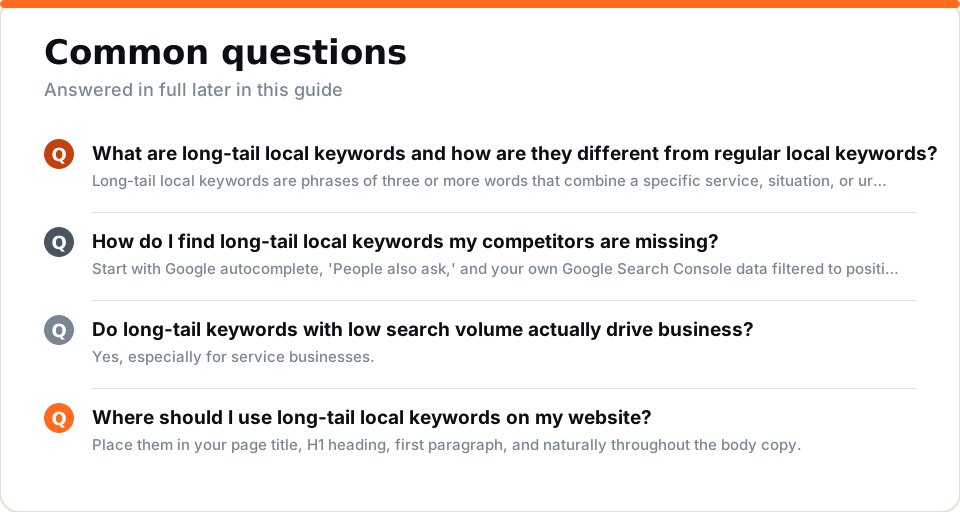
- What are long-tail local keywords and how are they different from regular local keywords?
- Long-tail local keywords are phrases of three or more words that combine a specific service, situation, or urgency with a location context. Unlike broad terms like 'dentist,' they reflect exactly what a ready-to-hire customer types, making them less competitive and far more likely to convert into actual leads.
- How do I find long-tail local keywords my competitors are missing?
- Start with Google autocomplete, 'People also ask,' and your own Google Search Console data filtered to positions 5 to 20. Mine your customer reviews for the words real people use. Bing's free webmaster tools often surface different patterns too. These sources together reveal specific phrases bigger competitors rarely target.
- Do long-tail keywords with low search volume actually drive business?
- Yes, especially for service businesses. A phrase searched 40 times a month may seem small, but if each conversion is a $500 to $2,000 client, even one or two leads per month more than justifies the effort. Low volume also usually means low competition, making these phrases much easier to rank for.
- Where should I use long-tail local keywords on my website?
- Place them in your page title, H1 heading, first paragraph, and naturally throughout the body copy. Each specific service you offer should have its own page built around one or two focused phrases. Google Business Profile posts and your services section also index for long-tail queries and can show up directly in the map pack.
- How often should I revisit my long-tail keyword strategy?
- A quarterly review works well for most service businesses. Pull your Search Console or visibility dashboard data, find phrases ranked 5 to 20, update existing pages, and check recent reviews for new customer language. Search patterns shift with seasons, trends, and AI search behavior, so staying current gives you a real edge.
See where your own business stands.
We measure your local rankings, your listings, your website, and how AI assistants answer for your business. No signup required.
Or jump straight to pricing →