
Notes
Dental SEO Audit: A Step-by-Step Walkthrough for Your Practice
Every dentist knows the moment: a long-time patient settles into the chair and says, "I've been coming here for twelve years, my whole family loves you." That's a wonderful thing to hear.
Reviewed by Melike Erguven, Co-founder of LocalLeadSignal · August 5, 2026 · 14 min read

Every dentist knows the moment: a long-time patient settles into the chair and says, "I've been coming here for twelve years, my whole family loves you." That's a wonderful thing to hear. What's less wonderful is realizing that almost no one new is saying, "I found you on Google and booked right away." If new patients are trickling in through word of mouth but not through search, something is quietly off in how your practice appears online.
That gap is exactly what a dental SEO audit is built to find and fix.
Most dental practices aren't ignoring their online presence on purpose. It's more that nobody ever handed the front desk manager a clear, jargon-free picture of what "showing up on Google" actually requires. So the website goes untouched for three years, the Google Business Profile has old hours, and the Healthgrades listing still has the wrong suite number from when the practice moved. None of it is catastrophic alone, but together it adds up to a practice that's harder to find than it should be.
This walkthrough is that picture. It covers five concrete areas any practice owner or office manager can review, whether you handle your own marketing or are considering handing it off. You don't need an agency retainer or a dedicated marketing team to do this. You need a checklist and a willingness to look honestly at what's there.
What a Dental SEO Audit Actually Covers (and Why It Matters More Than Rankings Alone)
A dental SEO audit is a structured review of every signal Google and AI search engines use to decide whether your practice appears when someone nearby searches for a dentist. That sounds broad because it is. It covers your Google Business Profile, the way your name and address appear across directories, your website content, your review history, and now, increasingly, how AI-powered tools like ChatGPT or Gemini represent your practice in generated answers.
Rankings are an output, not the audit itself. A lot of practice owners check their ranking for "dentist near me" and stop there. But a ranking is just the result of dozens of inputs working together or against each other. The audit looks at those inputs: is your profile complete? Are your citations consistent? Do your service pages say anything useful? Are there unanswered one-star reviews sitting on your Google profile? Fix the inputs and the rankings tend to follow.
Dental SEO is also genuinely different from general SEO, and that distinction matters for how you prioritize your audit. For most local healthcare providers, the Google Map Pack, the block of three local listings that appears above organic results, drives more new patient clicks than any blog post or backlink. To earn a spot there, you need strong local signals: a well-optimized Google Business Profile, consistent citations, real reviews, and location-relevant content. Domain authority, which is the currency of traditional SEO, matters less here than local relevance and trust signals. If you've been reading general SEO advice and wondering why it doesn't quite apply to your practice, that's why.
It's also worth understanding the difference between dental practice SEO and the approach a large dental service organization (DSO) takes. A DSO is managing dozens or hundreds of locations simultaneously, which creates a completely different set of challenges around duplicate content, brand consistency, and scaled citation management. A single-location or small group practice actually has an advantage: you can build genuine local relevance and community trust in a way that a corporate chain struggles to replicate. That specificity is something to lean into, not apologize for.
This walkthrough is organized into five audit areas. A thorough dental SEO audit touches all of them, and skipping one tends to limit what the others can accomplish.
Step 1: Audit Your Google Business Profile for the Basics and the Easy Wins
Your Google Business Profile is where most new patients will encounter your practice before they ever visit your website. It controls a huge share of your local map pack ranking, and it's surprisingly easy to let it go stale. Start here because the wins are often fast and the mistakes are often obvious.
Go through every field methodically. Check that your business name matches exactly what's on your signage and website, no extra keywords stuffed in, no abbreviations that don't match anywhere else. Confirm your address is current, including suite number. Make sure the phone number is your main line, not a fax number or an old number that rings somewhere else. Review your hours, including holiday hours and any special scheduling notes. These are the basics, and Google's tips for improving your local ranking make clear that completeness and accuracy are foundational to how the profile performs.
Category selection is one of the most impactful and most overlooked fields. Your primary category should be "Dentist" in most cases. But if you also offer cosmetic procedures, pediatric care, or orthodontics, adding the relevant secondary categories can meaningfully expand the search queries your profile shows up for. A lot of practices pick one category and move on, missing legitimate visibility they're already qualified for.
Now look at the sections most profiles leave completely empty. GBP posts, the Q&A section, and the services or products fields are often untouched for months or years. Posts can highlight a new service, a seasonal reminder to use insurance benefits before year-end, or a community event. The Q&A section lets you answer common patient questions before they even call. These aren't cosmetic additions, they're engagement signals that Google factors into how active and relevant your profile looks.
Search your practice name directly in Google Maps and look for duplicate or unclaimed listings. A duplicate listing splits the ranking signals that should be concentrated on your main profile. This is more common than people expect, especially for practices that have moved, changed names, or had a previous owner. Duplicate listings confuse Google and confuse patients.
Common GBP mistakes worth flagging: keyword-stuffed business names (adding "best family dentist" to your official business name violates Google's guidelines), service areas set too broadly or incorrectly, and phone numbers that don't match what's on your website. Any of these can quietly suppress your map pack performance. For a deeper look at what this kind of profile review actually surfaces, a systematic review of your local presence walks through the broader process.
Step 2: Check Your NAP Consistency and Local Citations Across the Web
NAP stands for name, address, and phone number. For local SEO, consistency in these three pieces of information across every place they appear online is a foundational trust signal. When Google or an AI search engine aggregates data about your practice from dozens of sources, conflicting information creates doubt. And doubt translates to lower rankings.
The challenge is that inconsistencies accumulate quietly. Your practice moved suites two years ago, but Yelp still has the old address. You added a second phone line, and now some directories list one number while others list another. The name on Zocdoc is "Dr. Martinez Family Dentistry" but your Google profile says "Martinez Dental." None of these feel like crises when they happen, but collectively they're telling search engines and AI tools that your practice data is unreliable.

For dental practices specifically, the citation sources that matter most include Healthgrades, Zocdoc, Yelp, WebMD, Bing Places, Apple Maps, and general business directories. Each of these is a structured data source that contributes to how your practice is understood across the web. Healthgrades and Zocdoc carry particular weight in healthcare local SEO because they're trusted, high-authority platforms that both Google and AI tools reference when surfacing provider information.
A simple audit process: search your exact practice name plus your city in Google. Review the first two pages of results and open every listing you find. Log the name, address, and phone number in a spreadsheet and compare them to your "canonical" information, the version you want everywhere to match. Mark any discrepancy, even small ones like a missing suite number or a slightly different phone format.
It's worth understanding the difference between citations and backlinks here, because they're related but not the same thing. A citation is any online mention of your name, address, and phone number, a directory listing, a chamber of commerce page, a local business association profile. A backlink is a link from another website pointing to yours. Both matter for local SEO, but they work differently. Fixing a citation error on Zocdoc doesn't earn you a link; it cleans up a trust signal. Earning a mention from a local newspaper or a neighborhood blog is a different kind of effort with a different kind of payoff. Knowing which is which keeps your audit focused.
Unresolved citation errors don't just stay where they are. They get scraped and re-syndicated by data aggregators, which means one wrong address can propagate to dozens of directories over time. The earlier you catch and fix these, the less cleanup you're dealing with later.
Step 3: Review Your On-Site Content and Local Keyword Signals
Your website is the part of dental SEO that most practices feel most uncertain about. It doesn't need to be complicated, but it does need to be clear. The core question for every page is: does this page tell Google what you do, where you are, and who you serve?
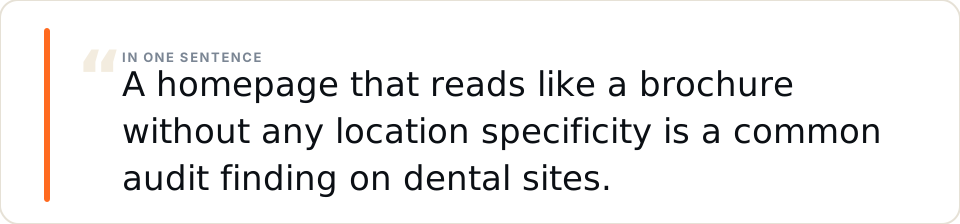
Start with your homepage. Does it mention your city or region? Does it name your core services? Is there a clear call to action for new patients? A homepage that reads like a brochure without any location specificity is a common audit finding on dental sites. Your homepage should make it obvious in the first few sentences that you're a dentist in a specific place accepting new patients.
Then move to your service pages. Title tags and meta descriptions are often the most neglected pieces of on-site SEO for dental practices, and they're still among the most direct signals Google uses to understand what a page is about. A title tag that says "Our Services" tells Google almost nothing. One that says "Teeth Whitening in [Your Town] | Smith Family Dental" is doing real work. Check every core service page for a descriptive, location-aware title and a meta description that actually summarizes what the page covers.
Local keyword research gaps show up most clearly when a service exists on your menu but nowhere else on your website. A lot of dental sites have a navigation link for "Invisalign" that goes to a page with two sentences and a contact form. That's not a page Google is going to rank; it's a placeholder. If you offer a service, that service deserves a page with enough content to explain what it is, who it's for, how it works at your practice, and what a patient should expect. This is especially true for high-intent searches like emergency dental care, where patients are ready to book immediately.
Once your content is in place, local business schema markup is the next layer to add. Schema is structured data you embed in your website's code to tell search engines exactly what kind of business you are, where you're located, what your hours are, and how to contact you. For dental practices, LocalBusiness structured data and healthcare-specific extensions help Google parse your site with more confidence, which supports both traditional rankings and AI search citations. It sounds technical, but most modern website platforms have plugins or built-in tools that make implementation straightforward.
Thin or duplicate content is worth flagging as a separate audit finding. If you have multiple service pages that say nearly the same thing with the city name swapped in, that's a signal quality issue worth cleaning up.
Step 4: Evaluate Your Reviews and Online Reputation Signals
Reviews are not just social proof. They're a ranking factor. Google uses review quantity, recency, and how actively a practice responds as signals of legitimacy and relevance. A profile with 200 reviews and steady new ones coming in every week looks healthier than a profile with 200 reviews and the last one from fourteen months ago.
Start with the basics during your audit. How many Google reviews does the practice have? What's the average rating? When was the most recent review posted? Scroll through and look specifically at negative reviews, are they answered? A one-star review with no response doesn't just sit there quietly. It shapes how prospective patients perceive the practice, and it signals to Google that nobody's paying attention.

A healthy review profile has a few consistent characteristics: new reviews coming in on a regular basis (not in bursts that look artificial), responses to all reviews including the positive ones, and a rating that reflects genuine patient experience. Getting there requires a system for asking patients to leave reviews after their visit, not pressuring them, just making it easy and part of the standard follow-up process.
The connection between reviews and AI visibility is newer but increasingly important. AI tools like ChatGPT and Gemini pull sentiment signals from public review data when generating recommendations for local providers. A practice with hundreds of detailed, recent reviews talking about specific services or the doctor's approach is giving AI models richer material to work with than a practice with a handful of generic five-star ratings. This is one of the reasons reputation management is no longer just about looking good online, it's about being represented accurately in AI-generated answers.
Reputation recovery is a different kind of audit finding. A practice sitting at a 3.8 average with several unanswered negative reviews and nothing new in months needs a different action plan than a practice with a 4.9 average that just hasn't been actively asking for reviews. The first situation requires response, recovery, and a steady influx of new voices. For practices dealing with negative reviews in a healthcare context, the response approach matters enormously, both for the prospective patients reading it and for demonstrating professionalism to search engines. If your practice operates in a regulated healthcare setting, that layer of compliance and sensitivity applies to how you respond publicly.
Source: Pew Research Center, 2025
Step 5: Check Your AI Search Visibility, the Audit Area Most Practices Skip
Most dental practices have never asked themselves whether they show up in an AI-generated recommendation. That's understandable because this is genuinely new territory, but it's also the reason acting now creates an advantage over waiting.
Here's a simple manual test. Open ChatGPT, Perplexity, and Gemini in separate windows. Type something like "Who are the best dentists in [your city]?" or "Find a family dentist near me that accepts new patients." See what comes back. Does your practice appear? If someone else's practice does, what does that listing say about them? This test won't give you a complete picture, but it tells you whether you're showing up at all in the AI layer of search that a growing number of patients are using.
Generative engine optimization, often called GEO, is the practice of structuring your online presence so that AI models can find, trust, and cite your business in their generated answers. It doesn't require a completely different strategy from what's already in this audit. Strong GBP data, consistent citations, a healthy review profile, and authoritative content on your website all feed into the signals that AI models use. Google's guidance on how search works explains the crawling and indexing foundation that AI-assisted results build on, even when the output looks very different from a traditional search results page.
Voice search and AI search are increasingly the same conversation. When a patient asks their phone "find a dentist near me open on Saturday," that query is now routing through AI-assisted interpretation on some platforms before surfacing results. Conversational queries favor practices with complete, well-structured profiles and content that directly answers common patient questions. A blog FAQ that answers "Does this practice offer same-day emergency appointments?" isn't just content, it's a potential source for an AI-generated answer.
The practices that build AI visibility now will have a meaningful head start on competitors who treat this as something to think about later. It's not a separate strategy, it's the same local SEO foundation, applied with awareness that the output now includes AI-generated recommendations alongside traditional results. For practices looking to understand the broader shift in how patients find providers, the changing landscape of dental search is worth understanding alongside this audit process.
A dental SEO audit isn't something you do once and file away. Google updates its algorithm continuously, AI search is evolving quickly, and your practice's online footprint changes every time a patient leaves a review, a directory syncs new data, or a competitor updates their profile. The five areas above are a living checklist, not a one-time project.
These are also the exact areas LocalLeadSignal tracks and manages every month for practices starting at $249 with no contract. We handle the audit, the fixes, and the ongoing monitoring, from your Google Business Profile and citations to your reviews and AI visibility, so you don't have to become an SEO expert to stay competitive.
If going through this list feels like a lot to keep up with alongside actually running a practice, that's not a personal failing. That's just the reality of how much local search has grown. It's also exactly the problem LocalLeadSignal is built to solve.
Frequently asked questions
- How do I do a dental SEO audit on my own practice?
- Start with five areas: your Google Business Profile completeness, NAP consistency across directories, on-site content and schema markup, your review profile and response rate, and AI search visibility. Work through each area with a simple spreadsheet to log findings and prioritize fixes by impact.
- How long does a dental SEO audit take?
- A basic audit covering your GBP, top citations, homepage content, and reviews can take two to four hours for someone unfamiliar with the process. A more thorough pass that includes schema markup, all service pages, and AI visibility testing typically takes a full day or is best handled by a dedicated service.
- What is the most common SEO problem dental practices have?
- Inconsistent NAP data across directories is the most common and most overlooked issue. A phone number update or address change that never got applied to Healthgrades, Yelp, or Bing Places quietly splits your ranking signals and confuses both Google and AI search tools.
- Does a dental SEO audit include AI search visibility?
- It should. AI tools like ChatGPT and Gemini are increasingly used to find local providers, so a complete audit now checks whether your practice appears in AI-generated recommendations, not just traditional Google search results. Strong citations, reviews, and structured content all contribute to that visibility.
- How is a dental practice SEO audit different from a DSO audit?
- A single dental practice audit focuses on one Google Business Profile, one set of citations, and one reputation footprint. A DSO audit multiplies every step across multiple locations, each needing its own GBP, consistent NAP, and review strategy. The fundamentals are the same but the scope and complexity grow significantly at scale.
See where your own business stands.
We measure your local rankings, your listings, your website, and how AI assistants answer for your business. No signup required.
Or jump straight to pricing →