
Notes
Healthcare Local SEO in 2026: How Small Practices Get Found (and Stay Found)
You run a genuinely good practice. Your patients get better outcomes, your staff actually picks up the phone, and people who find you tend to stick around.
Reviewed by Melike Erguven, Co-founder of LocalLeadSignal · July 27, 2026 · 15 min read

You run a genuinely good practice. Your patients get better outcomes, your staff actually picks up the phone, and people who find you tend to stick around. But somewhere across town, a clinic with a mediocre reputation and a decent SEO setup is pulling in the new patients you should be getting, simply because they show up first in Google. That gap is frustrating, and it's also fixable.
Healthcare local SEO isn't some mysterious dark art reserved for big hospital systems with full marketing departments. It's a set of specific, learnable systems: keeping your Google Business Profile accurate and active, building a consistent presence across the directories patients and Google both trust, collecting reviews steadily, and now, making sure AI-powered search tools actually know your practice exists. None of that requires a massive budget or an in-house team.
This article is a practical walkthrough of all of it, written for independent and small group practices that are tired of watching their competitors outrank them without knowing exactly why. We'll cover how Google's local search actually works for healthcare providers, what the audit process looks like, where most practices quietly lose ground, and what it takes to stay visible as search itself keeps shifting toward AI-generated answers.
Why Healthcare Local SEO Is a Different Animal Than General SEO
Traditional SEO and local SEO both involve Google, but they're trying to accomplish completely different things. A national content strategy is built around ranking for broad terms, often with no geographic qualifier at all. Local SEO for healthcare practices is about showing up for the person who is three miles away, in pain or worried, searching for a specific type of help right now. That's a fundamentally different problem, and it needs a fundamentally different approach.
Healthcare search is especially high-intent. Someone searching "knee pain physical therapist accepting new patients" isn't browsing. They've already decided they need help and they're ready to call. That means ranking matters at the moment of decision, not just for general awareness. Patients search by condition, by specialty, and almost always by some combination of proximity cues, whether that's a city name, "near me," or even a neighborhood. The query itself tells you exactly what they want.
The trust bar is also higher in healthcare than in almost any other local vertical. People aren't picking a pizza place; they're choosing someone who will examine them, treat them, or advise on their health. That means reviews, photos, credentials, and consistent information across platforms all carry more weight than they would for a retail business. A missing phone number or an outdated address isn't just an inconvenience; it's a reason a prospective patient calls someone else.
There's a layer of compliance awareness here too. HIPAA-aware content practices shape what you can and can't say in your marketing, and that does create some guardrails around things like patient testimonials and condition-specific language. It's worth being thoughtful about that framing, and if you want to go deeper on exactly where the lines are, there's a solid breakdown in this guide to compliant healthcare marketing. For now, the key point is that compliance is a guardrail, not a barrier. Plenty of effective local SEO work sits well within it.
The resource gap between independent practices and larger systems is real. A DSO or regional hospital network may spend thousands per month per location on local search, with a dedicated team managing it. An independent chiropractor or physical therapist has none of that, and often can't justify the $500-plus monthly retainer most agencies quote before they've even looked at your profile. The good news is that local SEO rewards consistency and accuracy more than raw spend. A well-maintained presence from a smaller practice can outrank a neglected one from a bigger competitor. That's the gap worth closing.
The three areas this article focuses on are visibility, which starts with your Google Business Profile and your map pack position; reputation, meaning your reviews and how you handle them; and AI search, which is where the next wave of patient discovery is already happening. Getting all three working together is what actually moves the needle.
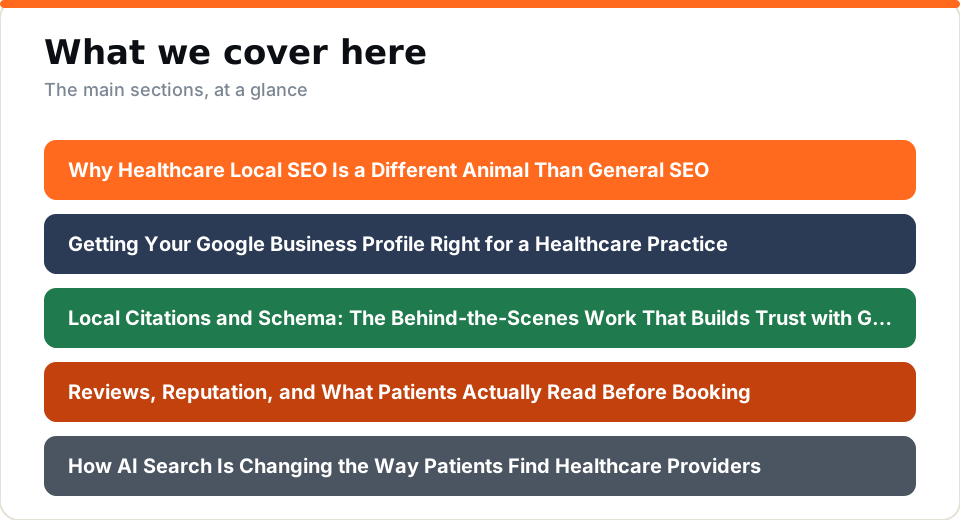
Getting Your Google Business Profile Right for a Healthcare Practice
Your Google Business Profile is the single most important piece of local search real estate you control directly. It powers your appearance in the Google Map Pack, those three local listings that appear above organic results on most searches, and it feeds information into Google Maps, voice search results, and increasingly, AI-generated answers. For a healthcare practice, getting it right isn't optional; it's foundational.
Category selection is where a lot of practices quietly lose ground. Google uses your primary category as a major signal for which searches you're eligible to appear in, so choosing the right one matters. A physical therapy clinic that lists itself as "Health Consultant" instead of "Physical Therapist" is essentially invisible to anyone searching for PT by name. Your primary category should be as specific as possible to your actual specialty. Secondary categories let you expand your eligibility, so a clinic offering both chiropractic and massage therapy should list both. Google's own guidance on improving local ranking confirms that relevance, including category accuracy, is one of the core ranking factors.
For practices with a physical location patients visit, your address should be listed precisely and consistently. Service area settings are more relevant for providers who travel to patients. Accepted insurance is an attribute that's often left blank, and it's one that patients actively filter on. Filling it in takes ten minutes and can meaningfully affect whether you show up when someone searches for a provider in their network.
Photos are worth more attention than most practices give them. Exterior shots help patients confirm they've found the right building. Interior photos reduce first-visit anxiety, which is real for people walking into a healthcare setting for the first time. Staff photos build a sense of familiarity before anyone ever steps through the door. What you want to avoid is anything that could tie a specific patient to a visit, which is both a HIPAA concern and just good judgment. Stick to team photos, treatment rooms, waiting areas, and equipment.
The Map Pack ranking itself is determined by three things: proximity (how close the practice is to the searcher), relevance (how well your profile matches the query), and prominence (how well-known and trusted Google considers your business to be, based on reviews, links, and citations). Proximity is fixed. Relevance and prominence are where your ongoing GBP work actually moves rankings.
Common GBP mistakes in healthcare tend to cluster around neglect rather than errors. Services and FAQs are left blank because no one has time to fill them in. Posts go unpublished for months at a time. The Q&A section accumulates unanswered questions, sometimes from prospective patients who never got a reply and called someone else. GBP posts, even simple ones like seasonal reminders, service spotlights, or updated hours, tell Google that your listing is active. The Q&A section is free marketing copy that most practices ignore entirely.
Maintaining all of this on a monthly basis is where independent practices usually fall behind. It's not that the work is hard; it's that no one on staff has it as their job. That's the exact problem that done-for-you local SEO is designed to solve, handling the ongoing maintenance so the practice doesn't have to think about it.
Local Citations and Schema: The Behind-the-Scenes Work That Builds Trust with Google
Local citations are mentions of your practice's name, address, and phone number across the web. They show up in directories like Healthgrades, Zocdoc, and WebMD, but also in general business directories, insurance provider lookups, and local chamber of commerce listings. Google cross-references these sources when deciding how much to trust the information in your GBP. A practice with consistent, accurate citations across reputable directories signals stability. Inconsistencies signal the opposite.
Healthcare is a particularly tricky environment for NAP consistency. Multiple providers often share a suite address. Practices relocate. Phone numbers change. Old listings linger in directories that no one ever thinks to update. Each mismatch is a small signal to Google that something might be off, and when those signals pile up, they can suppress your map pack position without any obvious cause. Medical citation management is slow and unglamorous work, but it pays off in ranking stability over time.
Beyond directories, schema markup is the behind-the-scenes technical layer that helps Google understand what your website actually is. Local business schema tells Google your hours, phone number, address, and service types in a structured format that's easy for machines to read. For healthcare practices specifically, Google supports more granular schema types like MedicalBusiness, Physician, and MedicalClinic, which can be applied to confirm specialty, accepted insurance, and other healthcare-specific attributes. Google's documentation on LocalBusiness structured data is the definitive reference for what fields are available and how to implement them correctly.
Healthcare schema markup matters more now than it did two years ago, because AI search tools read structured data directly when generating answers. A practice whose website has clean, accurate schema is more likely to be surfaced in an AI-generated recommendation than one whose site has no structured data at all. It's one of those quiet technical investments that used to be optional and is now genuinely important.
Citations and backlinks are different things, and it's worth being clear about that distinction. Citations confirm to Google that your practice is real, located where you say it is, and listed accurately across the web. Backlinks, meaning links from other websites pointing to yours, signal authority and relevance in your field. Healthcare practices need both, but many independent practices start with neither. A reasonable citation foundation for a single-location practice means coverage across the major health-specific directories plus the main general directories. Quality and consistency beat raw volume. A hundred inconsistent citations are worse than thirty accurate ones.
Reviews, Reputation, and What Patients Actually Read Before Booking
A review profile does two separate jobs. First, it's a ranking signal. Practices with more frequent, recent, and highly-rated reviews tend to rank better in the Map Pack, all else being equal. Second, and arguably more important for healthcare, it's a conversion signal. A prospective patient scanning their options will often click the practice with the better reviews even if it sits lower in the results. Star rating and review count are the first things people see, and in a trust-sensitive vertical like healthcare, they carry enormous weight.
Volume matters, but so does recency. A cluster of glowing reviews from three years ago doesn't carry the same weight as a steady stream of recent ones. Patients trust patterns, and a practice that consistently generates reviews over time reads as actively serving people right now, not as a place that had a good run years ago. The goal isn't a one-time push for reviews; it's a system that keeps a slow, natural drip of new ones coming in every month.
Asking for reviews in a healthcare context feels awkward for a lot of providers, and there are legitimate guardrails around how you phrase the ask. The short version: you can ask patients to share their experience, you just can't reference specific treatments or conditions in the way you frame that request. Timing matters too. Asking right after a positive interaction, at checkout or in a follow-up message, is when patients are most likely to follow through.

Responding to reviews is underused and undervalued. A thoughtful response to a positive review takes thirty seconds and reinforces the relationship. A thoughtful response to a negative review is harder, but silence is almost always worse. For healthcare providers, the goal with a negative review response isn't to win an argument; it's to demonstrate professionalism to every future patient reading that thread. A calm, non-defensive reply that acknowledges the concern and invites the reviewer to contact the office directly says a lot about how the practice handles difficult situations.
Reputation recovery is a real scenario, not an edge case. Practices sometimes have a concentrated cluster of old negative reviews pulling down their overall rating, sometimes from a specific period when staffing was in flux, or from a billing dispute, or just from the unpredictability of running any patient-facing operation. The path out is consistent, ongoing review generation, not asking for the removal of old reviews or trying to game the system. New reviews don't erase old ones, but they dilute them over time and shift the overall average. That's patient review management as an ongoing practice, not a one-time crisis response.
Online reputation management for healthcare providers is simply the discipline of keeping that review profile healthy and representative of how the practice actually performs. It doesn't happen by accident, and it doesn't stay healthy without attention.
How AI Search Is Changing the Way Patients Find Healthcare Providers
Google is still where most patients start their search, but the experience of that search is changing fast. AI-powered tools like ChatGPT, Perplexity, and Gemini are increasingly answering health-related local queries directly, synthesizing information and recommending providers rather than returning a page of links. A patient asking "who's a good chiropractor near me who accepts my insurance" is, in some search contexts, getting a single confident answer back instead of ten results to scroll through. If your practice isn't in that answer, you don't exist to that patient.
What makes a practice show up in AI-generated answers is different from what makes it rank on a traditional search results page. AI tools pull from structured data, from citation-rich web presences, and from content that directly and clearly answers the kinds of questions patients ask. A practice whose website has accurate schema, whose directory listings are consistent, and whose content addresses real patient questions in plain language has a much better chance of being cited in an AI summary than one whose web presence is thin or contradictory.
Generative engine optimization, or GEO, is the emerging name for the practice of making sure your business shows up in AI-generated answers and summaries. For healthcare providers, this means ensuring that the information AI tools can find about your practice is accurate, structured, and comprehensive. It also means producing content that answers specific questions, not just keyword-rich pages designed for the old model of search. The shift isn't sudden, but it's accelerating, and practices that build for it now have a head start.
Voice search fits into the same pattern. When someone asks a smart speaker who the best dentist near them is who's accepting new patients, the device returns one answer. That answer comes from the same ecosystem of structured data, consistent citations, and prominent reviews that AI search tools draw from. Chiropractor AI search visibility and dental SEO are two verticals where this gap between optimized and unoptimized practices is already showing up clearly. Independent practices that haven't thought about any of this are, in many cases, completely invisible in these channels.
The practical reality is that most single-location practices haven't done any deliberate AI visibility work, because the concept barely existed two years ago. That's not a criticism; it's an opportunity. A relatively small investment in structured data, citation consistency, and content clarity can meaningfully improve how AI search tools represent your practice, especially compared to competitors who are still treating a GBP update as their entire local SEO strategy.
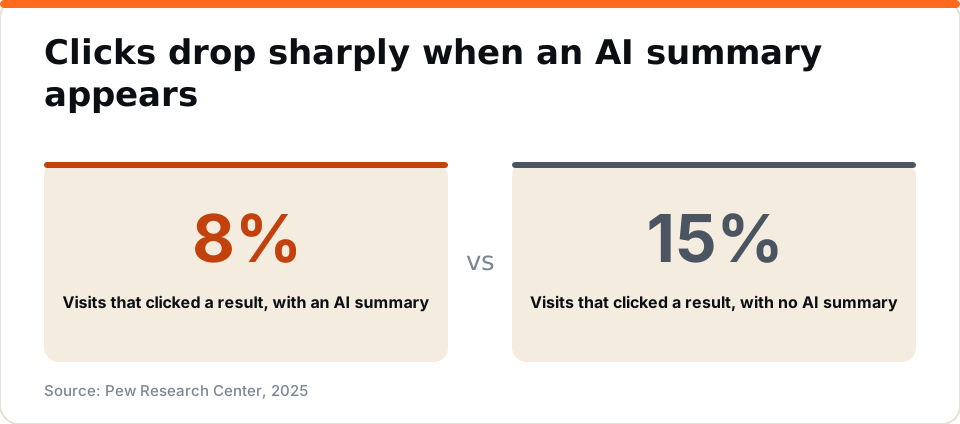
Source: Pew Research Center, 2025
What a Healthcare Local SEO Audit Actually Covers (and How to Know If You Need One)
A local SEO audit for a healthcare practice isn't a single checklist item. It's a look across several interconnected systems to find where visibility is leaking. The main components are a GBP health check, a citation accuracy scan, an on-site schema review, a keyword gap analysis, a review profile assessment, and an AI visibility check. Each one can surface different problems, and fixing them in isolation without looking at the others often misses the actual cause.
The GBP health check looks at category accuracy, completeness of profile fields, photo quality and recency, post frequency, and Q&A activity. The citation scan checks how your NAP appears across the directories that matter most for healthcare, flagging inconsistencies by source. The schema review looks at whether your website has local business markup at all, whether it's accurate, and whether it's using the healthcare-specific types that give AI tools more to work with. If you want to see what a full profile review looks like in practice, running a quick audit of your dental practice's profile against these criteria is a good starting point for understanding the common gaps.
Keyword gap analysis is where long-tail local keywords often surface as a missed opportunity. Practices frequently optimize for their general specialty term, "physical therapy" or "chiropractor," without capturing the condition-plus-location queries that convert at a much higher rate. Searches like "knee pain physical therapy" or "family dentist accepting new patients" or "back pain relief chiropractic" represent patients who are further along in their decision. Those are the searches you actually want to rank for, and a review of how physical therapy practices are showing up for condition-specific queries illustrates exactly why the gap matters.
The signals that tell a practice they have a problem are often gradual. Call volume from new patients starts slipping. A competitor that didn't used to outrank you now appears above you for your own specialty. Your map pack position for your main service term drops from the top three to the next page, which might as well be invisible. None of these things happen overnight, which is why waiting until it's obviously bad means you've been losing ground for months.
The way LocalLeadSignal approaches this is worth explaining plainly. Starting at $249 per month with no contract, the audit isn't a deliverable that gets handed back so you can figure out what to do with it. The findings become the work plan. GBP management, citation cleanup, schema implementation, review flow, and AI visibility are all handled on an ongoing basis. Larger agencies at $500 or more per location often come with the assumption that you have someone on your side who can coordinate, review deliverables, and manage implementation. Most independent practices don't. DIY tools like BrightLocal are genuinely useful for surfacing data, but the data still needs someone to act on it. For a practice without a marketing team, the gap between a report and actual results is where the work either happens or doesn't.
Healthcare local SEO is not a project you complete and check off. It's a set of ongoing systems that need regular attention: a GBP that stays accurate and active, citations that stay consistent as directories update, reviews that keep flowing in and getting responses, schema that reflects your current services, and an AI presence that grows as these tools become a bigger part of how patients find care.
Most practices that are losing visibility aren't losing to better competitors. They're losing to more visible ones. And visibility is fixable.
LocalLeadSignal was built specifically for practices that don't have a marketing department, can't justify a $500-plus monthly agency retainer, and don't want to spend their evenings chasing down directory listings. No contract. Real work done every month. The cost starts at $249, and the scope covers everything in this article.
See what healthcare local SEO looks like when someone else does the work. Start with LocalLeadSignal, no contract, no jargon, just results.
Frequently asked questions
- How is local SEO for healthcare practices different from regular local SEO?
- Healthcare local SEO involves the same core signals as any local SEO, but the stakes are higher. Patients research providers more carefully than they research restaurants, HIPAA adds content guardrails, and competing against DSOs or hospital systems means independent practices need to be precise and consistent everywhere they appear online.
- Can a small independent practice realistically compete against a DSO or hospital system in local search?
- Yes, and often more easily than they think. DSOs manage dozens of locations and tend to be inconsistent with local details. A single-location practice that keeps its GBP accurate, earns steady reviews, and builds clean local citations can outrank a larger system for its specific neighborhood or specialty searches.
- What does a healthcare local SEO audit actually look for?
- A solid audit checks your Google Business Profile for completeness and accuracy, scans your citations across directories for NAP consistency, reviews your website for local schema markup, identifies keyword gaps in your specialty and service area, and assesses your review profile for volume, recency, and response patterns.
- Will my healthcare practice show up when patients ask ChatGPT or voice search for a provider?
- Only if your online presence is structured in a way AI can read and trust. Practices with consistent citations, proper schema markup, and content that directly answers patient questions are far more likely to appear in AI-generated answers. Most independent practices are currently invisible in AI search, but that gap is closable.
- How much does healthcare local SEO cost for a single-location practice?
- It varies widely. Large agencies typically start at $500 or more per month and expect you to have a marketing team coordinating with them. LocalLeadSignal starts at $249 per month with no contract and handles the ongoing work, including GBP management, citation cleanup, review monitoring, and AI visibility, for you.
See where your own business stands.
We measure your local rankings, your listings, your website, and how AI assistants answer for your business. No signup required.
Or jump straight to pricing →