
Notes
Physical Therapy SEO Case Study: How FYZICAL Saint Peters Got 35% More Patient Calls in 60 Days
Most physical therapy practices are not failing because of bad care. The therapists are skilled, the patients leave happy, and the referrals trickle in. But the phone still is not ringing the way it should.
Reviewed by Demir Devecigil, Co-founder of LocalLeadSignal · August 19, 2026 · 13 min read

Most physical therapy practices are not failing because of bad care. The therapists are skilled, the patients leave happy, and the referrals trickle in. But the phone still is not ringing the way it should. New patients are searching "physical therapy near me" on their phones right now, and someone else keeps showing up at the top of Google Maps. That is the quiet, frustrating problem FYZICAL Saint Peters was dealing with before a focused 60-day local SEO engagement changed the picture entirely.
This is a walkthrough of exactly what happened: what was broken, what got fixed, and what the numbers looked like afterward. If you run a PT practice and you have ever wondered why a competitor seems to dominate Google Maps despite your clinic being just as good, this case study is going to feel very familiar.
Where FYZICAL Saint Peters Started: The Visibility Problem Most PT Practices Do Not Realize They Have
FYZICAL Saint Peters is a solid clinic. Strong clinical outcomes, a tight-knit care team, and patients who genuinely appreciated the work being done for them. The problem was not inside the four walls of the practice. It was everywhere else online.
Before the engagement started, the clinic had low map pack visibility, meaning it was rarely showing up in the three Google Maps results that appear at the top of a local search. A competitor a few miles away was consistently grabbing one of those spots, pulling in patients who had no idea FYZICAL even existed. That is a painful position to be in, especially when you know your outcomes are just as strong.
The Google Business Profile was technically live, but it had not been meaningfully touched in a long time. Categories were thin, photos were minimal, and the services section was almost completely empty. The Q&A section, which Google actively surfaces in search results, had nothing in it.
Reviews were another gap. The practice had some, but not many, and the ones that existed were spread out over a long period with no recent activity. Google treats recency of reviews as a signal, and a profile that looks quietly abandoned sends the wrong message to both the algorithm and prospective patients.
Physical therapy practices are particularly exposed to these issues compared to, say, a dental office or a primary care clinic. PT often relies heavily on physician referrals, which can create a false sense of security around patient volume. The practice stays busy enough from referral channels that no one stops to notice the organic search visibility has been quietly sliding. By the time the referral pipeline slows even slightly, the online presence is so underdeveloped that recovery takes real effort.
NAP consistency, meaning the exact match of a practice's name, address, and phone number across every directory and listing online, was also a problem. Directory entries had small variations: abbreviations in the address on one site, a slightly different phone number format on another. These are the kinds of things that look trivial but actively work against map pack visibility by signaling inconsistency to Google's local ranking systems.
A local SEO audit was the logical starting point. Auditing covers citation health, Google Business Profile completeness, keyword positioning, and the technical signals on the website itself. Think of it as a physical examination for the practice's online presence: you cannot treat what you have not diagnosed.
The 60-day timeline is shorter than most practice owners expect to see results. But that is the thing about foundational local SEO: a lot of the gains come from fixing problems that are actively suppressing visibility, not from building something from scratch. Removing friction often moves the needle faster than adding new content.

The Local SEO Audit: What We Found and What It Told Us
The audit surfaced a set of problems that are extremely common in healthcare local SEO, and that is almost the most important thing to understand about this case study. These were not exotic or unusual issues. They were the standard collection of gaps that accumulate when a practice focuses on patient care and lets the online infrastructure run on autopilot.
Duplicate listings were one of the first findings. On a couple of key directories, the clinic had more than one listing active, sometimes from an old address or an old phone number that never got cleaned up. Duplicate listings dilute whatever authority the correct listing is trying to build, and they can actively confuse Google about which information to trust.
NAP inconsistencies showed up across Yelp, Healthgrades, and Bing Places. The variations were small: a suite number formatted differently on one site, the business name with a comma on another. In plain terms, NAP consistency means every single directory on the internet spells your name, address, and phone number exactly the same way. When they do not match, Google has to decide which version to believe, and the answer it often lands on is to trust none of them fully, which suppresses ranking.
For physical therapy specifically, the citation gap mattered a lot. PT practices need to be accurately listed not just on the major general directories but also on healthcare-specific directories that patients and referring physicians actually use. Healthgrades, WebMD's provider directory, and a handful of physical therapy-specific platforms all carry real weight. Missing or malformed listings on these sites means leaving local authority on the table.
The website audit revealed something else: no local business schema markup. Schema markup is structured data that tells search engines, in machine-readable language, exactly what your business is, where it is, what it does, and how to contact it. Google has published guidance on LocalBusiness structured data specifically because this kind of markup helps search engines index and understand local businesses with confidence. Without it, a website forces Google to infer that information from regular page text, which is less reliable and less effective. For healthcare practices thinking about AI search visibility as well as traditional Google rankings, schema markup is quickly becoming non-negotiable.
What the audit produced was not a 30-page PDF with vague recommendations. It translated directly into a prioritized action list: fix the duplicates first, standardize NAP across every directory, update the GBP, add schema, then move to reviews. The sequence matters because some fixes unlock the value of later fixes.
The 60-Day Game Plan: What Actually Got Done
Month one was almost entirely foundational. The kind of work that no one sees from the outside but that search engines notice immediately.
Google Business Profile optimization was the first major task. This means more than just checking that the address is correct. Every service the clinic offered was added to the services section, which is one of the most underused levers in local SEO. Most PT practice GBP listings have three services listed if they are lucky. FYZICAL's was updated with specific offerings: balance and vestibular rehab, post-surgical rehab, sports injury recovery, and more. Each one is a potential keyword match when a patient searches for that specific type of care.
Photos went in as well: interior shots showing the treatment space, equipment photos, and team images. Google favors profiles that look active and complete. The Q&A section was populated with questions that real patients ask, along with clear answers. Primary and secondary business categories were reviewed and corrected; a physical therapy practice should not just be listed under "Physical Therapist" if it also serves patients through vestibular or sports rehab categories.
Citation cleanup ran in parallel. Every major directory got audited and corrected, duplicates were suppressed or merged, and NAP was standardized to an exact format across the board. This included the healthcare-specific directories that matter for physical therapy marketing and the broader general directories like Google, Bing Places, and Apple Maps.
Month two shifted toward reputation and content. A review generation campaign went live, which in practical terms means building a simple, low-friction process for asking satisfied patients to leave a Google review. No begging, no incentivizing, just a straightforward ask with a direct link. Existing reviews, including a couple that were less than glowing, got responses. Responding to reviews is a ranking signal and a trust signal, and practices in the healthcare space often skip it out of uncertainty about what to say.
Local business schema was added to the key service pages and the homepage. Underperforming service pages were refreshed with clearer language and better alignment to the search terms patients actually use. Physical therapy marketing has a specific patient journey: someone usually searches for a symptom or condition before they search for a provider type. Pages that addressed both performed better.
The whole plan was sequential and practical. Nothing exotic, nothing that required a big technical team or a six-figure budget.
The Results After 60 Days: What Changed and Why It Matters
Thirty-five percent more patient calls over the 60-day window. That is the headline number, and it is the one that matters most to a practice owner trying to decide whether this kind of investment is worth it.
Call tracking made it possible to attribute that increase specifically to organic local SEO activity. A dedicated tracking number was used for the GBP listing and the website's local search traffic, which meant calls coming from Google Maps or local search results could be separated from referrals, paid ads (there were none), and word of mouth. The increase was real, measurable, and tied directly to the changes made.
Map pack appearances increased significantly over the period. More searches relevant to the clinic's services started returning FYZICAL in that top three-pack result. GBP views climbed. Direction requests, which show up in the Google Business Profile dashboard and represent people actively trying to find the clinic's physical location, went up. Website clicks from the GBP listing increased too, which means the profile itself was doing more of the heavy lifting to drive traffic.
The review profile changed as well. More reviews came in during those 60 days than in the prior several months combined. A stronger, more recent review record reinforced the ranking improvements by sending fresh trust signals to Google. The relationship between reviews and map pack ranking is not a straight line, but consistency and recency clearly matter.
Here is what did not happen: no paid advertising, no major website overhaul, no new blog content published every week, no social media campaign. The results came from fixing what was broken and completing what was missing. That is a different mindset than most practices expect, because the marketing world tends to push "more" as the answer. Sometimes the answer is "get the basics right first."
What This Means for AI Search and Long-Term Visibility
Google Maps ranking is not the only game anymore. Patients are increasingly asking conversational questions through AI tools like ChatGPT, Perplexity, and Gemini, and those tools are pulling from the same ecosystem of signals that drive traditional local search.
When someone types "what's the best physical therapy option for knee pain near me" into an AI search tool, the answer that gets surfaced is built from sources those tools consider trustworthy and well-structured. Consistent NAP data, complete and accurate directory listings, structured data on the website, and a strong GBP all contribute to that picture of trustworthiness. The same foundational work that moved FYZICAL into the Google map pack also strengthened its presence in the data sources that AI engines draw from.
Generative engine optimization, or GEO, is the practice of making sure your business shows up well in AI-generated answers, not just traditional search results. For a physical therapy practice, that means being the answer when someone asks Perplexity which PT clinics specialize in post-surgical rehab, or when ChatGPT gets asked about balance therapy options. It is a layer of visibility that most PT practices are not thinking about yet, which is exactly why the ones who start building it now will have a real advantage.
AI search citations work a lot like traditional local authority: they are earned through consistency, completeness, and the overall trustworthiness of your online presence. There is no separate "AI SEO" checklist that exists apart from solid local SEO practice. If your listings are accurate, your schema is in place, your reviews are recent, and your GBP is complete, you are already doing the foundational work that feeds AI visibility. You can read more about how this is playing out for practices right now by looking at how healthcare providers are adapting to AI-driven search.
The window to get ahead of this is open right now, but it will not stay open indefinitely.
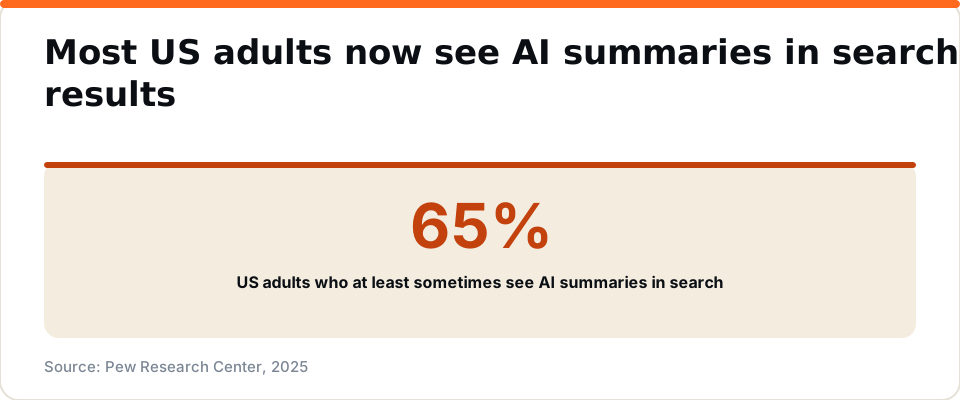
Source: Pew Research Center, 2025
How to Apply This to Your Physical Therapy Practice Without Hiring a Big Agency
Start with what you can see. Pull up your Google Business Profile and look at it like a stranger would: is every service listed? Are the photos recent? When was the last review posted, and did anyone respond to it? These are not trick questions. They are the same questions Google is asking when it decides whether to show your clinic to a nearby patient.
Check your name, address, and phone number on Yelp, Healthgrades, Bing Places, and a couple of other major directories. If the format varies at all between them, that is a NAP consistency problem that is worth fixing. It is tedious work, but it is not complicated, and the payoff in map pack positioning is real.
Count your reviews and look at the last 90 days specifically. Recency matters more than people realize. A profile with 40 reviews, all from two years ago, sends a weaker signal than one with 25 reviews that includes a steady stream from recent months.
The most common objection to doing this work is that it feels expensive or requires marketing expertise the practice does not have in-house. That objection made a lot of sense when the only option was a full-service agency charging $500 or more per location, requiring a long-term contract, and expecting you to already have someone managing the relationship on your end.
That is not the only model anymore. LocalLeadSignal starts at $249 per month, there is no contract, and the team handles all of it: tracking your visibility, managing your listings, generating and responding to reviews, adding schema, and monitoring your AI search presence. It is built specifically for practices that want the results without the infrastructure overhead. You can see what that looks like at /pricing.
The comparison to a traditional agency model is straightforward. Most agencies in this space assume you have a marketing coordinator, a content team, and a budget to match. LocalLeadSignal assumes you are a practice owner who wants to focus on patients and needs someone else to handle the digital side competently and affordably. Those are two very different products solving what looks like the same problem.
You do not need to fix everything at once. The FYZICAL case study is useful precisely because it shows what a focused, sequential 60-day effort can produce without a massive overhaul. Pick the highest-priority gap, fix it, then move to the next one. If you want help figuring out which gap is highest priority, a quick audit of your current local presence is the right place to begin.
The core problem for most physical therapy practices is not clinical. It is visibility. Patients cannot choose a provider they cannot find, and right now, a meaningful portion of the patients who need what your clinic offers are finding someone else because that practice happens to have a cleaner GBP, more consistent listings, and a handful of recent reviews.
FYZICAL Saint Peters' 60-day results show that this is a solvable problem. Not with paid ads, not with a website rebuild, and not with a months-long content strategy. Foundational local SEO, done in the right sequence with the right tools, moves the needle in a way that shows up directly as phone calls.
LocalLeadSignal was built for exactly this situation: a practice that delivers excellent care, wants to be found by more patients, and does not have the time or budget to hand the problem to a large agency. Affordable, no contract, and fully managed so you can stay focused on what you do best.
Get a free local visibility snapshot for your practice and see exactly where you stand before spending a dollar.
Frequently asked questions
- How long does local SEO take to work for a physical therapy practice?
- Foundational changes like GBP optimization, citation cleanup, and NAP consistency can show measurable results in 30 to 60 days. The FYZICAL Saint Peters case study saw a 35% increase in patient calls within 60 days, though timelines vary depending on how competitive your local market is.
- What is the most important local SEO factor for a physical therapy clinic?
- Google Business Profile optimization tends to have the biggest immediate impact. Making sure your categories, services, photos, and contact details are complete and accurate directly affects your map pack ranking. Consistent NAP information across all directories is a close second.
- Do physical therapy practices need a different SEO approach than other healthcare providers?
- The core local SEO principles are the same, but physical therapy practices benefit from emphasizing condition-specific service pages, insurance acceptance details, and patient outcome language in their GBP and website. Search intent for PT tends to be high urgency, so visibility at the moment of need is critical.
- Can a physical therapy practice show up in AI search results like ChatGPT or Perplexity?
- Yes. AI search engines pull from the same trust signals as Google: consistent business information, structured data, and a strong online presence. Practices that have clean citations, complete GBP listings, and schema markup are more likely to be surfaced in AI-generated answers about local healthcare providers.
- How much should a physical therapy practice expect to pay for local SEO management?
- Most agencies start at $500 or more per location and require you to have a marketing team already in place. LocalLeadSignal starts at $249 per month with no contract, and handles everything including listings, reviews, visibility tracking, and AI search optimization, so you do not need an internal marketing team.
See where your own business stands.
We measure your local rankings, your listings, your website, and how AI assistants answer for your business. No signup required.
Or jump straight to pricing →