
Notes
Local Services Ads vs Google Ads and the Decision Most Service Businesses Get Backwards
Most service business owners land on the question of local services ads vs google ads the same way: a sales call comes in, they Google the two options, and every comparison they find treats the choice as a coin flip. It is not.
Reviewed by Melike Erguven, Co-founder of LocalLeadSignal · September 30, 2026 · 13 min read

Most service business owners land on the question of local services ads vs google ads the same way: a sales call comes in, they Google the two options, and every comparison they find treats the choice as a coin flip. It is not. These are two different products built for two different moments, and picking the wrong one first does not just waste money on that channel. It can quietly make the other one perform worse, too. The smarter path runs through your existing Google presence before it runs through any ad platform.
Before You Pick an Ad Type, Understand What Google Is Already Showing for Your Business
Both ad products read your existing signals before they serve a single impression. This surprises a lot of business owners who expect paid campaigns to work independently of their organic presence. They do not.
For Local Services Ads, Google checks several things before deciding how often to show your ad and where to rank it among competitors:
- Google Business Profile completeness: Hours, services, photos, business description, and category all factor in. A sparse profile signals a sparse business.
- Review count and recency: More reviews, earned recently, push your LSA higher. A handful of reviews from two years ago carries far less weight.
- License and insurance verification: Google requires documentation for most categories. Until this clears, the badge does not appear and your ad may not run at all.
- NAP consistency: Your business name, address, and phone number need to match across your GBP, your website, and the major citation directories. Mismatches create doubt in Google's ranking logic.
For standard Search Ads, the signals are different but equally upstream of your budget:
- Landing page relevance: Google's Quality Score system grades how closely your destination page matches the intent behind the keyword you are bidding on. A generic homepage rarely wins that grade.
- Site speed and usability: Slow pages cost more per click over time because Quality Score penalizes poor user experience.
- Keyword-to-page alignment: If the searcher typed a specific service query and your page talks about your company history, the system notices.
The practical consequence is straightforward. A business with an incomplete GBP, thin reviews, or citation inconsistencies will pay more per lead in LSAs and earn lower Quality Scores in Search Ads. The problems compound the budget, they do not disappear once you start spending.
This is why a local SEO audit is genuinely the first step, not a nice-to-have. We built a free local SEO audit page partly because "local seo audit" turned out to be the search query that most often surfaced our own site in Google Search Console. Diagnosis before budget is the sequence that actually works. Google's own tips for improving your local ranking lay out many of the same signals, and they apply equally to paid and organic performance.
What Local Services Ads Actually Are and Who They Were Built For
Local Services Ads are a pay-per-lead product. You do not pay when someone sees your ad. You pay when someone contacts you through it. That distinction matters enormously for a service business managing a tight monthly budget.
The ads appear above traditional search ads and above the map pack for high-intent local queries. When someone types something like "plumber near me" or "family law attorney," LSAs are what they see first. The Google Guaranteed or Google Screened badge sits next to the business name, and that badge is not cosmetic. It tells the searcher that Google has vetted this business, which meaningfully shifts trust at the moment of decision.
Eligibility is not universal. LSAs currently cover home services, legal, healthcare, real estate, financial services, and a handful of other verticals, but the specific categories and geographic availability vary. Not every service type qualifies, and not every market has LSA inventory for a given category.
Getting verified takes a few steps, and skipping any of them stalls the account:
- Background check: Required for the business owner and, in many cases, field technicians.
- License verification: You upload the relevant professional or contractor license for your state and category.
- Insurance documentation: General liability is the standard requirement; some categories require additional coverage.
Once verified, Google awards the badge and factors your account into its ranking algorithm for LSA placement.
Billing works on a dispute model. If a lead comes in from the wrong service category, from a geographic area you do not serve, or from obvious spam, you flag it. Google reviews the dispute and credits verified cases back to your account. This keeps the pay-per-lead model from becoming a pay-for-junk model, provided you actually track and dispute bad leads promptly.
The business profile that performs best in LSAs looks like this: an established local provider with more than ten recent reviews, verified credentials, a complete GBP, and consistent listings across the major directories. Google's algorithm weights all of these heavily in LSA rank, so a strong organic foundation directly translates to lower cost per lead.
New businesses, or businesses with fewer than ten reviews and unverified licenses, often find LSAs frustrating at first. The volume is low, the badge may not display correctly, and the ranking algorithm has little to work with. That is not the product failing. That is the preparation phase signaling it is not done yet.
What Standard Google Search Ads Do That Local Services Ads Cannot
The clearest way to understand the local services ads vs google ads divide is at the keyword level. LSAs respond to category-level queries that Google matches automatically. You tell Google your service type and your location, and it decides when to show you. Search Ads let you choose exactly which queries trigger your ad, which means you can bid on specific long-tail local keywords, competitor terms, service modifiers, and geographic qualifiers that LSAs would never reach.
That control has real value in specific situations:
- Services outside LSA-eligible categories: If Google has not opened LSA to your vertical or your market, Search Ads are your paid option.
- Multiple service lines with distinct landing pages: A business offering three different services can send each keyword group to a page written specifically for that service, which LSAs cannot replicate.
- Thin LSA inventory in your market: Some categories have very few LSA competitors, which sounds good but often reflects low query volume. Search Ads let you cast a wider net.
- Message control: If your differentiation is specific (a warranty, a certification, a price guarantee), you want to write that into the ad copy. LSAs give you limited copy flexibility.
Quality Score is the engine that makes Search Ads efficient or expensive. Google grades each keyword on the relevance of your ad copy and the relevance of your landing page to that keyword. A high score means you pay less per click for the same position. A low score means you pay more and still rank lower. The fix is rarely in the bid. It is almost always in the page.
Long-tail local keywords are where smaller budgets find an edge. A phrase like "emergency water heater replacement in [your area]" attracts a buyer who is ready to hire, faces less competition than a broad term, and costs less per click. The buyer who types a general category term is often still comparing options. Specificity in the keyword maps to specificity in buyer intent.
Search Ads also carry more management overhead. Keyword lists need regular pruning. Bids need adjustment as competitors enter and exit. Ad copy needs testing. For a solo operator or a small team without a dedicated marketing person, that overhead is real. LSAs are simpler to run, which is why many service businesses find them the easier starting point, assuming they qualify and their foundation is ready.
The Early Phase: Running One Channel First and Reading What It Tells You
Start with LSAs if the business is eligible, has at least ten recent reviews, and has a verified and complete GBP. The pay-per-lead model limits waste while the account is in its learning phase, and the verification process forces the kind of profile cleanup that improves organic performance at the same time.
Start with Search Ads if the business is not LSA-eligible, targets multiple specific services with distinct landing pages, or needs to control messaging around something a competitor cannot easily copy.
Either way, the first four to six weeks are a data-collection phase, not a performance phase. Here is what to watch in each channel:
In LSAs:
- Lead volume by day of week: Patterns here tell you when buyers are actually searching, which feeds scheduling and staffing decisions.
- Disputed lead rate: A high rate (above ten percent) suggests category mismatch or a geographic setting that needs adjustment.
- Review count movement: New reviews during this phase directly influence your ranking, so this is the moment to activate your review request process.
- Badge display: Check that the Google Guaranteed or Google Screened badge is appearing correctly on the ad. If it is not, there is usually a verification issue still pending.
In Search Ads:
- Impression share by keyword group: Low impression share on your core terms usually means the budget or the bid is too low, not that demand is absent.
- Click-through rate by ad copy variant: Test two versions of the headline and let volume tell you which framing resonates.
- Cost per conversion by landing page: If one page converts and another does not, the difference is almost always in page relevance, not bid strategy.
- Quality Score trends: Watch these week over week. An improving score means your page and keyword alignment is working.
One mistake shows up constantly in new campaigns. The business pauses after two or three weeks because lead volume is lower than expected, decides the channel does not work, and moves on. Both LSA and Search Ad algorithms need a sustained data window to stabilize delivery. Cutting that window short means you never see what the channel would have done once it learned your account.
Organic signals and paid performance are not separate systems during this phase. Adding new Google reviews, correcting a citation discrepancy, or publishing a service page around a specific keyword can measurably improve your LSA rank and your Search Ad Quality Score at the same time. These are not parallel tracks. They feed each other.
The Later Phase: When Running Both Channels Together Starts to Make Sense

There is a specific signal that tells you it is time to add the second channel. The first channel is delivering leads at a cost the business can sustain, and the GBP and organic presence have stabilized. Running two paid channels before that point usually means neither one has the foundation it needs.
Once that threshold is crossed, the two channels cover genuinely different territory. LSAs capture high-intent category queries at the very top of the page. Search Ads cover the long-tail queries, competitor comparisons, and specific service variations that LSAs never reach. Together they reduce the gap between what a buyer searches and what your business shows up for.
A third layer becomes relevant at this stage, and it is not a paid channel. Buyers increasingly ask AI assistants, including ChatGPT, Perplexity, and Gemini, which service provider to hire. Those systems are not serving your ads. They are drawing on whatever content, citations, and reputation signals they have indexed about your business. This is what generative engine optimization (GEO) refers to in practice.
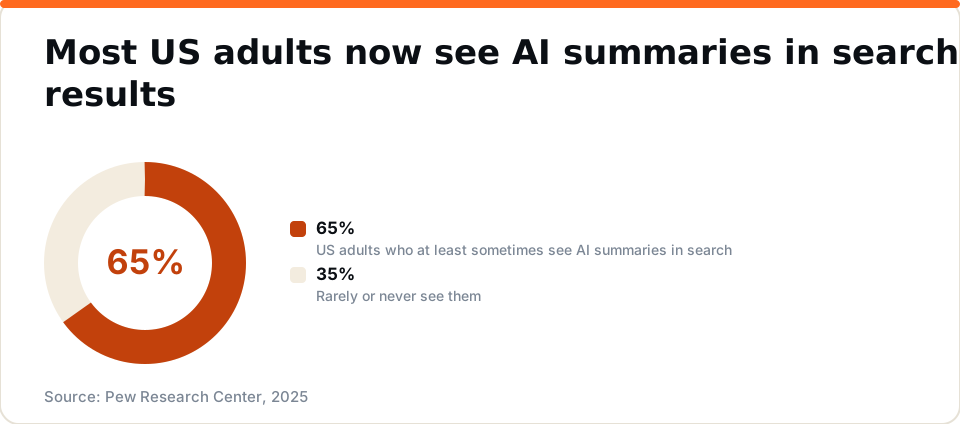
The work that supports AI search citations overlaps almost entirely with the work that supports organic local SEO. Strong service pages, consistent citations, structured data, and a healthy review profile are what feed AI assistants the information they need to surface a specific business in a recommendation. Pew Research Center found that Google users are less likely to click on links when an AI summary appears in the results, which means AI visibility is not a future concern. It is already shaping how buyers arrive at a decision.
We can speak to this directly. Over the summer of 2026, AI assistants named LocalLeadSignal more often when asked about us specifically. But for competitive buyer queries, the established brands still dominated the recommendations. That gap reflects how new any business is to AI recommendation engines, and how much accumulated citation history the older players carry. There is no shortcut to that accumulation. The businesses running both ad types and investing consistently in content are the ones already building it.
Ads drive leads now. Organic visibility and AI search presence reduce cost-per-lead over time by increasing the share of buyers who find the business before they run a paid search at all. That compounding effect is the real reason the two ad channels and the organic layer belong in the same strategy.
Source: Pew Research Center, 2025
What a Working Setup Looks Like Once Both Channels Are Running
Steady state is not a set-and-forget condition, but it does have a recognizable shape. LSAs run with a dispute rate below ten percent. Search Ads hold a Quality Score of seven or above on core keywords. The GBP is updated regularly with fresh posts and responses to new reviews. Citations are consistent across the major directories, meaning the same name, address, and phone number appear everywhere without variation.
The review feedback loop is one of the cleaner mechanics in local search advertising. Each new Google review improves LSA rank. A higher LSA rank generates more contacts. More contacts create more chances to earn reviews, provided the business has a systematic way to ask. Google's guidance on managing customer reviews on your Business Profile covers the mechanics of responding, which is its own ranking signal. Reviews that go unanswered, positive or negative, leave a signal gap.
Service pages written around specific long-tail local keywords do triple duty. They feed Quality Score for Search Ads by giving those campaigns relevant landing pages. They give AI assistants structured, citable content about what the business does and where. And they create the kind of topical depth that Google's organic ranking algorithm rewards. The writing work is not separate from the advertising work. It is infrastructure.

Schema markup is the technical layer that ties the content to the crawlers. Local business schema, service schema, and review schema help both Google and AI systems parse what the business does, in which locations, and how customers rate the experience. Google Search Central's documentation on LocalBusiness structured data is the right reference for implementation. For healthcare and legal practices, schema markup carries additional weight because those verticals carry higher stakes in Google's quality evaluation framework.
Budget allocation between the two channels has no universal answer. The right split depends on lead volume targets, how competitive the category is in your market, and how much organic visibility is already doing the work. A business with strong organic rankings and a high LSA placement may find Search Ads serve mostly a gap-filling role. A business in a competitive category with a newer GBP may lean harder on Search Ads while the LSA account builds authority.
The businesses that get the most from both ad products are consistently the ones that treated organic signals as infrastructure before the first campaign launched. Not as an afterthought when campaigns stalled. The preparation is not preliminary to the strategy. It is the strategy.
The choice between local services ads vs google ads is really a sequencing question. Which channel you start with depends on how prepared your existing Google presence is, not which ad type sounds simpler to set up.
Businesses that skip preparation and go straight to budget frequently find both channels underdeliver, then conclude that paid local advertising does not work in their market. Usually the signals both ad types depend on were never in place to begin with.
Before you set a budget or choose a channel, check whether the signals both ad types read are actually working in your favor. Run a free local SEO audit on your business and see exactly what Google and AI assistants are picking up about you today.
Frequently asked questions
- What is the difference between Local Services Ads and Google Ads for a service business?
- Local Services Ads charge per lead and display a Google Guaranteed or Screened badge above standard results. Google Ads charge per click and give you control over keywords, ad copy, and landing pages. LSAs are simpler to run; Google Ads offer more targeting precision and work in categories LSAs do not cover.
- Do I need a strong Google Business Profile to run Local Services Ads?
- Yes. Google reads your GBP completeness, review count, review recency, and verification status before it ranks your LSA. A thin or incomplete profile raises your cost per lead and lowers your position. Fixing those signals before launching is the step most businesses skip.
- Can I run Local Services Ads and Google Ads at the same time?
- You can, and many established service businesses do. LSAs handle high-intent category queries at the top of the page while Search Ads cover specific long-tail terms and service pages. Running both together makes most sense once each channel is stable and your organic presence is solid.
- How do AI assistants like ChatGPT or Perplexity fit into a local ad strategy?
- AI assistants do not serve your ads, they surface businesses based on content, citations, and structured data they have already indexed. Buyers who ask an AI which provider to hire bypass your ads entirely. Organic and AI visibility build over time and reduce reliance on paid spend as the business matures.
- Which channel should a new service business start with?
- If you are LSA-eligible and have at least ten recent reviews and a verified GBP, start there. The pay-per-lead model limits waste while your account learns. If you are not eligible or need to target specific services with custom messaging, start with Google Search Ads and focus early budget on long-tail local keywords.
See where your own business stands.
We measure your local rankings, your listings, your website, and how AI assistants answer for your business. No signup required.
Or jump straight to pricing →